

Short answer
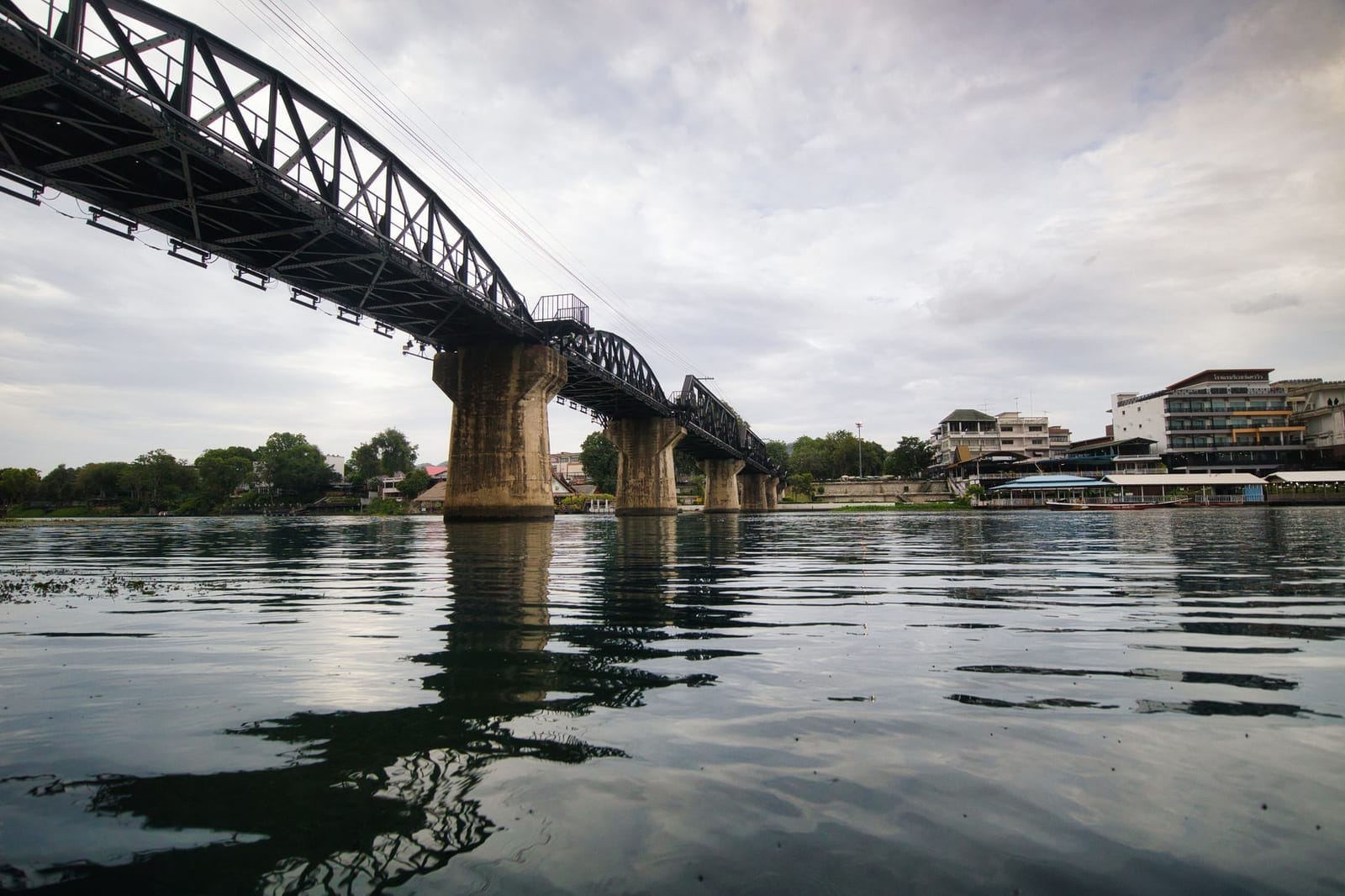
The Bridge on the River Kwai is a real railway bridge at Kanchanaburi, built in 1943 by Allied prisoners of war and Asian labourers for the Japanese army's Burma Railway. Wikipedia says its curved steel spans were brought from Java; spans destroyed by Allied bombing in 1945 were replaced after the war with angular ones from Japan, so the straight-edged spans are the postwar ones. The 1957 film is fiction and was shot in Sri Lanka. On our day trip you can walk across the bridge.
The bridge is real, and the film is not
The bridge stands at Tha Ma Kham, five kilometres from Kanchanaburi town, according to Wikipedia. It was part of the Burma Railway, about 415 kilometres of track from Ban Pong in Thailand to Thanbyuzayat in Burma. The Thailand-Burma Railway Centre says construction began in June 1942, took about sixteen months, and joined the two ends near Konkoita in October 1943.
The 1957 film The Bridge on the River Kwai, directed by David Lean, is based on Pierre Boulle's novel, and Wikipedia says that the novel and the screenplay are fiction. The film was made in what was then Ceylon, now Sri Lanka, and the bridge in it stood near Kitulgala. Boulle had never been to the real bridge, according to the same article, and the film's spectacular destruction of the bridge is entirely fictional.
Why a river called Khwae Noi became the River Kwai
Most of the Thai section of the railway ran along the valley of the Khwae Noi, the small tributary. Wikipedia explains that the British mispronounced khwae, which means a stream or tributary, as kwai, the Thai word for buffalo, and that this gave rise to the name River Kwai. The bridge, however, crosses a different stretch of water: the Mae Klong, as it was then called.
In 1960, after the film made the name famous, the part of the Mae Klong under the bridge was renamed the Khwae Yai, the large tributary, according to Wikipedia. So the bridge crosses the Khwae Yai, not the Khwae Noi. Boulle, the same article says, knew the railway ran parallel to the Khwae for many miles and wrongly assumed it crossed that river just north of Kanchanaburi.
How two bridges were built in 1942 and 1943
According to Wikipedia, British prisoners of war arrived at Tamarkan on 26 October 1942 to build the bridge, led by Colonel Philip Toosey. About 1,000 prisoners worked on it at first, and 1,000 Dutch prisoners joined in February 1943. Chinese, Malay and Tamil civilians also worked on the bridge. Wikipedia lists the bridge as Bridge 277 on the line.
Two bridges were built. A wooden railway bridge was finished in February 1943, and a steel and concrete bridge followed in June 1943. The steel bridge used eleven curved truss spans that the Japanese had brought from Java in 1942, says Wikipedia. Both crossed the river in the same direction, and the steel one is the bridge that remains today.
What was bombed, and which spans are original
Both bridges were bombed in 1945. Wikipedia lists a Royal Air Force raid on 13 February, which the labourers repaired, a United States Army Air Forces raid on 3 April that damaged the wooden bridge, and a final Royal Air Force raid on 24 June 1945 that destroyed both bridges and put the line out of use for the rest of the war.
The railway was rebuilt after the war, and the sources differ on one detail. Wikipedia says two curved spans were replaced by angular truss spans supplied by Japan as postwar reparations; Wikivoyage describes two central box spans replacing three destroyed sections. Either way, the straight-edged spans are postwar and the curved ones are from 1943. Wikivoyage adds that a section of the first wooden bridge is displayed at the JEATH museum. The line from Kanchanaburi to Nong Pla Duk was completed on 24 June 1949, according to Wikipedia.
The human cost behind the bridge
The numbers vary by source, and the figures for civilian labourers are estimates. The Commonwealth War Graves Commission says approximately 13,000 prisoners of war died and are buried along the railway, and that an estimated 80,000 to 100,000 civilians died, mostly forced labour from Malaya and the Dutch East Indies or people conscripted in Thailand and Burma. The Thailand-Burma Railway Centre says over 13,000 prisoners and around 100,000 Asian labourers.
Wikipedia gives lower figures for the prisoners, around 12,000 Allied soldiers, and says more than 90,000 civilians died. The point is the scale: most of the dead were Asian labourers whose names were not recorded. Thailand-Burma Railway Centre and the war cemetery are the places in Kanchanaburi that tell this part of the story, and we cover them in our guide to the Kanchanaburi War Cemetery.
Visiting the bridge today
The steel bridge is still in use, according to Wikipedia. Wikivoyage says you can cross it on foot on the central steel-plated walkway, that small platforms between the spans give room to step aside when a train comes, and that the guardrails are incomplete, so watch small children. Our Death Railway train guide explains the ride. Treat the bridge as a memorial: the details we hold for our tour ask visitors to keep their voices low at the war sites.
The JEATH War Museum is a separate stop. Wikipedia says it was founded in 1977 by the abbot of Wat Chaichumpol, and that tourist photos are not permitted in its first section. Hellfire Pass, the largest rock cutting on the railway according to Wikipedia, lies elsewhere; our Hellfire Pass guide covers it. On our day, the guide gives you time to walk across before the group moves on.
How our Kanchanaburi day handles the bridge
Our River Kwai bridge and Erawan Falls day trip from Bangkok is from $60 per person. The minibus collects you at your hotel between about 6:15 and 7:15 am and reaches Kanchanaburi at about 9:00, and the bridge is the first stop. Some programmes add a Death Railway train ride of about 60 minutes, from about 10:30; others add the war cemetery and museum, so ask which one your date has.
Lunch at a local Thai restaurant and a swim at Erawan Falls follow, and the minibus is back in Bangkok at about 7:30 to 8:00 pm. It is a long day of about 13 hours, and the times move with traffic. The travel guide for the tour follows the route stop by stop.
Practical checklist
- Decide whether you want the Death Railway train ride or the war cemetery and museum, and ask which our programme includes for your date.
- Walk on the bridge slowly, keep your voice low and follow the guide's advice about trains.
- Do not photograph in the first section of the JEATH War Museum if you visit it.
- Wear comfortable shoes with grip: the day also includes Erawan Falls.
- Read about the railway before you go; the Thailand-Burma Railway Centre site is a good start.
Questions and answers
Is the Bridge on the River Kwai real?
Yes. The bridge at Kanchanaburi is real and was built in 1943 as part of the Burma Railway. The 1957 film's story, including the bridge's destruction by commandos, is fiction.
Is the Kwai bridge the original?
Partly. Wikipedia says the curved steel spans came from Java in 1942, and that spans destroyed by bombing in 1945 were replaced after the war by angular spans supplied by Japan. The straight-edged spans in the middle are the postwar ones.
Was the film shot at the real bridge?
No. According to Wikipedia, the film was made in Ceylon, now Sri Lanka, and its bridge was built near Kitulgala. Pierre Boulle, who wrote the novel, had never been to the real bridge.
Why is it called the River Kwai?
British soldiers mispronounced khwae, a Thai word for stream, as kwai, which means buffalo. The part of the river under the bridge was renamed Khwae Yai in 1960.
Can you walk across the bridge?
On our tour, yes: the programme includes time to walk across the steel bridge with a local guide. Take care with trains and keep your voice low, because the site is a memorial.