

Short answer
Erawan Falls has seven tiers along a trail of about 1.5 km in Erawan National Park. The first six can be reached on foot and the seventh needs a short scramble up the rocks, according to Wikipedia and the Western Forest Complex website. Swimming is allowed in the pools, with small fish nibbling at your feet. As of June 2026 the park fee is 300 baht for foreign adults, food is not allowed beyond the second tier, and each drink bottle carries a 20 baht deposit. The park is open from 08:00 to about 16:30.
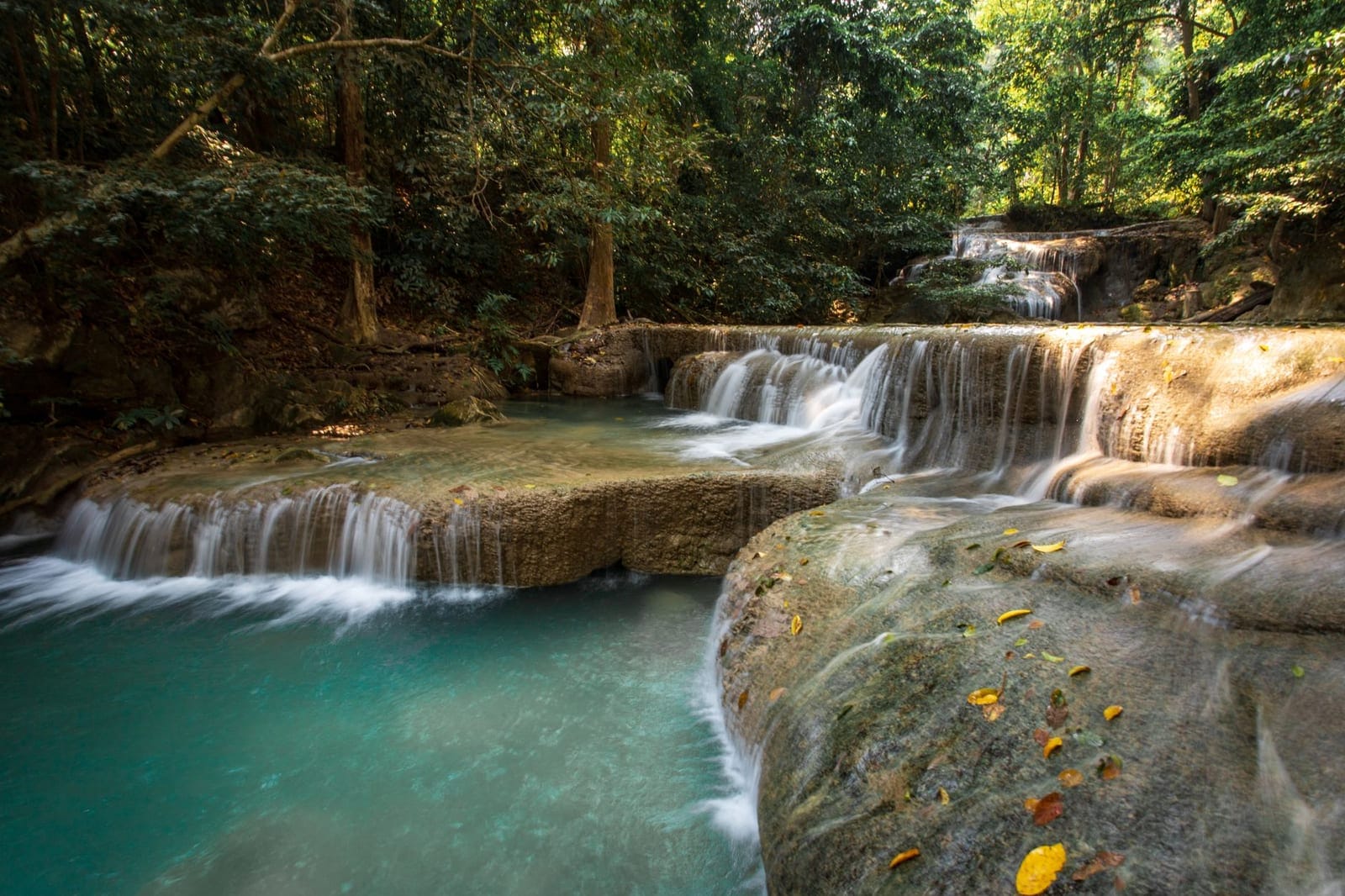
The seven tiers in one picture
Erawan Falls is the main sight of Erawan National Park in Kanchanaburi Province, which Wikipedia says was declared Thailand's 12th national park in the Royal Gazette of 19 June 1975. The falls have seven tiers, and the trail from the foot to the top is about 1.5 km. Wikipedia says the first to sixth tiers are reached by a trail from the visitor centre, and the Western Forest Complex website says the seventh needs a scramble up a cliff.
Thai Wikipedia lists a name for each tier. In our romanisation they are Lai Khuen Rang, Wang Matcha, Pha Nam Tok, Ok Nang Phi Suea, Buea Mai Long, Dong Phruek and Phu Pha Erawan. The falls are named after Erawan, the three-headed white elephant of Hindu mythology; Wikipedia says the water flows from three spouts that look like its heads. Wikivoyage gives the whole walk as 2.2 km, so treat distances as approximate.
Tiers 1 and 2: the easy start
Thai Wikipedia puts the falls about 500 metres from the park office. The independent Thai National Parks website says it is a few hundred metres from the visitor centre, signposted, and that a golf cart runs to the first tiers for 20 baht per person, about 700 metres. It lists bicycles at 20 baht a day, which can be used only for the first two tiers.
The same site says there are toilets near the first two tiers where visitors change into swimwear, and a few picnic spots with benches around them. These are the tiers most visitors see. Thai Wikipedia says the second tier is called Wang Matcha, and that fish swim in large numbers in tiers 1 to 4. If you have small children or limited time, tiers 1 and 2 are a complete visit.
Tiers 3 to 6: trail, footbridges and the climb
Beyond the second tier the walk turns into a climb on trails and footbridges. Wikivoyage describes the walk as steep at points, and the Thai National Parks site says a concrete path has recently been built to make the way safer when it is wet. The details we hold for our tour warn that the limestone is slippery when wet and recommend shoes with grip, so leave flip-flops in the minibus.
The Thai National Parks site says all tiers up to the sixth are reached by trails and footbridges, and that the trail passes many emerald ponds where visitors are allowed to swim. The site advises going as early in the morning as possible, because the falls are visited by many people every day and get overcrowded at weekends and on public holidays.
Tier 7: the scramble at the top
The seventh tier is the hardest to reach. The Western Forest Complex website says a trail leads as far as the sixth level and that you must scramble up the cliff to the seventh, and calls the sight of the water well worth the effort. The Thai National Parks site agrees that the last tier needs scrambling up a few cliffs, for those who want more of a challenge.
Whether you get there depends on fitness, queues and time. On our day trip the group has 2.5 to 3 hours in Erawan National Park, and the details we hold say that includes swimming, walking the trails and seeing the seven tiers. Do not rush the climb to reach the top: Wikivoyage says all the tiers are the same turquoise colour, and the minibus leaves at about 4:30 pm.
Swimming, life jackets and the fish
Swimming is allowed in the pools, according to Wikipedia and the Thai National Parks site, which says visitors may swim in the many emerald ponds along the trail and that they are full of fish. Wikivoyage says a life vest is required to go into the falls. The details we hold say life jackets can be rented at the falls for about 30 baht per person, so carry cash for that.
The fish are part of the experience. Wikipedia says Garra rufa, known as doctor fish, are found throughout, and the details we hold say that small fish nibble at your feet in some of the pools. Thai Wikipedia names a barb called pla phluang in tiers 1 to 4. Wear swimwear under your clothes, bring a towel and a dry bag, and expect cool water.
Park fee, food and bottle rules, and opening hours
The Thai National Parks site says that as of June 2026 the fees for foreigners are 300 baht for adults and 150 baht for children aged 3 to 14, and that Thai citizens pay 60 and 30 baht. Wikivoyage, updated in August 2025, lists the same foreign rates. We could not open the Department of National Parks' own fee page in October 2026. On our tour the park fee is not in the price and is paid in cash on the day.
Food is strictly forbidden beyond the second tier, the Thai National Parks site says, and visitors pay a deposit of 20 baht per drink bottle, refunded when the bottle is returned, to stop bottles being left in the forest. The park is open daily from 08:00 to about 16:30, but does not admit visitors after about 15:30, according to the same site and the details we hold. Arrive on time.
When to go, and how our day fits
Wikipedia says the rainy season runs from May to October and that the park sits in the rain shadow of the hills, so average rainfall is low. The Thai National Parks site says rain peaks in September and October, with cooler weather from November to January. Wikivoyage says the dry season is best, with cooler weather and less mud, and also the most crowded. Avoid weekends and public holidays if you can.
During Songkran, 13 to 15 April, the tiers turn into a water-fight party, according to the Thai National Parks site; leave phones and cameras that are not waterproof behind. Our River Kwai bridge and Erawan Falls day trip from Bangkok is from $60 per person and lasts about 13 hours. See the schedule and packing guide for times.
Practical checklist
- Bring cash: 300 baht for the park fee per foreign adult, plus about 30 baht for a life jacket.
- Wear swimwear under your clothes and shoes with grip, not flip-flops.
- Leave food in the minibus: it is not allowed beyond the second tier, and bottles carry a 20 baht deposit.
- Be at the park well before 15:30, because entry stops then.
- Take a dry bag for your phone, and leave non-waterproof cameras behind during Songkran, 13 to 15 April.
- Pace yourself: tiers 1 to 6 are on a trail, and tier 7 needs a scramble.
Questions and answers
How many tiers does Erawan Falls have?
Seven. According to Wikipedia, the first six are reached by a trail from the visitor centre, and the Western Forest Complex website says the seventh needs a scramble up a cliff. The trail from foot to top is about 1.5 km.
Can you swim at Erawan Falls?
Yes, in the pools along the trail. Wikivoyage says a life vest is required, and the details we hold say life jackets can be rented at the falls for about 30 baht. Small fish nibble at your feet in some pools.
How much is the Erawan Falls entrance fee?
As of June 2026, 300 baht for foreign adults and 150 baht for children aged 3 to 14, according to the Thai National Parks website, which we could not check against the park's own page. It is paid in cash on the day.
Can you bring food to Erawan Falls?
Not beyond the second tier. The Thai National Parks website says food is strictly forbidden there, and each drink bottle carries a 20 baht deposit that is refunded when you bring it back.
What time does Erawan National Park close?
It is open from 08:00 to about 16:30 daily, but visitors are not admitted after about 15:30, according to the Thai National Parks website and the details we hold for our tour.