

Short answer
Kanchanaburi War Cemetery, on Saeng Chuto Road in Kanchanaburi, holds 5,085 Commonwealth and 1,896 Dutch graves of prisoners of war who died building the Burma Railway, according to the Commonwealth War Graves Commission. Entry is free, and the Thailand-Burma Railway Centre museum stands next to it. Opening hours differ by source: the commission lists 08:00 to 17:00 on weekdays and 08:00 to 12:00 on Saturday. On our day trip, some programmes include the cemetery and the JEATH War Museum; ask us which yours does.
Who lies in the cemetery
The Commonwealth War Graves Commission, which maintains the cemetery, says that 5,085 Commonwealth casualties of the Second World War are buried or commemorated there, together with 1,896 Dutch war graves and one non-war grave. Its database lists 6,858 identified casualties, and Wikipedia gives 6,982 graves in total, of British, Australian and Dutch prisoners of war. The figures differ slightly between sources, so expect small differences.
The cemetery is known locally as the Don-Rak War Cemetery, according to Wikipedia, and it lies beside the main road through town, next to an older Chinese cemetery. The commission says the graves of the Americans who died on the railway were repatriated, so the American dead are not here. The cemetery was designed by Colin St Clair Oakes.
Why the graves are in Kanchanaburi
The Commission's account explains it. Kanchanaburi lies a short distance from the site of the prisoner base camp known as Kanburi, through which most prisoners passed on their way to other camps. After the war the Army Graves Service moved the graves along the southern section of the railway, from Bangkok to Nieke, into this cemetery. Graves from further along the line went to Chungkai in Thailand and Thanbyuzayat in Myanmar.
The commission records two special cases. About 300 men who died at Nieke camp, most of them in a cholera epidemic in May and June 1943, were cremated, and their ashes lie in two graves; their names are on panels in the shelter pavilion. The Kanchanaburi Memorial inside the entrance building records 11 men of the army of undivided India who are buried in Muslim cemeteries in Thailand where their graves could not be maintained.
What you see inside
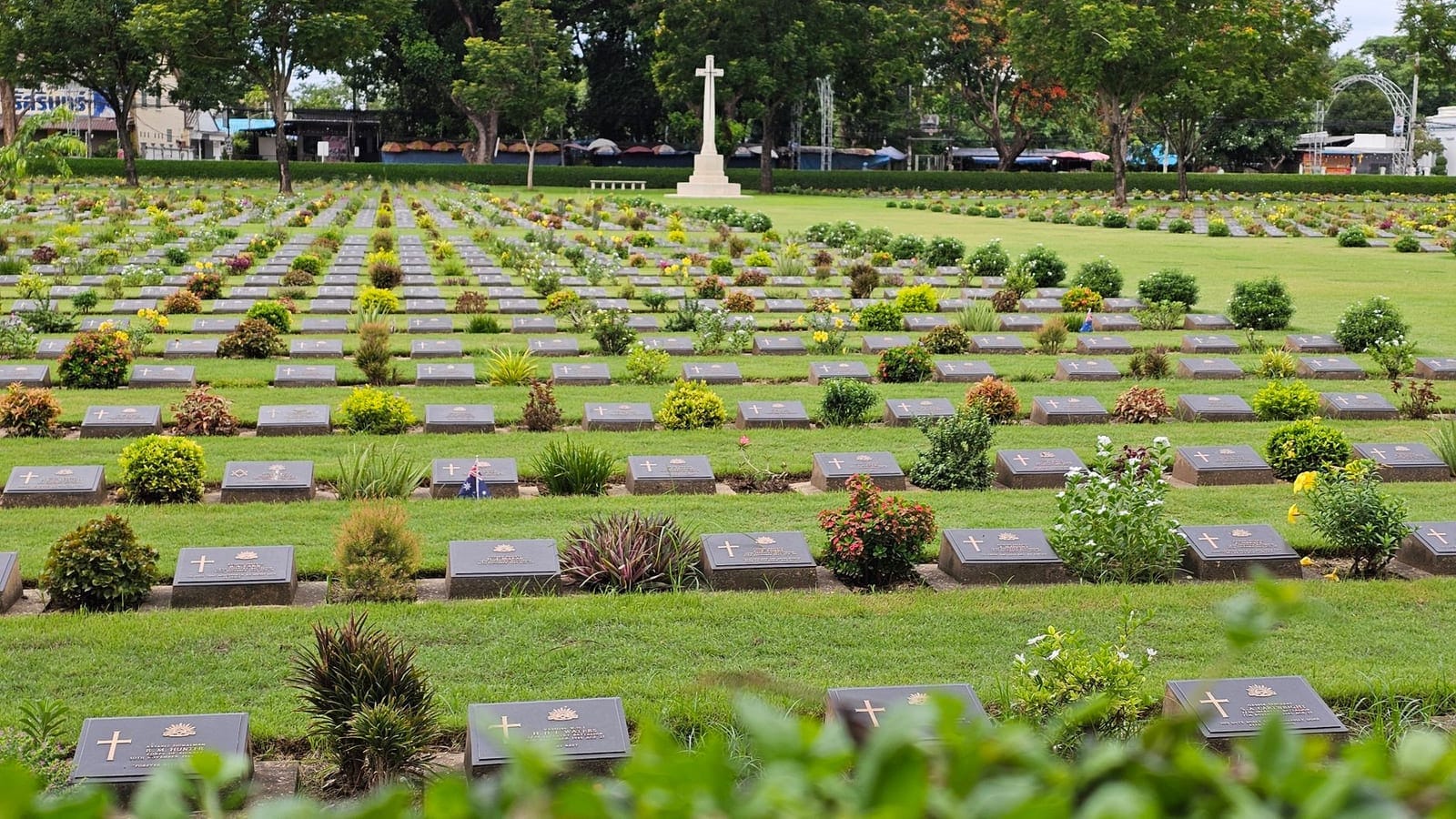
The commission describes a large rectangular cemetery, level and turfed, entered through a stone building with three arches and bronze memorial panels. At the far end stand the Cross of Sacrifice and a seating area; the Stone of Remembrance is on the far right, and a memorial shelter on the far left. Wikivoyage describes graves in straight lines on neatly mown lawns, some with personal inscriptions.
The cemetery registers are kept in the service area and can be requested from the gardeners, the commission says. If you are looking for a particular name, that is where to ask. There is no entrance fee, according to Wikivoyage, and the commission's page describes no ticket or dress rule; we ask guests to keep their voices low at the war sites and to treat the cemetery as a place of mourning, not a photo stop.
Opening hours and practical notes
The commission's page lists 08:00 to 17:00 from Monday to Friday and 08:00 to 12:00 on Saturday; it does not give a Sunday time. Wikivoyage lists 07:00 to 14:00 and was last updated in February 2019. The sources overlap in the morning, so a morning visit is the safe plan, and you should confirm the hours if you are travelling on a Sunday.
The commission adds two warnings: there may be snakes in the cemetery, and the pavement in front is extremely uneven and a trip hazard. It also notes a large car park, a step-free route through the service entrance by the office, and that the cemetery is generally level. The Thailand-Burma Railway Centre says it is about 1 km from the town centre, and a short walk from Kanchanaburi railway station.
The museum next door: Thailand-Burma Railway Centre
The Thailand-Burma Railway Centre stands across a side road from the cemetery. Its own website, last updated on 31 October 2022, says it is open every day from 9:00 to 16:00, with admission of 160 baht for adults and 80 baht for children aged 7 to 12. Wikivoyage lists 09:00 to 17:00 and the same 160 baht, so confirm the closing time on the day.
Wikipedia describes the layout: an introduction under a mock-up of a wooden railway bridge, a boxcar of the kind that carried prisoners, and then the planning and building of the railway, with tools recovered since the late 1990s, and the living conditions and deaths. Wikivoyage says a visit takes at least an hour, and that the entry includes a tea or coffee at the upstairs cafe, which overlooks the cemetery.
Other places that tell the same story
A second museum, the JEATH War Museum, is a separate stop. Wikivoyage lists it at 40 baht and open 08:30 to 18:00, but rates the Thailand-Burma Railway Centre far above it. Wikipedia says tourist photos are not permitted in the first section of the JEATH museum, and the details for our tour repeat that. Chungkai War Cemetery, on the west side of the river, is smaller, and Wikivoyage describes it as neatly maintained.
If you have a free hour, put the museum first and the cemetery second, because the exhibits explain who the graves belong to. Our guide to the Bridge on the River Kwai covers the bridge, and our Hellfire Pass guide covers the rock cutting that was built without proper construction tools.
Does our Kanchanaburi day include the cemetery?
It depends on the programme. On our River Kwai bridge and Erawan Falls day trip from Bangkok, the first stop is the bridge, and the details we hold say that some programmes add the Allied War Cemetery and the JEATH War Museum, while others add a Death Railway train ride of about 60 minutes. We confirm which one your date has when you book.
The tour is from $60 per person and lasts about 13 hours, with hotel pickup between about 6:15 and 7:15 am. Erawan Falls takes 2.5 to 3 hours, so a cemetery stop shortens something else. If the cemetery matters to you, say so when you book. The travel guide for the tour follows the route.
Practical checklist
- Visit in the morning: the commission lists 08:00 to 17:00 on weekdays and 08:00 to 12:00 on Saturday.
- Tell us when you book if the cemetery matters, and we confirm whether your date's programme includes it.
- Watch your step on the uneven pavement outside, and stay on the paths because the commission warns of snakes.
- Keep your voice low, and treat the cemetery as a place of mourning.
- Allow at least an hour for the Thailand-Burma Railway Centre if you add it, and bring 160 baht.
- Do not take photos in the first section of the JEATH War Museum.
Questions and answers
Is the Kanchanaburi War Cemetery free?
Yes, according to Wikivoyage, and the Commonwealth War Graves Commission's page lists no entry charge. The museum next door, the Thailand-Burma Railway Centre, charges adults 160 baht.
How many graves are in Kanchanaburi War Cemetery?
The commission says 5,085 Commonwealth casualties, 1,896 Dutch war graves and one non-war grave. Its database lists 6,858 identified casualties; Wikipedia gives 6,982 graves in total.
Are there Americans buried at Kanchanaburi?
No. The commission says the remains of American prisoners who died on the railway were repatriated, so the cemetery holds British, Australian and Dutch prisoners, according to Wikipedia.
What are the opening hours of the cemetery?
The commission lists 08:00 to 17:00 on weekdays and 08:00 to 12:00 on Saturday; Wikivoyage lists 07:00 to 14:00. A morning visit works under both, and Sunday is not listed by the commission.
Is the Thailand-Burma Railway Centre worth visiting?
Wikivoyage calls it the best source of information on the railway in Thailand and says to allow at least an hour. Its own site lists 160 baht for adults and daily hours from 9:00 to 16:00.