

Short answer
Seat61 lists two daily third-class trains from Bangkok Thonburi station to Kanchanaburi and Nam Tok: one at 07:45, reaching Kanchanaburi at 10:30 and Nam Tok at 12:05, and one at 13:55, reaching Kanchanaburi at 16:21 and Nam Tok at 18:15. The fare is 100 baht each way and no reservation is needed. The line is the surviving 130 km of the 415 km Burma Railway, according to Wikipedia, and ends at Nam Tok. Timetables change, so check the State Railway of Thailand before you go.
The two daily trains from Thonburi, and the timetable
Seat61 lists train 257 leaving Bangkok Thonburi at 07:45, reaching Kanchanaburi at 10:30, River Kwae Bridge station at 10:35 and Nam Tok at 12:05, and train 259 leaving at 13:55, reaching Kanchanaburi at 16:21 and Nam Tok at 18:15. A third train, 485, starts at Kanchanaburi at 06:02 and reaches Nam Tok at 08:00. The whole run from Thonburi to Nam Tok takes about 4 hours 20 minutes.
Coming back, Seat61 lists train 260 leaving Nam Tok at 05:20 and reaching Thonburi at 09:35, train 258 leaving Nam Tok at 13:00 and Kanchanaburi at 14:43 and reaching Thonburi at 17:40, and train 486 leaving Nam Tok at 15:30 and stopping at Kanchanaburi at 17:28. The Hellfire Pass site says that as of August 2024 two afternoon trains left Nam Tok for Kanchanaburi, at 13:00 and 15:00. We could not open the State Railway timetable, so confirm on the day.
The fare is 100 baht, and you do not need to book
Seat61 gives the fare as 100 baht each way for Bangkok to Kanchanaburi, Bangkok to Nam Tok and Kanchanaburi to Nam Tok. The trains are third class only, and it says no reservation is necessary, that they cannot sell out, and that you can turn up, buy a ticket and board. There is no buffet car, but vendors walk the train selling drinks, fruit and food. Seat61 calls the open-window third-class carriages a pleasant way to travel.
At weekends and on holidays Seat61 says there is also an excursion railcar from Bangkok to the bridge, Nam Tok and Kanchanaburi. The Thaiger reported in June 2024 that the State Railway planned a refurbished Royal Blossom tourist train on the Kanchanaburi route at weekends and public holidays, running from Kanchanaburi to the Sai Yok Noi waterfall. We could not confirm that either still runs, so ask at the station.
Getting to Thonburi station
Trains for Kanchanaburi do not leave from Bangkok's main long-distance station. Seat61 says they use the much smaller Thonburi station, formerly known as Bangkok Noi, on the west bank of the river. It is a 9-minute, 750-metre walk from Bang Khun Non station on the MRT Blue Line. All the trains also call at Jaran Sanitwong station, one stop from Thonburi and next to Bang Khun Non MRT station.
On the way back, Seat61 says it can be easier to get off at Jaran Sanitwong if you are changing to the MRT. If you would rather not walk with luggage, a taxi is the alternative; our Bangkok BTS and MRT fares guide covers the Blue Line fares, and our taxi prices guide the meter. Allow time before the 07:45 departure to buy your ticket.
What you ride past: the bridge, the viaduct and Nam Tok
Wikipedia describes the Burma Railway as a 415 km line between Ban Pong in Thailand and Thanbyuzayat in Burma, built from 1940 to 1943 by abducted Southeast Asian civilians and captured Allied soldiers forced to work by the Japanese army. It says at least 250,000 civilians were put to forced labour, that more than 90,000 civilians died, as did around 12,000 Allied soldiers, and that the two sections met at kilometre 263 in October 1943.
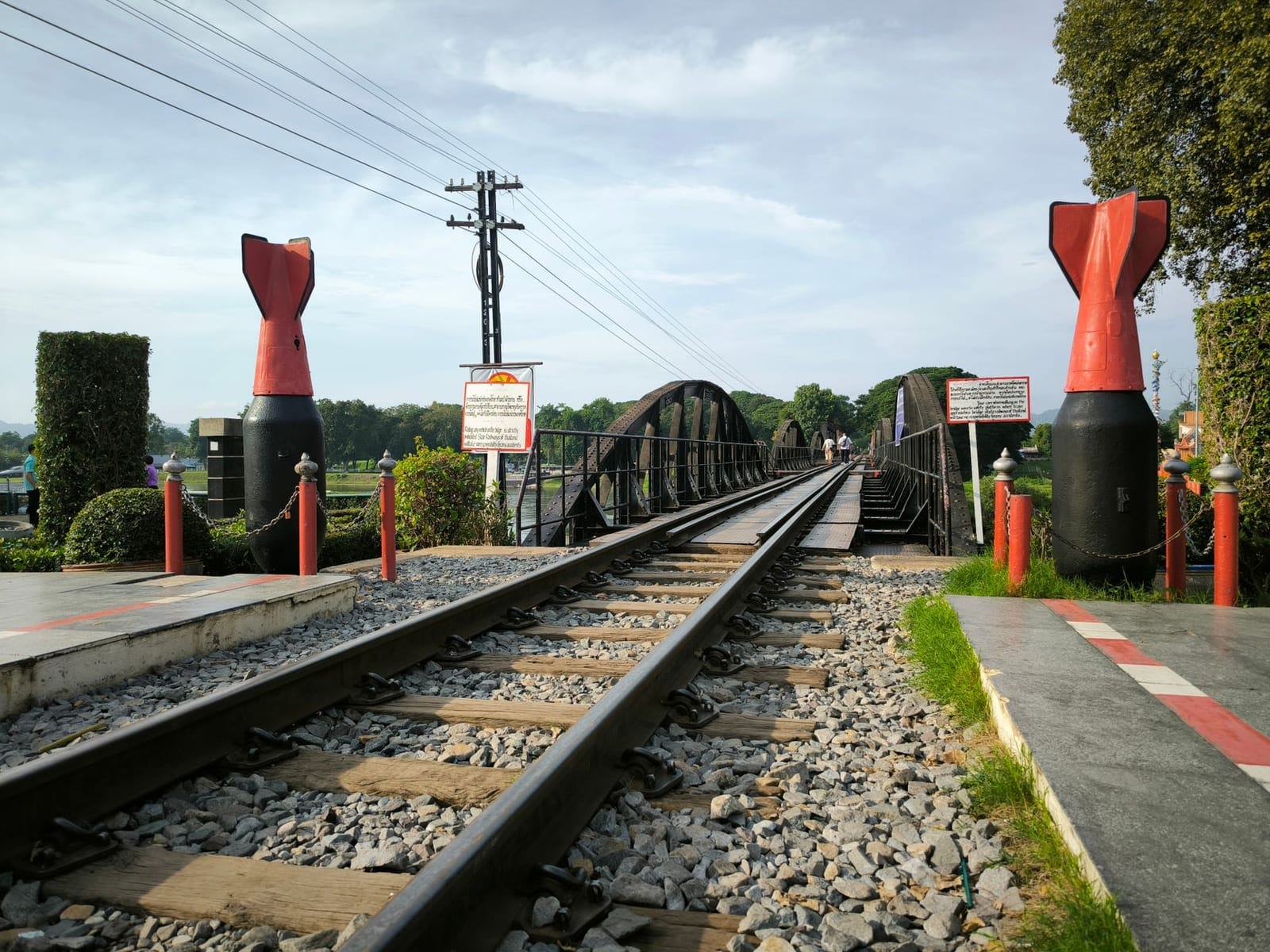
Beyond the bridge the line follows the Kwae Noi river to the Wampo (Wang Po) Viaduct, which Wikipedia says was built by civilians and prisoners of war, and ends at Nam Tok. Seat61 says the train slows right down to cross the viaduct, and calls the scenery fabulous. The Hellfire Pass site says travellers can still ride the remaining 130 km of the Burma-Thailand Railway, and that Nam Tok station is about 20 km from its Interpretive Centre.
What the line was, in numbers
Seat61 says you can see the bridge as a day trip using the morning train out and the afternoon train back, but that two or three days is better. There are two ways to use the day. Stay on the 07:45 to Nam Tok at 12:05, then take the 13:00 back, reaching Thonburi at 17:40: you cross the bridge and the viaduct twice and get about an hour at Nam Tok. Or get off at Kanchanaburi at 10:30 and take the 14:43 back, which gives about four hours for the bridge, the war cemetery and the museum.
Most of the line was dismantled after the war, Wikipedia says, and only the first 130 km in Thailand remain, with trains running as far as Nam Tok. The Thaiger reported in August 2026 that Thailand is preparing to nominate part of the Death Railway in Kanchanaburi for UNESCO World Heritage status. The sites are memorials, so keep your voice low at the cemetery and the JEATH War Museum, where photos are not allowed in the first section.
A day on the train alone: what fits and what does not
Seat61 says you can see the bridge as a day trip using the morning train out and the afternoon train back, but that two or three days is better. With the 07:45 from Thonburi you reach Kanchanaburi at 10:30, and with the 14:43 from Kanchanaburi you are back in Thonburi at 17:40, so you have about four hours on the ground for the bridge, the war cemetery and the museum, and a train ride on to Nam Tok is possible only by taking a later return.
Erawan Falls does not fit that day. On our tour it is roughly another hour's drive from the bridge, the park does not admit visitors after about 3:30 pm, and the group spends 2.5 to 3 hours there, so a train day and a waterfall day are different trips. If you want both the railway and the falls, the tour below is the one-day answer; if you want the railway at your own pace, stay a night in Kanchanaburi.
Our Kanchanaburi day: the train ride is part of some programmes
Our River Kwai Bridge and Erawan Falls day trip, from $60 per person, starts with hotel pickup in Bangkok in an air-conditioned minibus at about 6:15 to 7:15 am and reaches Kanchanaburi at about 9:00. You walk on the bridge, then on programmes that include it ride the Death Railway for about 60 minutes from around 10:30. Lunch is at a local Thai restaurant, and you spend 2.5 to 3 hours at Erawan Falls. The minibus is back in Bangkok at about 7:30 to 8:00 pm.
Some programmes add the Allied War Cemetery, which holds 6,982 graves, or the JEATH War Museum instead of the train. Tell us on WhatsApp if the railway is the reason you are going, and we confirm which stops your date includes. The Erawan park fee, 300 baht per adult as of June 2026, is paid in cash on the day. Our Hellfire Pass guide and bridge history guide cover the sites beyond the tour.
Practical checklist
- Check the State Railway timetable for the day, because the times we found date from Seat61 and a 2024 note.
- Plan to be at Thonburi station well before 07:45; it is a short walk from Bang Khun Non MRT.
- Bring cash for the 100-baht ticket, water and a hat; there is no buffet car.
- Do not plan Erawan Falls on a train day.
- Keep your voice low at the cemetery and the JEATH War Museum, and take no photos in the first section of the museum.
- Tell us if the train ride is the reason for your trip, so we confirm the programme.
Questions and answers
How much is the Death Railway train from Bangkok?
Seat61 gives 100 baht each way for Bangkok to Kanchanaburi, Bangkok to Nam Tok and Kanchanaburi to Nam Tok. The trains are third class only, and no reservation is needed.
What time is the train from Bangkok to Kanchanaburi?
Seat61 lists departures from Thonburi at 07:45, reaching Kanchanaburi at 10:30, and at 13:55, reaching Kanchanaburi at 16:21. We could not open the State Railway timetable, so confirm on the day.
Where does the Death Railway train leave from in Bangkok?
From Thonburi station on the west bank, formerly Bangkok Noi, a 9-minute walk from Bang Khun Non MRT station, according to Seat61. It is not the main long-distance station.
Does the train cross the Bridge on the River Kwai?
Yes. Seat61 says the trains call at River Kwae Bridge station, about 200 metres before the bridge, then cross it on the way to Nam Tok. You can also walk across it.
How far does the railway go today?
Wikipedia says only the first 130 km in Thailand remain, with trains running as far as Nam Tok. The Hellfire Pass site says Nam Tok is about 20 km from its Interpretive Centre.