

Short answer
A Bangkok taxi meter starts at 40 baht and then adds 6.5 baht a kilometre from the second to the tenth kilometre, 7 baht to the 20th, 8 baht to the 40th and 8.5 baht to the 60th, according to The Thaiger's January 2023 report of the Department of Land Transport rates. Airport taxis add 50 baht, slow traffic adds 3 baht a minute and tolls are yours. Tuk-tuks have no meter, so agree the price before you get in: in October 2026 a driver was fined after demanding 4,000 baht for an 11 to 13 km ride.
The taxi meter: 40 baht to start, then 6.5 baht a kilometre
The Thaiger, reporting the Department of Land Transport's announcement in January 2023, said the base fare for a Bangkok-registered taxi with up to seven seats rose from 35 to 40 baht. After that the meter adds 6.5 baht a kilometre from the second to the tenth kilometre, 7 baht from the 11th to the 20th, 8 baht from the 21st to the 40th and 8.5 baht from the 41st to the 60th. When the taxi is stuck below 6 km an hour, the meter adds 3 baht a minute.
As an illustration only, our own arithmetic on that table gives about 66 baht for 5 km, about 100 baht for 10 km and about 170 baht for 20 km, before slow-traffic time and tolls. Real fares are higher in a jam, because the per-minute charge applies when the taxi crawls. Use these as a sense of scale, not a quote. The Thaiger reported the rates were based on a study by the Thailand Development Research Institute.
What is added: the airport 50 baht, tolls and the meter rule
Two extras matter to visitors. Taxis from Suvarnabhumi and Don Mueang add 50 baht to the meter, and expressway tolls are paid by the passenger, according to The Thaiger's reports of the Ministry of Transport rules. Wikivoyage says there are no other surcharges, even at night, and warns against drivers who say otherwise. Keep small notes for the toll booths so that you are not charged extra later.
The Thaiger reported in June 2022, citing a Royal Gazette notice, that Bangkok-licensed taxis must use the meter within Bangkok and six nearby provinces, but outside them the fare is negotiated, so a trip to Pattaya or Hua Hin is an agreed price. In September 2026 it added that the Department of Land Transport lets drivers in the Bangkok area agree a fare instead of using the meter, but only if the passenger accepts it beforehand. A flat fare you did not choose is a reason to get out.
How to take a taxi without an argument
Wikivoyage's advice is to insist on the meter and to get out if the driver refuses, claims your destination is closed or takes you somewhere else. A red sign lit on the windscreen means the taxi is free. It suggests hailing a moving taxi from the main road, or walking a block away from a tourist spot, because the drivers who wait still outside attractions are the likeliest to quote a fixed price.
The Thaiger reported in February 2026 that the Department of Land Transport has put a three-colour QR code system in about 70,000 metered taxis, with the rollout due to finish by June 2026. The purple code near the driver verifies the driver's identity, the blue code on the rear window gives fare estimates and trip tracking, and the red code on the outer rear door sends urgent complaints to government channels. The department's hotline is 1584, according to The Thaiger.
Tuk-tuk prices: there is no tariff, so agree before you get in
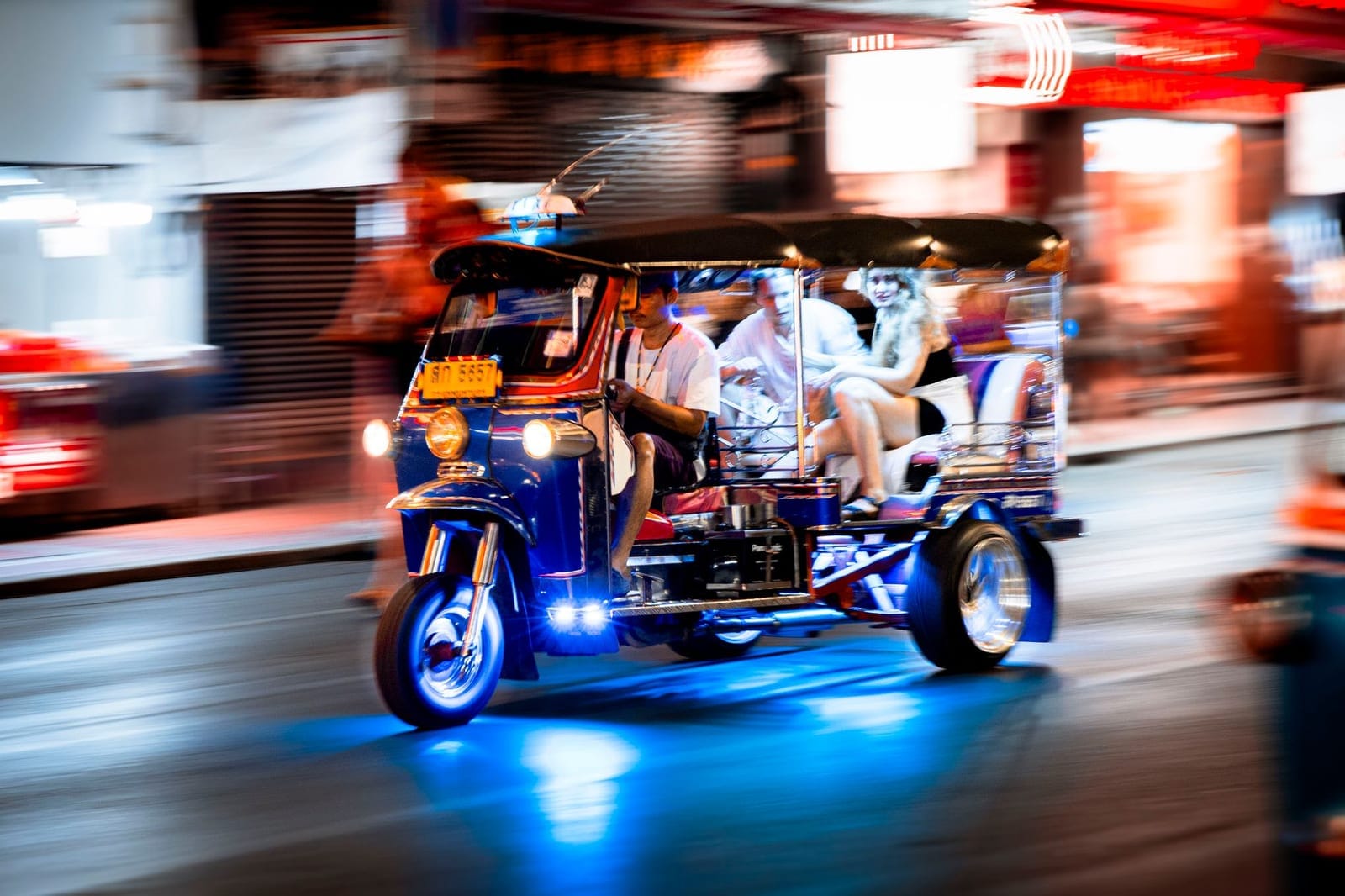
Tuk-tuks have no official fare table. Wikivoyage says to agree the price before you enter, to hail a moving tuk-tuk from the main road and not one waiting at a tourist spot, and that for anything more than a short hop they are not worth the price; it says locals pay around 30% less than the equivalent metered taxi fare. It also warns of drivers who offer cheap tours that end in shops, and says to be firm about your destination.
The risk is real in 2026. The Thaiger reported in April that a driver asked 2,000 baht for a trip of about 700 metres, and in October that a driver demanded 4,000 baht for a ride of 11 to 13 km from Rajamangala National Stadium, then fell to 2,000 baht. Police fined him 1,500 baht in total, 500 for overcharging and 1,000 for not producing his licence, and the Department of Land Transport said it would question him. The department said it planned to improve tuk-tuk services, including installing meters.
Grab and ride-hailing: fixed prices, with some surge
Wikivoyage says the main ride-sharing company in Bangkok is Grab, which can also book taxis, and that its predictable fares and English address entry help you avoid both the language barrier and possible scams, although fares may rise at surge times. You can pay the driver in cash, and as with taxis you pay the cost of any tolls at the booth. The Thaiger reported in 2021 that taxi hailing apps were approved, with the hailing charge capped at 20 baht.
The Thaiger reported in May 2025 that taxi drivers protested at Government House against Grab's pick-up points at Suvarnabhumi, after ministerial regulations legalised e-hailing and small hire cars. The report says the regulations legalise e-hailing, so the apps are a legal option, and the pick-up point at the airport may differ from the taxi queue. Our Grab or Bolt guide compares the apps, and our BTS and MRT fares guide covers the cheaper way across town.
Motorbike taxis: fixed fares for short hops, with a safety warning
Wikivoyage describes motorbike taxis, in orange or yellow vests, as the fastest way through a jam when no train serves your destination, and says prices should be agreed in advance. Most of them shuttle up and down long side streets for a fixed fare, which it calls marginally less dangerous than a long ride. It also warns that motorcycle accidents are brutally common and that the transport is inherently hazardous.
We would use them only for a short hop on a quiet soi, with a helmet. For anything longer, the taxi meter or an app is the better trade-off between price, safety and certainty. If you are travelling with luggage or children, the taxi is the practical choice, and the airport taxi counter is covered in our Suvarnabhumi Airport to city guide.
Why our night tour includes the tuk-tuk, and what it does not
On our Bangkok night tuk-tuk food tour, from $40 per person, the tuk-tuk ride between all the stops is included, so there is nothing to negotiate. The group meets at about 5:30 pm at a central point near a BTS station, rides open tuk-tuks past the Grand Palace and Wat Pho, stops at Wat Arun, the Giant Swing and the flower market, then eats a street-food meal and dessert on Yaowarat Road.
The tour ends in Chinatown at about 9:30 pm, and the way back to your hotel is not included: taxis and ride-hailing apps are easy to find there, and the meter rates above apply. Hotel pickup is possible at extra cost; ask us on WhatsApp. The tuk-tuks are open at the sides, so hold your phone and bag tight and wear shoes that stay on. Drinks other than water, extra snacks and tips are paid by you.
Practical checklist
- Ask the driver to use the meter, and get out if they refuse.
- Budget the meter plus 50 baht from the airports, plus tolls, and keep small notes for the toll booths.
- Agree the full tuk-tuk price, or the destination and the price, before you get in.
- Scan the QR code in the taxi or call 1584 if you are overcharged.
- Use an app when you want a fixed price, and expect higher fares at surge times.
- Plan your ride home from Chinatown before the night tuk-tuk food tour.
Questions and answers
How much is a taxi in Bangkok per kilometre?
The Thaiger reported that the meter starts at 40 baht and adds 6.5 baht a kilometre from the second to the tenth kilometre, then 7, 8 and 8.5 baht in the next bands. Slow traffic adds 3 baht a minute.
Is there a surcharge for airport taxis?
Yes. Taxis from Suvarnabhumi and Don Mueang add 50 baht to the meter, and the passenger pays any expressway tolls. The Thaiger reported this in 2023 and again in September 2026.
How much should a tuk-tuk cost in Bangkok?
There is no official tariff, so agree the price first. Wikivoyage says locals pay about 30% less than a metered taxi would charge. In October 2026 a driver was fined 1,500 baht after demanding 4,000 baht for an 11 to 13 km ride.
Do Bangkok taxis have to use the meter?
Within Bangkok and six nearby provinces, yes, according to The Thaiger's 2022 report of the Royal Gazette notice. Outside them, the fare is negotiated. A fare agreed beforehand is legal; one forced on you is not a reason to stay in the cab.
How do you report a taxi driver?
The Thaiger reported that the Department of Land Transport has QR codes in about 70,000 metered taxis, including a red code for urgent complaints, and that you can call the hotline 1584 with the plate number.
Is Grab cheaper than a taxi in Bangkok?
We could not confirm a general comparison. Wikivoyage says Grab's fares are predictable and may rise at surge times, while the taxi meter follows the official rates above. Compare both for your route.