

Short answer
Grab is the safer default in Thailand: its own locations page lists 72 areas, including Bangkok, Phuket, Krabi, Pattaya, Hua Hin and Samui, and Wikivoyage says its fares are fixed and can be paid by card. Bolt is listed in only 13 Thai cities, among them Bangkok, Chiang Mai, Krabi and Phuket, and Wikivoyage says it is usually cheaper but drivers may refuse its fares. Grab can be up to twice the price of a metered taxi. At airports, use the official taxi queue or book a ride in the app.
Grab is the default, and Bolt is a smaller add-on
Wikivoyage's Thailand page calls Grab the main ride-hailing app: it took over Uber's Southeast Asian business, including Thailand's, and is generally available in larger cities and beach destinations. Prices are fixed in advance, navigation is easy, and you can pay by credit card. Grab's own Thailand page says the same about upfront pricing, with the note that tolls and surcharges are not included in the quoted price.
Bolt is the second app. The Longest Way Home's Bangkok guide, updated in March 2026, calls it a popular alternative because its fares are often 20% cheaper, and says both apps can book a regular taxi or a private car at a fixed price shown upfront. Wikivoyage adds that Bolt covers fewer cities and that drivers often refuse its fares because they earn more from Grab. So treat Bolt as a second app for comparing prices, and install both before you fly.
Where each app works
Grab's locations page lists 72 areas in Thailand, from Ang Thong to Yasothon. They include Bangkok, Chiang Mai, Chiang Rai, Chonburi (with Pattaya), Krabi, Phang Nga, Phuket, Prachuap Khiri Khan (with Hua Hin) and Surat Thani (with Samui). Outside those areas, ask your hotel to arrange a driver. Grab's own page adds that some products, such as vans and SUVs, are available only in specific cities.
Bolt's cities page lists 13 Thai cities: Bangkok, Buriram, Chiang Mai, Chiang Rai, Khon Kaen, Krabi, Maha Sarakham, Nakhon Ratchasima, Nakhon Si Thammarat, Phitsanulok, Phuket, Surat Thani and Udon Thani. Pattaya is not on that list, and while Surat Thani is, we could not confirm that Bolt works on Koh Samui. Wikivoyage's Phuket page names Bolt or Grab as the rideshare apps there, and says both can be booked in advance.
What the fares look like against a taxi
Wikivoyage says Grab fares are typically up to twice as expensive as taxis, but they are fixed. It warns that many tourist routes and popular destinations carry highly inflated fixed prices. Its trick is to enter a nearby destination, perhaps 300 to 500 metres away, and see the price drop, for example from 400 baht to 40 baht. Walk away from the tourist spot if the app only shows inflated quotes.
Wikivoyage's Bangkok page adds that Grab fares can rise during surge periods, that you can pay the driver in cash, and that you pay any tolls at the toll booth, as in a taxi. It also says that late at night in the rain it is hard to find a taxi that will use its meter, which is when a fixed fare is worth the premium.
What Grab books: taxis, cars, bikes and vans
Grab's Thailand page describes more than one product. GrabTaxi is a 24-hour taxi that you can book in advance; GrabCar is a private car; GrabBike is a motorcycle ride; GrabVan takes up to 10 passengers in specific cities; and in some cities you can rent a car or van with a driver for up to four hours. It also offers advance booking for airport transfers.
We could not find an official Thai statement in October 2026 on the legal status of private-car ride-hailing, so we do not give a verdict. What is clear from Grab's page is that GrabTaxi books a regular taxi, and that a motorcycle ride means a helmet: the UK Foreign Office reminds visitors that by law you must wear one on a motorcycle, and that Thailand has a high number of road accidents.
Airports: the official queue, the touts and the airport fee
The Longest Way Home's guide to Suvarnabhumi, updated on 18 February 2026, says the official taxi rank is outside the building on Level 1, and that anyone offering a taxi inside arrivals is an unlicensed driver without a meter, who may charge three to five times the metered fare. A kiosk prints a slip with your bay and a complaint number: keep it. The cost is the meter, which starts at 35 baht, plus a 50-baht airport surcharge and any tolls, typically 300 to 550 baht to central Bangkok.
The same guide says that in March 2024 Grab was officially given permission to pick up at the airport, with a dedicated area at Entrance 4 on Level 1, and gives 400 to 600 baht for an economy car to central Bangkok. At Phuket, Wikivoyage describes a metered-taxi stand where the fare is the meter plus an airport fee, and says Bolt or Grab can be booked. Lonely Planet says an app pickup outside an airport's perimeter can avoid airport charges. More in our Phuket airport to Patong guide.
Metered taxis and tuk-tuks as the other options
Wikivoyage's Bangkok page says metered taxis are quick and comfortable if the traffic flows, but drivers are notorious for running up the fare. Insist that the meter is used, and if the driver refuses after a couple of polite attempts, get out. It says taxis parked outside hotels and attractions mostly want to overcharge, and that all Bangkok taxis are now metered with no surcharges except from the airport.
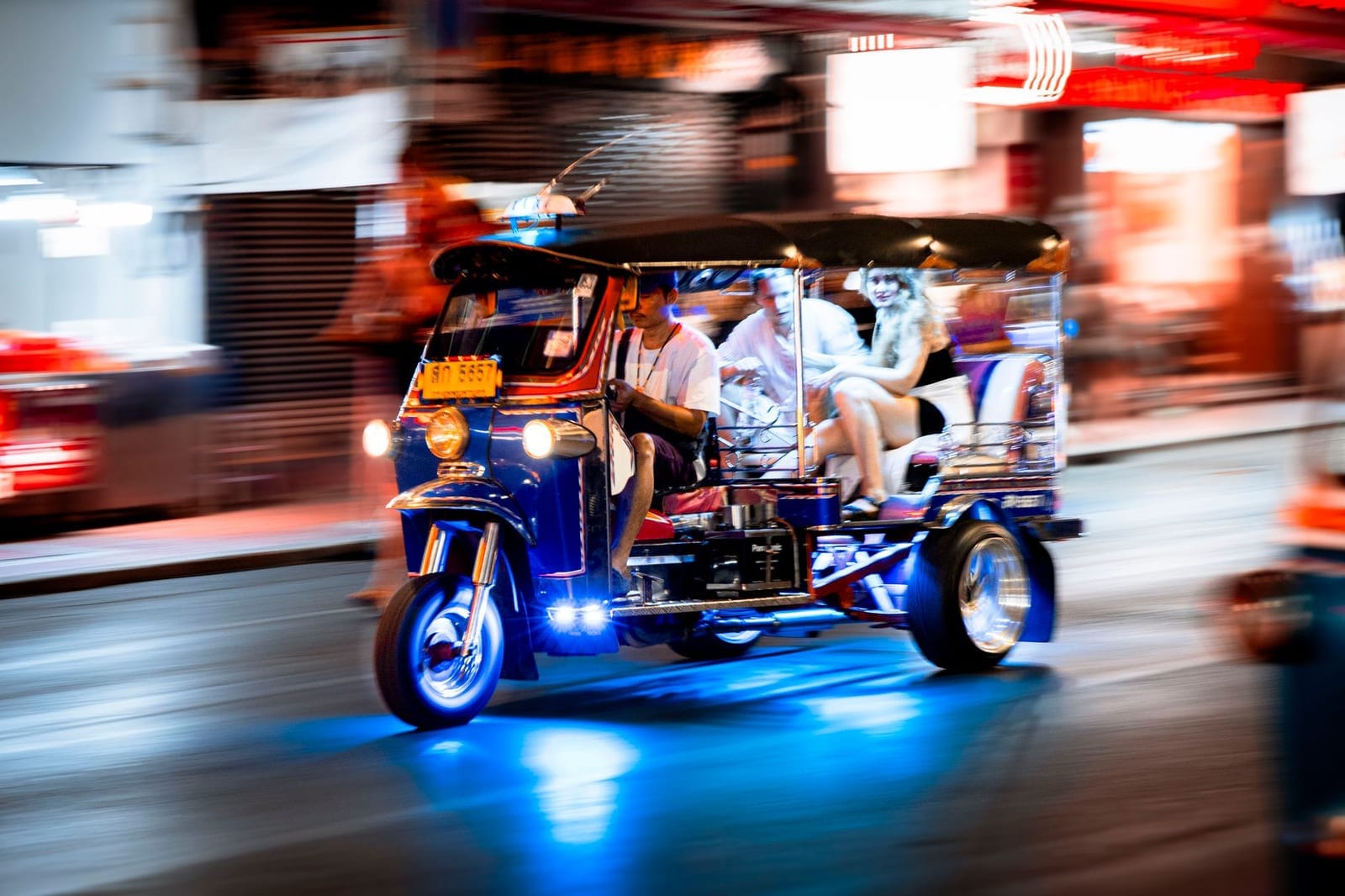
The same page says a tuk-tuk is worth it only for the experience or a very short hop, and that you should agree the price before getting in. The UK Foreign Office advises taking care in open transport like tuk-tuks. Our guide to taxi and tuk-tuk prices in Bangkok and the one on Phuket taxis and Grab prices give figures for each city.
Getting home after the Bangkok night tuk-tuk food tour
Our Bangkok night tuk-tuk food tour is from $40 per person. It meets at about 5:30 pm near a BTS station and ends in Chinatown at about 9:30 pm, not at the meeting point. On our tour you ride in open tuk-tuks between the stops, and the guide tells you that taxis and ride-hailing apps are easy to find in Chinatown at the end of the evening.
Request a ride in Grab or Bolt before you reach the end of the street, so that you have a price in front of you, and compare it with a metered taxi. Charge your phone, keep it in your hand, and hold your bag tight in the tuk-tuk, since the sides are open. If you need data on your phone, see our SIM and eSIM guide, and for cash see our notes on ATM fees.
Practical checklist
- Install Grab before you fly, and Bolt as a second app to compare prices in cities where it works.
- Check the price of a nearby pickup or drop-off if the app shows an inflated tourist quote.
- At airports, use the official taxi queue or a ride booked in the app, and ignore touts in the hall.
- Insist on the meter in a taxi, and get out if the driver refuses.
- Put your phone away from open sides in a tuk-tuk, and wear a helmet on any motorcycle ride.
Questions and answers
Is Grab or Bolt cheaper in Thailand?
The Longest Way Home says Bolt fares are often 20% cheaper. Wikivoyage says Bolt covers fewer cities and that drivers often refuse its fares, while Grab can cost up to twice as much as a metered taxi, at fixed prices.
Does Bolt work in Phuket and Bangkok?
Yes. Bolt's own cities page lists both, along with Chiang Mai, Chiang Rai, Krabi and eight other Thai cities. Pattaya is not on its list.
Is there Grab in Pattaya, Hua Hin and Samui?
Grab's locations page lists Chonburi (with Pattaya), Prachuap Khiri Khan (with Hua Hin) and Surat Thani (with Samui), among 72 areas in Thailand.
Can you pay for Grab in cash?
Wikivoyage's Bangkok page says you can pay the driver in cash, and its Thailand page says you can easily pay by credit card. You pay tolls at the toll booth, as in a taxi.
How do you get a taxi at Suvarnabhumi airport?
Use the official taxi rank outside on Level 1 and ignore touts in arrivals, says The Longest Way Home. A kiosk prints a slip with your bay. The fare is the meter plus a 50-baht airport surcharge and any tolls.