

Short answer
Most Thai ATMs charge a flat fee of about 220 to 250 baht each time you withdraw with a foreign card, whatever the amount. Travel guides updated in March 2026 give 250 baht as the figure you are most likely to meet, and the machine normally shows it before you confirm. Withdrawal limits are about 20,000 baht at most machines and up to 30,000 at some, so one large withdrawal costs far less per baht than several small ones. We found no bank notice with an official rate.
The fee is a flat 220 to 250 baht
The Longest Way Home's money guide, updated on 15 March 2026, says every withdrawal with an international card carries a fixed fee, whatever you take out: 220 to 250 baht depending on the bank, and rising. Wikivoyage's Thailand page gives a 250 baht surcharge as of March 2026 at most ATMs, and says the machine will usually warn you about it first. Lonely Planet's Thailand connectivity guide calls 220 baht the standard fee.
We found no bank notice or Bank of Thailand rule that sets the number. The same site's guide to Suvarnabhumi airport, updated on 18 February 2026, says nearly all Thai banks charge a flat 220 baht per foreign-card transaction on top of whatever your home bank charges. So treat 220 as the lower figure and 250 as the one you may meet. Aeon is reported at 150 baht by one guide, but Wikivoyage says it no longer seems to accept foreign cards. Read the screen before you confirm.
One big withdrawal beats several small ones
Because the fee is flat, the size of the withdrawal decides the cost. At 250 baht, a 5,000-baht withdrawal loses 5%, while 20,000 baht loses 1.25% and 30,000 baht less than 1%. Wikivoyage says most machines stop at 20 notes, which is 20,000 baht; Bangkok Bank usually pays out 25 notes, and Krungsri, TMB and CIMB may pay out 30. The Longest Way Home likewise says Krungsri typically allows 30,000 baht.
Your own bank may add a charge on top, and Wikivoyage warns that card issuers often charge more for cash advances, so check your card terms before you travel. A big withdrawal also means a lot of cash in your bag. The UK Foreign Office advises carrying valuables and cash securely against pickpockets and watching for bag-snatchers on motorbikes. Keep most of it in your hotel safe.
Pay in baht, not in your home currency
Some machines ask whether you want to be charged in your home currency or in Thai baht. Choose baht. Wikivoyage names Krungsri and SCB as banks known for offering to convert the money for you, and says that accepting costs about 5% or more below the mid-market rate. The Longest Way Home gives the same advice and calls the bank's rate almost always a rip-off compared with your own bank's rate.
The same rule applies in shops. Wikivoyage says you may be offered the choice at the till, and that the merchant's rate is worse than yours. It also notes that some businesses add a surcharge of 2 to 3% for credit cards, and that in this case paying in cash can be cheaper. Ask before you tap if the price matters, especially in markets and small restaurants.
Use a machine at a bank, and protect your card
The UK Foreign Office warns of card fraud in Thailand, including incidents of ATM skimming. It advises you to use an ATM in a bank, never to lose sight of your card during a transaction and to protect your PIN. The Longest Way Home gives a practical reason for the bank-branch rule: if the machine keeps your card, you can walk inside and get it back at once.
A teller can also pay out cash against your card. The Longest Way Home calls this a counter withdrawal or cash advance: take your passport to a branch and ask. It says that some branches process it for free or at a lower fee, that it takes about ten minutes, and that some banks have started charging their own counter fees, so ask the price first. Wikivoyage says Bangkok Bank universally accepts this type of withdrawal.
How much cash a boat day needs
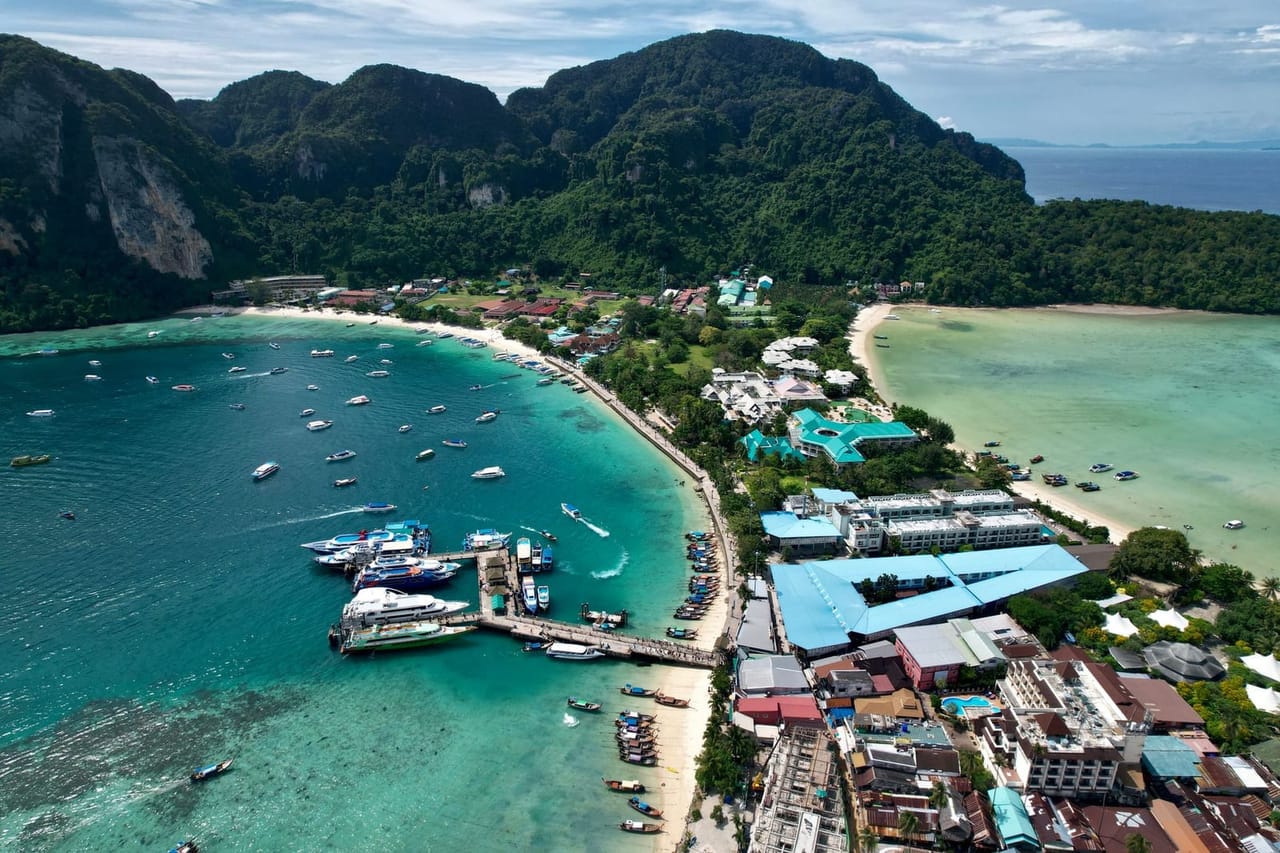
Cards work in malls, hotels and convenience stores, but The Longest Way Home says that cash remains king once you step off the main tourist strip. The national park fee on a boat day is a good example. On our Phi Phi and Maya Bay speedboat tour the operator collects 400 baht per adult and 200 per child in cash on the day, so two adults and a child need 1,000 baht.
The tour is from $75 per person, and the fee is not part of that price. We give 400 and 200 as what the operator collects on our tour, not as an official rate. For the fees on other islands and what the Department of National Parks publishes, see our guide to national park fees. Put a little extra in the same pocket for tips and drinks; our tipping guide says how much is usual.
Small islands and remote places: withdraw before you go
Wikivoyage says very remote areas, including smaller islands, have no banks or ATMs, so entering those places with cash is essential. A national park pier is not a place to look for a cash machine either. Take out what you need for the whole day the evening before, in one withdrawal if you can, rather than hoping to find a machine near the boat.
Plan the cash for the trip as a whole: the day-trip fees, a few taxi rides, market food and small tips. Our guide to Grab and Bolt in Thailand covers the apps that can take a card instead. When the amounts are fixed, such as a 400-baht park fee, count out the notes before you leave the hotel, because small notes are easier to hand over than a 1,000-baht note.
Foreign cash and money changers
Wikivoyage says an ATM typically gives a much better exchange rate than many money changers, especially if your card has no foreign-transaction fee. It adds that some changers, especially in Bangkok, offer rates even better than the ATM, and that if you plan to spend small amounts of cash, it can be better to bring foreign cash and change it. It names SuperRich as one changer with dozens of branches in Bangkok.
That is a trade-off, not a rule. Compare the rate on offer with the mid-market rate on your phone, ask about any commission before you hand over notes, and count the baht before you leave the counter. A mix of one large ATM withdrawal and a small exchange of spare notes is a sensible plan for a week, and it leaves you with cash for a park fee and a card for the hotel.
Practical checklist
- Expect a flat fee of 220 to 250 baht per ATM withdrawal and take out as much as is sensible in one go.
- Choose to be charged in Thai baht, and decline any conversion to your home currency.
- Use an ATM attached to a bank, cover the keypad and keep your card in sight.
- Count your park fees in advance and keep that cash separate, in small notes.
- Withdraw before you go to small islands, where there may be no machines.
Questions and answers
How much is the ATM fee in Thailand for foreign cards?
Travel guides updated in March 2026 give 220 to 250 baht per withdrawal, with 250 the more common figure. We found no bank notice, and the machine normally shows the fee before you confirm.
What is the maximum ATM withdrawal in Thailand?
Wikivoyage says most machines stop at 20 notes, or 20,000 baht, with Bangkok Bank paying out 25 notes and some banks 30. The Longest Way Home says Krungsri typically allows 30,000 baht.
Should you accept the ATM's currency conversion in Thailand?
No. Wikivoyage says accepting the machine's conversion costs 5% or more compared with the mid-market rate, and The Longest Way Home advises choosing to be charged in Thai baht.
Do you need cash for the Phi Phi national park fee?
Yes. On our tour the operator collects 400 baht per adult and 200 per child in cash on the day. This is what the operator collects, not an official rate.
Is it safe to use ATMs in Thailand?
Mostly, but the UK Foreign Office reports ATM skimming incidents. It advises using an ATM inside a bank, keeping your card in sight and protecting your PIN.
Read next
- Thailand national park fees for foreigners: the four groups, what children pay, and cash against e-tickets
- Tipping in Thailand: what is expected on tours, in restaurants and for massage
- How much is a Phi Phi island tour from Phuket, and what is not in the price?
- Phi Phi and Maya Bay: times, packing and seasons