

Short answer
Tipping is not customary in Thailand, and Thais themselves rarely do it. Round a taxi fare up to an easy number, leave small change at a street stall, and do not tip where a service charge has been added. Wikivoyage's Thailand page advises never giving more than 50 baht, and notes that tipping has become common in high-end hotels and tourist restaurants. On our tours, tips are not included in the price: they are your choice and are paid in cash.
Tipping is not expected, but it is welcome
Wikivoyage's Thailand page says that tipping is not common and that Thais themselves do not do it. You do not have to feel odd if you do not tip at all, because that is what locals do. The Longest Way Home's etiquette guide, updated on 15 March 2026, agrees: tipping is not customary in Thailand.
The same Wikivoyage page notes that the presence of many foreign visitors has changed some expectations. Tipping is now common in many high-end hotels and tourist restaurants. Its advice is to avoid going overboard: never give more than 50 baht. That is guidebook advice, not a rule, and we found no Thai source that sets a standard percentage, so there is no right amount to calculate.
Restaurants and street stalls: small change is plenty
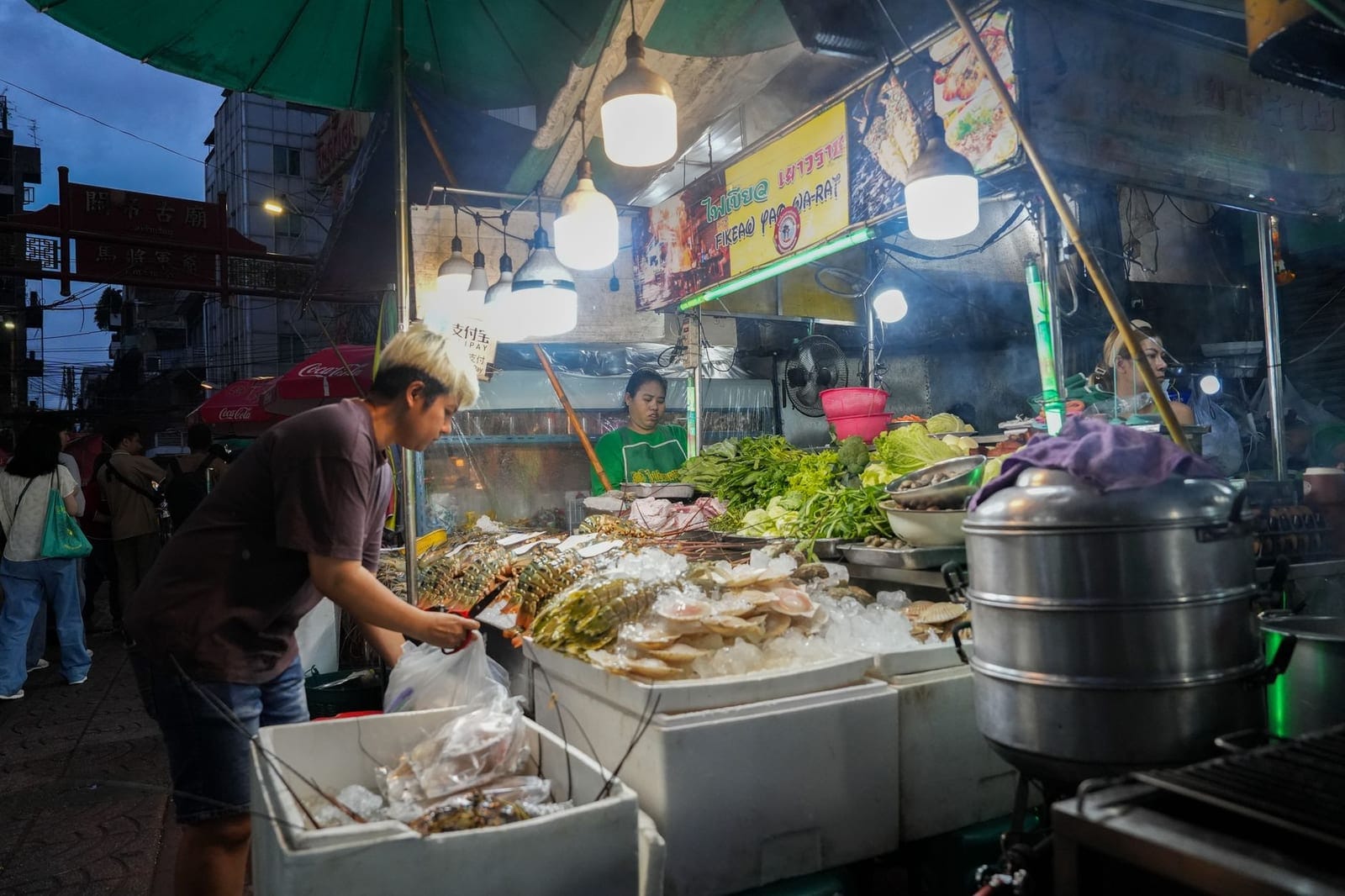
At small street stalls tipping is not expected, says The Longest Way Home, but leaving small change is a nice touch. Wikivoyage describes the same habit: Thais sometimes leave the change in restaurants, though even this is a rare occurrence. That is all a stall expects, and it is the habit to copy on a food tour, where you eat at small stalls.
Wikivoyage also says that in some tourist places, especially along Khao San Road, restaurants hint for a tip. That is not common in Thai culture, and it calls the hint even rude, so you can easily ignore it. If a bill already includes a service charge, do not add a tip on top: Wikivoyage explains that the charge is supposed to be the tip.
Taxis, rides and tuk-tuks: round up
Wikivoyage's Thailand page says that Thais round the taxi fare up or down to an easier amount, for example from 59 or 61 to 60 baht. Its Bangkok page adds that tips are not necessary but welcome if you are happy with the service, and that most local passengers round up or leave the coin change. It also advises carrying small bills of 100 baht or less, as drivers may have trouble with change.
The same habit works for a ride booked in an app. In our Grab and Bolt guide we note that the app shows a fixed price and that you can pay by card or in cash. For a tuk-tuk, agree the price before you get in and pay that price. For airport taxis, see our Suvarnabhumi airport guide.
Hotels and other places where tipping is common
Wikivoyage names many high-end hotels and tourist restaurants as the places where tipping is now common. It does not give a price list, and we did not find an official one, so keep amounts modest and hand a small note over directly. The 50-baht ceiling that the page suggests is a sensible limit for a small favour, such as help with your bags or a taxi found for you at night.
In small guesthouses and local places the expectation is lower, in line with the local habit of rounding up or leaving the change. For a bigger service, such as a driver who stays with you all day, ask your hotel what is usual before you decide, because the guidebooks we read do not set a figure. A tip is always your choice.
Guides, drivers and massage: no standard amount
For tour guides, private drivers and massage therapists we could not find a Thai source, official or in the guidebooks we read, that sets a standard amount or percentage. Wikivoyage's general article on tipping lists tour guides and massages among the services for which tipping is customary in some countries, but it does not say that this applies to Thailand. So we do not give a figure, because it would be invented.
The practical rule is the Thai one: a tip is a gesture of thanks, not a payment. If you enjoyed a guide's day, a tip in cash is welcome and you decide the amount. If you did not, do not tip. In either case, ask at the start whether a service charge is already included, so you do not pay twice, and keep a few small notes in your day bag.
What is and is not included on our tours
On our Bangkok night tuk-tuk food tour, from $40 per person, the price covers the tuk-tuk ride between the stops, an English-speaking guide, a street-food meal in Chinatown, a Thai dessert and a bottle of drinking water. Drinks other than water, extra snacks and tips are paid by you. The evening starts at about 5:30 pm and ends in Chinatown at about 9:30 pm.
On our Grand Palace, Wat Pho and Wat Arun tour, from $75 per person, the three entrance tickets and the ferry are included, and tips and anything you buy on the way are paid by you. We suggest bringing some cash for tips and snacks. Whether to tip the guide, and how much, is your decision, and we confirm the total on WhatsApp before you pay.
Small notes, temples and cash
Carry small notes. Wikivoyage warns that taxi drivers can have trouble with change, and The Longest Way Home's airport guide says drivers commonly claim not to have change for large bills. A 1,000-baht note is hard to break for a 40-baht ride, so break larger notes in a shop or a 7-Eleven first. Our guide to ATM fees and cash explains how to get cash cheaply.
Temples work differently: you leave a donation, not a tip. The Longest Way Home suggests a donation of about 20 baht in notes, not coins, because jingling is tacky. Wikivoyage adds that cash is not offered to monks directly and belongs in the donation box. See our guide to temple etiquette for the other rules.
The same etiquette guide says that at a Thai home you should bring a small gift such as fruit, not cash. So for a host, as opposed to someone who serves you for a living, a small gift is the safer way to say thank you. If you are invited somewhere, take the fruit and keep the notes in your pocket.
Practical checklist
- Do not feel obliged to tip, but round taxi fares up and leave small change where it feels natural.
- Skip the tip when a service charge is already on the bill.
- Keep any tip modest: Wikivoyage's ceiling is 50 baht.
- Carry small notes, because drivers and stalls often cannot change a large one.
- Bring cash for tips and drinks on our tours, since neither is part of the price.
Questions and answers
Do you have to tip in Thailand?
No. Wikivoyage says tipping is not common in Thailand and that Thais do not tip themselves, and The Longest Way Home says it is not customary. Tips are welcome in tourist-facing places, but not expected.
How much should you tip in Thailand?
There is no official amount. Wikivoyage advises never giving more than 50 baht, and says Thais round taxi fares up or down to a convenient figure. A small note or the change is the usual gesture.
Should you tip if a service charge is on the bill?
No. Wikivoyage says a service charge is supposed to be the tip, and that it is applied only in luxury restaurants and hotels. Check the bill before you add anything.
Are tips included on your Bangkok tours?
No. On our tuk-tuk food tour and our Grand Palace tour, tips are paid by you and are not part of the price. The meal, dessert, water, tuk-tuk ride or entrance tickets are included.
Do you tip taxi drivers in Bangkok?
Not necessarily. Wikivoyage says tips are not necessary but welcome, and that most local passengers round up or leave the coin change. It also advises carrying small bills.