

Short answer
Choose Kanchanaburi for the Death Railway story and a swim at Erawan Falls, and Ayutthaya for ruined temples and a shorter day. Our Kanchanaburi day is from $60 per person for about 13 hours, with about 120 km and 2 to 3 hours of driving each way. Our Ayutthaya day is from $25 for about 9 hours, with about 80 km and 1.5 hours each way. On both, some costs are paid on the day: 300 baht per adult for Erawan National Park as of June 2026, and about 280 baht in temple tickets at Ayutthaya.
What each day is: history and a waterfall, or a ruined capital
Choose Kanchanaburi for the war history and a swim, and Ayutthaya for temples and ruins. Wikipedia says the town of Kanchanaburi lies about 120 km west of Bangkok, where the Khwae Noi and Khwae Yai rivers join, and it is the centre of the Death Railway story: a 415 km line from Ban Pong in Thailand to Thanbyuzayat in Burma, built by captured Allied soldiers and forced Southeast Asian labourers. Wikipedia says more than 90,000 civilians and around 12,000 Allied soldiers died building it.
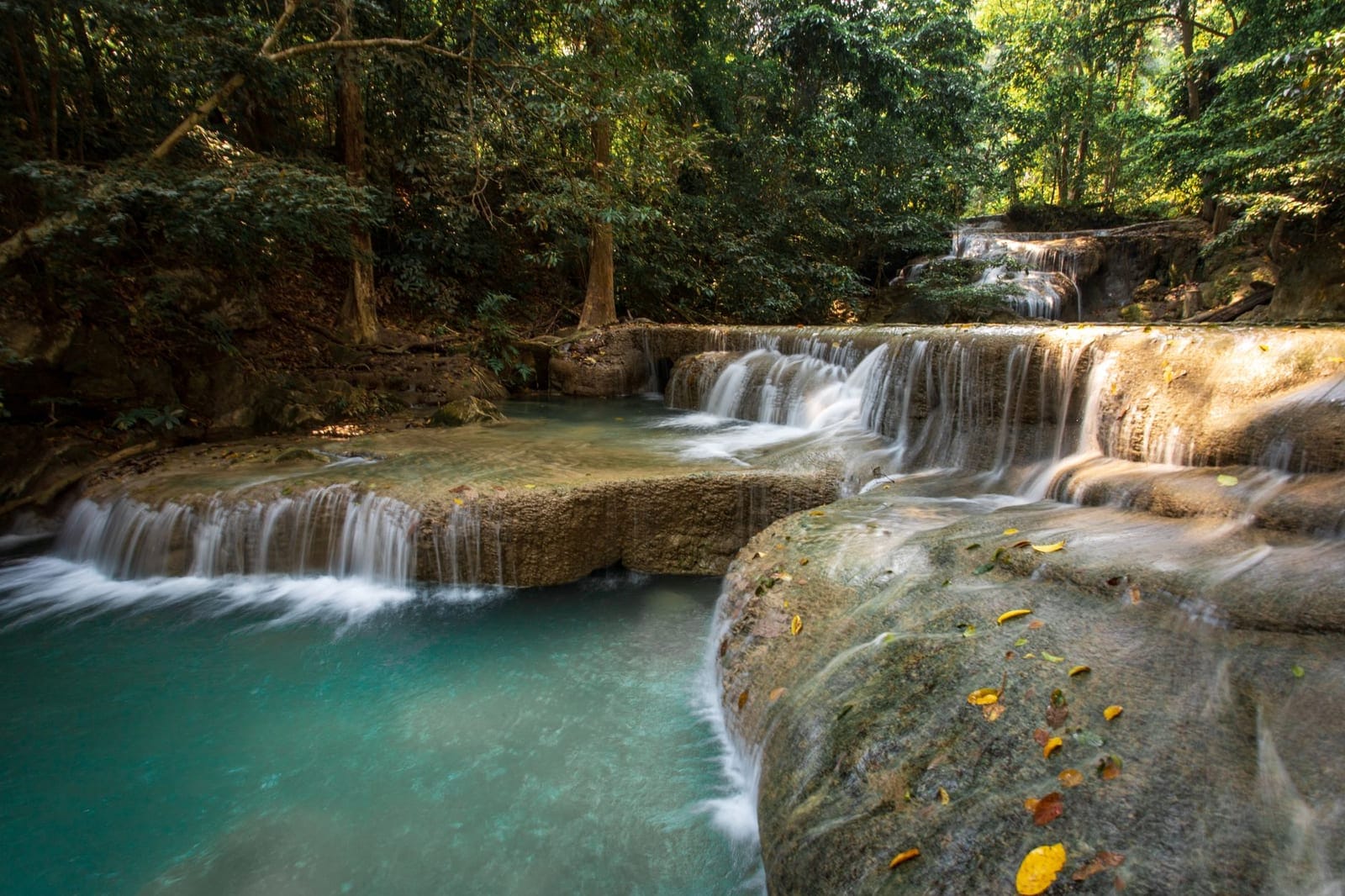
Our Kanchanaburi day adds Erawan Falls, a seven-tier waterfall in Erawan National Park. Wikipedia says the first to sixth tiers are reached by a trail from the visitor centre and visitors can swim in the pools. Ayutthaya, by contrast, was the capital of Siam for 417 years until 1767, according to Wikipedia, and our day there is about the ruined temples: Wat Yai Chai Mongkhon, Wat Mahathat with the Buddha head in the banyan roots, Wat Phra Si Sanphet and Wat Chaiwatthanaram.
Distance and the length of the day
Kanchanaburi is the longer day. Our tour is about 13 hours: pickup from your Bangkok hotel at about 6:15 to 7:15 am, arrival in Kanchanaburi at about 9:00, the Bridge on the River Kwai, lunch at about 12:00, 2.5 to 3 hours at Erawan Falls, and a return reaching Bangkok at about 7:30 to 8:00 pm, with times moving with traffic. The operator gives 2 to 3 hours of driving each way to the town, and Erawan is roughly another hour on.
Ayutthaya is the shorter day. The tour is about 9 hours from a central meeting point near a BTS or MRT station, with about 80 km and 1.5 hours of driving each way. Lunch is a stop at a local restaurant, and the group waits up to 10 minutes at the meeting point because Bangkok traffic is heavy. If your free day is short, or you dislike long drives, that difference is the one that matters most.
What you see, and what to expect at each
At Kanchanaburi the first stop is the Bridge on the River Kwai, where you can walk across the steel bridge over the Khwae Yai. Some programmes add a Death Railway train ride of about 60 minutes, the Allied war cemetery and the JEATH War Museum, and we confirm which your date includes. Wikipedia says only the first 130 km of the line in Thailand remain, with trains still running as far as Nam Tok. The war sites are memorials: keep your voice low, and photos are not allowed in the first section of the JEATH museum.
At Ayutthaya the day is walking among ruins in the sun. Our route takes in Wat Yai Chai Mongkhon with its 60-metre chedi, Wat Mahathat, Wat Phra Si Sanphet with the great bronze Buddha of Wihan Phra Mongkhon Bophit, and the Khmer-style Wat Chaiwatthanaram on the river. At Wat Mahathat visitors are asked to crouch or kneel for photos with the Buddha head, so that their own head is not higher than the Buddha's. Our Wat Mahathat Buddha head guide explains more.
What each costs, and what is paid on the day
On our site Ayutthaya is from $25 per person and Kanchanaburi from $60. The Kanchanaburi price includes hotel pickup in an air-conditioned minibus, an English-speaking guide in Kanchanaburi and lunch at a local Thai restaurant, plus the Death Railway ride on programmes that have it. The Erawan park fee is extra: the Department of National Parks' June 2022 table puts Erawan in the group where foreign adults pay 300 baht and children 150, and on our tour the fee is 300 baht per adult as of June 2026, in cash.
Smaller items add up. At Erawan, life jackets can be rented for about 30 baht per person, and each drink bottle carries a 20-baht deposit that is refunded when you bring it back. The Ayutthaya price covers transport, a guide and water; temple tickets come to about 280 baht in total and lunch is paid on the day. The Fine Arts Department charges foreign visitors 80 baht per monument at Ayutthaya, according to its page archived on 14 May 2026. Our Kanchanaburi price guide and Ayutthaya price guide list the details.
Heat, season and crowds
Both days are hot. The Thai Meteorological Department's 1981 to 2010 table shows the Kanchanaburi station with a mean maximum of 38.2 degrees in April and 37.3 in March, against 35.4 and 34.3 at Bangkok. Kanchanaburi is also drier than Bangkok in the table, with about 1,056 mm a year against 1,648 mm. Wikipedia says Erawan National Park lies in the rain shadow of the hills and has low average rainfall, with a rainy season from May to October.
Crowds and closing times matter more at Erawan. Our operator says weekends and public holidays are crowded, the park is open from 8:00 am to about 4:30 pm and admits no one after about 3:30 pm, and during Songkran, 13 to 15 April, the falls turn into a water-fight party, so leave non-waterproof phones behind. The Department of National Parks' 2026 closure list shows no closed period for Erawan. At Ayutthaya the day is hot with a lot of walking in the sun, so bring water, a hat and sunscreen.
Doing it yourself by train
Both can be done without a tour, at very different costs. Seat61 says Bangkok to Kanchanaburi on the Death Railway itself costs 100 baht, on two daily local trains from Thonburi station, and Bangkok to Ayutthaya costs 20 baht in third class. It also lists a weekend tourist railcar leaving Hualamphong at 06:30 and reaching Kanchanaburi at 09:25 and Nam Tok at 11:30, with special fares and a reservation required.
The catch is the last stretch. Wikipedia puts Erawan National Park about 50 km north-west of Kanchanaburi town, so reaching the falls after the train needs more transport. At Ayutthaya, Seat61 says the start of the UNESCO-listed area is some 3.5 km from the station, a short tuk-tuk hop. A tour pays for the door-to-door transport and the guide. Our Death Railway train guide and Ayutthaya tour or train guide compare the options.
Which to pick
Pick Kanchanaburi if you want the history of the Death Railway and a swim, and you are happy with a 13-hour day. Pick Ayutthaya if you have one shorter day, prefer temples and ruins, or want to spend less. Children who like water will enjoy Erawan, but it is a long day in a minibus. Ayutthaya has a lot of walking in the sun, so it is harder for anyone who tires in the heat.
We run both days from Bangkok, so we have no reason to push one. Kanchanaburi is not for anyone who dislikes long days in a minibus, and its war sites are memorials, not entertainment. Ayutthaya is not for anyone who dislikes heat and walking. If you cannot decide, our guide to the best day trips from Bangkok lays out the choices.
Practical checklist
- Decide how long a day you want: about 9 hours for Ayutthaya, about 13 for Kanchanaburi.
- For Kanchanaburi, bring swimwear, shoes with grip and cash: 300 baht per adult for the Erawan park fee, about 30 baht for a life jacket and a 20-baht bottle deposit.
- For Ayutthaya, bring cash for temple tickets, about 280 baht in total, and for lunch.
- Dress with shoulders and knees covered at Ayutthaya's temples, and bring water, a hat and sunscreen.
- Avoid Erawan at weekends and public holidays if you can, and leave non-waterproof phones behind during Songkran.
Questions and answers
Which is better, Kanchanaburi or Ayutthaya?
Neither is better for everyone. Kanchanaburi suits the Death Railway history and a swim at Erawan Falls, on a 13-hour day. Ayutthaya suits ruined temples on a 9-hour day that costs less. Choose by the day you want.
How far is Kanchanaburi from Bangkok?
About 120 km west, according to Wikipedia. The operator of our day gives 2 to 3 hours of driving each way to the town, and Erawan Falls is roughly another hour from the bridge.
How much is the Erawan Falls park fee?
On our tour it is 300 baht per adult as of June 2026, paid in cash, and children pay less. The Department of National Parks' June 2022 table puts Erawan National Park in the group at 300 baht for foreign adults and 150 for children.
Can you swim at Erawan Falls?
Yes. Wikipedia says the first to sixth tiers are reached by a trail from the visitor centre and visitors can swim in the pools. Wear swimwear under your clothes and shoes with grip, because the limestone is slippery when wet.
Can I go from Bangkok to Kanchanaburi by train?
Yes. Seat61 says two daily local trains run from Thonburi station on the Death Railway for 100 baht, and a weekend tourist railcar leaves Hualamphong at 06:30. Erawan Falls then needs more transport.
How long is the Ayutthaya day trip?
About 9 hours on our tour: about 1.5 hours each way by road, four temples and a lunch stop. It is from $25 per person, with temple tickets of about 280 baht and lunch paid on the day.
Read next
- Kanchanaburi day trip from Bangkok price: what $60 covers, the Erawan park fee you pay on the spot, and how long the day is
- Erawan Falls day trip from Bangkok: what you pay in the park, when it opens and how far you walk
- Ayutthaya by train or by tour from Bangkok: time, cost, heat and which one is worth it for you
- Floating market or Ayutthaya day trip from Bangkok: what you see, what each costs and who should pick which