

Short answer
By train, Ayutthaya costs far less than a tour: Seat61 gives 20 baht for a third-class seat from Bangkok, and the ride takes about an hour on a rapid train or 1 hour 45 minutes on a local one. You then pay a ferry or tuk-tuk, buy tickets at 80 baht a monument and plan the day yourself. Our tour is from $25 per person for about 9 hours, with transport, a guide and four temples. Temple tickets, about 280 baht, and lunch are paid on the day.
The short answer: the train is cheaper, the tour is simpler
By train, Ayutthaya is the cheaper day. In a guide updated on 1 October 2026, Seat61 gives 20 baht for a third-class seat from Bangkok, with no reservation needed on local trains. The ride takes about an hour on an express or rapid train and 1 hour 45 minutes on a local one. What is left to pay is the ferry or tuk-tuk to the ruins, the monument tickets and the work of planning a day in a park that GoAsia says looks after more than 300 historic sites.
Our tour is from $25 per person for about 9 hours and four temples, with transport from a central Bangkok meeting point, an English-speaking guide and drinking water. Temple tickets, about 280 baht in total, and lunch are paid on the day. In return the route is planned, a guide explains what you see, and two of the temples, which sit outside the centre of the old island, are included in the day.
By train: station, journey time and fares
Since 19 January 2023, Wikipedia says, long-distance trains run from Krung Thep Aphiwat Central Terminal, also known as Bang Sue Grand Station, when 52 long-distance trains moved there from Hua Lamphong. Ordinary and commuter trains that call at all stations still continue to Hua Lamphong. The terminal is linked to the Bang Sue MRT station by an underground walkway. Wikipedia puts Ayutthaya station 71 km from Bangkok and says every passenger train stops there.
Seat61 gives 20 baht for third class on a local or rapid train and 61 baht for second class on a rapid, with higher fares on express trains because of a surcharge. GoAsia, quoting the 2026 State Railway timetable in October, lists Rapid 111 leaving Krung Thep Aphiwat at 07:50 and arriving at 08:59, and Special Express 7 leaving at 07:30 and arriving at 08:23. Wikivoyage also describes a commuter service, Bangkok Connex, which it puts at about 1 hour 15 minutes for 50 baht.
From the station to the ruins: 3.5 km and a river
Ayutthaya station is not on the island with the ruins. Seat61 says the start of the UNESCO-listed area is some 3.5 km from the station, a 44-minute walk or a short tuk-tuk hop. Wikivoyage adds that the station is on the east bank of the river, and that you cross by a short ferry, which runs every few minutes and costs 5 baht, or by a bridge with a walkway just to the south.
After that you need a way to get round. Wikivoyage's Ayutthaya guide, which does not date these figures, says a tuk-tuk from the station should cost no more than 100 baht for two people, that official tuk-tuks at the station quote about 300 baht an hour, bargained to around 1,000 baht for four hours, and that a bicycle rents for about 40 baht a day. It also warns of drivers who offer a temple tour from 2,000 baht. Agree the price and the stops before you get in.
A train day on the clock
Take the times GoAsia read in the 2026 timetable. Rapid 111 reaches Ayutthaya at 08:59, the park is open from 8:00 am to 6:00 pm according to the Fine Arts Department, and Rapid 112 leaves Ayutthaya at 16:04 and reaches Krung Thep Aphiwat at 17:10. Allowing an hour for the transfers, that leaves about six hours at the ruins. A later return, Rapid 102 at 18:59, arrives at 20:05, but the ruins close at 18:00. Check the timetable before you rely on any of these times.
Our tour is a 9-hour day with about 1.5 hours by road each way, so up to about 6 hours remain for the temples and lunch. On site the two days are close in length. The difference is the other end: on the train you get yourself to Krung Thep Aphiwat and across the river, while on the tour the group meets at a central point near a BTS or MRT station and you arrive at the first temple already in a vehicle with a guide.
Which temples you reach
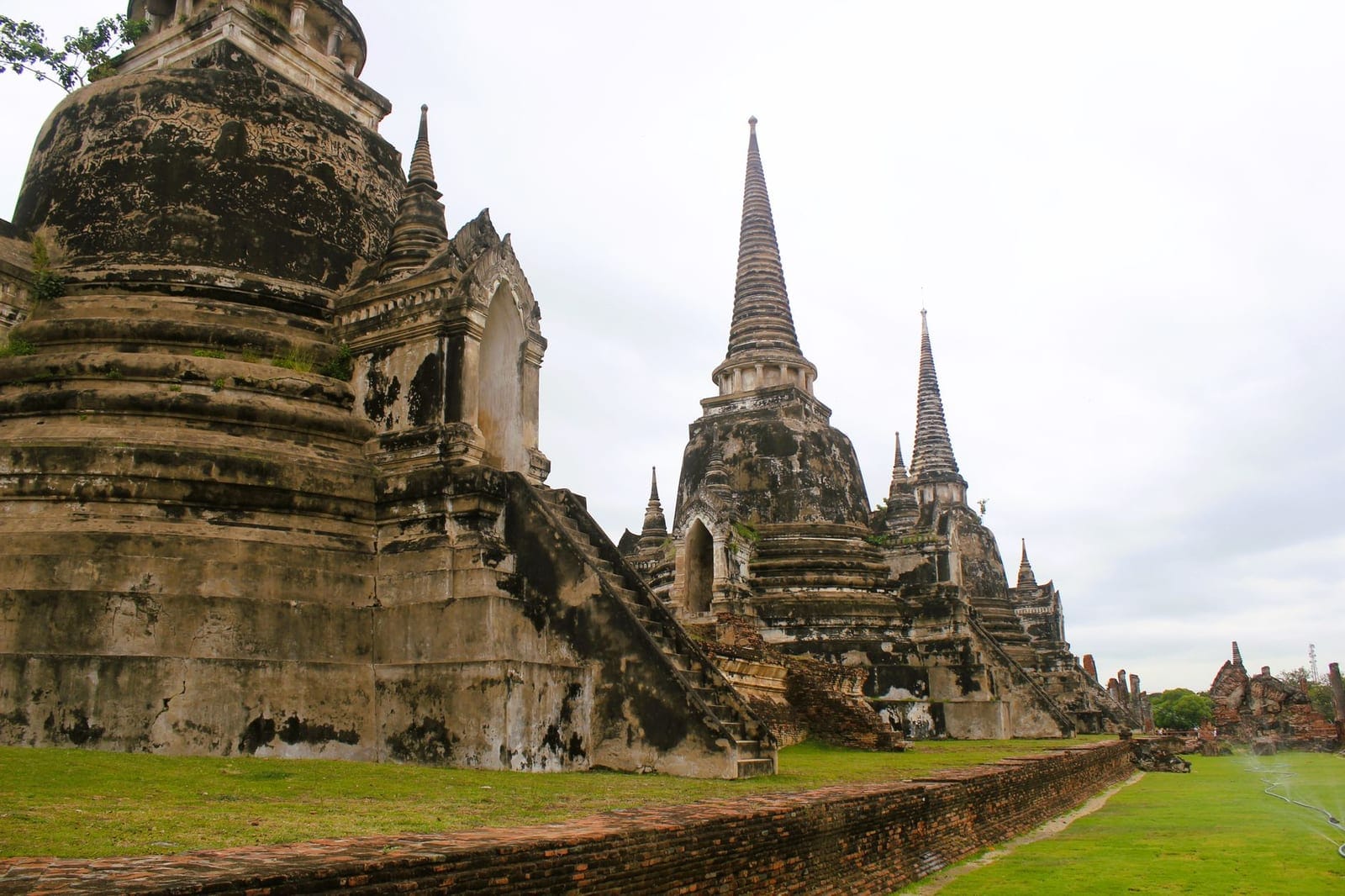
A train and a tuk-tuk can reach all of them, but the sites are spread out. Wikivoyage places most temple ruins in the north-west of the island, and GoAsia advises grouping stops by area to save backtracking. UNESCO names Wat Mahathat and Wat Phra Si Sanphet as testimony to the city's wealth, and both are on the island, close to Wihan Phra Mongkhon Bophit, the large seated Buddha next to Wat Phra Si Sanphet.
Our route adds two temples outside the centre of the island: Wat Yai Chai Mongkhon, which Wikipedia calls the temple with the tallest chedi in the city, and Wat Chaiwatthanaram on the west bank of the Chao Phraya. Wikipedia says Wat Chaiwatthanaram belongs to Ayutthaya Historical Park but not to the UNESCO-listed area. If the UNESCO core is all you want, the train and a bicycle will reach it.
Heat, walking and shade
Wikipedia's article on Ayutthaya gives the hot season as March to May, the rainy season as June to October and the cool season as November to February. Wikivoyage's Thailand guide says temperatures reach as high as 40°C in March and April, April being the hottest month, which it calls not the best time for temple-tramping in Bangkok. Seat61 describes third-class trains as non-air-conditioned with opening windows, a pleasant ride with a breeze.
Neither option avoids the sun at the ruins. Our tour information says plainly that it is hot with a lot of walking, so take water, a hat and sunscreen. Wikivoyage advises independent visitors to start early, before the tour groups arrive from Bangkok, or to start later and skip the sites the Bangkok day tours visit until the buses have left. That advice applies to us too, since we are one of those groups.
Who each option suits
Take the train if you like to improvise, travel alone or in a pair, want to stay until the ruins close at 6 pm, or want to cycle between temples, which Wikivoyage calls the most enjoyable way to spend the day. It is the cheaper option in cash, and the journey is part of the day. It asks for more planning: a station across the city, a river crossing, hiring a tuk-tuk or bicycle, and the sums at each ticket booth.
Take the tour if you have one day, want the logistics handled, like having someone explain the history, or want Wat Yai Chai Mongkhon and Wat Chaiwatthanaram without arranging a driver. Skip it if you want to linger or avoid groups. Send us the date, the number of guests and whether you want hotel pickup, and we confirm availability and the total on WhatsApp before you pay. The price guide gives every cost on the day.
Practical checklist
- Choose the train if you want the cheapest day and are happy to plan the transfers yourself.
- Check the State Railway timetable before you go, and check which Bangkok station your train leaves from.
- Agree a tuk-tuk price and your stops before you get in, and check the ferry runs.
- Choose the tour if you want transport, a guide and four temples arranged for one price.
- Bring water, a hat, sunscreen and cash for temple tickets either way.
Questions and answers
How long does the train from Bangkok to Ayutthaya take?
Seat61 gives about an hour on an express or rapid train and 1 hour 45 minutes on a local third-class train. GoAsia, quoting the 2026 timetable, lists rapid trains of about an hour from Krung Thep Aphiwat.
Which Bangkok station do trains to Ayutthaya leave from?
Long-distance and express trains leave from Krung Thep Aphiwat Central Terminal, which replaced Hua Lamphong for long-distance services on 19 January 2023, says Wikipedia. Seat61 notes that some local trains still leave Hua Lamphong, so check your train.
How much is the train from Bangkok to Ayutthaya?
Seat61 gives 20 baht for third class and 61 baht for second class on a rapid train, with higher fares on express trains. Wikivoyage lists 50 baht on the Bangkok Connex commuter service.
How far is Ayutthaya station from the ruins?
Seat61 puts the start of the UNESCO-listed area some 3.5 km from the station. You can walk, take a short ferry for 5 baht, as Wikivoyage describes, or hire a tuk-tuk or a bicycle.
Is Ayutthaya worth a day trip from Bangkok?
UNESCO describes it as the second capital of Siam, founded in 1350 and destroyed by the Burmese in the 18th century, with prang towers and large monasteries still standing. It suits visitors who like ruins and can cope with heat and walking.