

Short answer
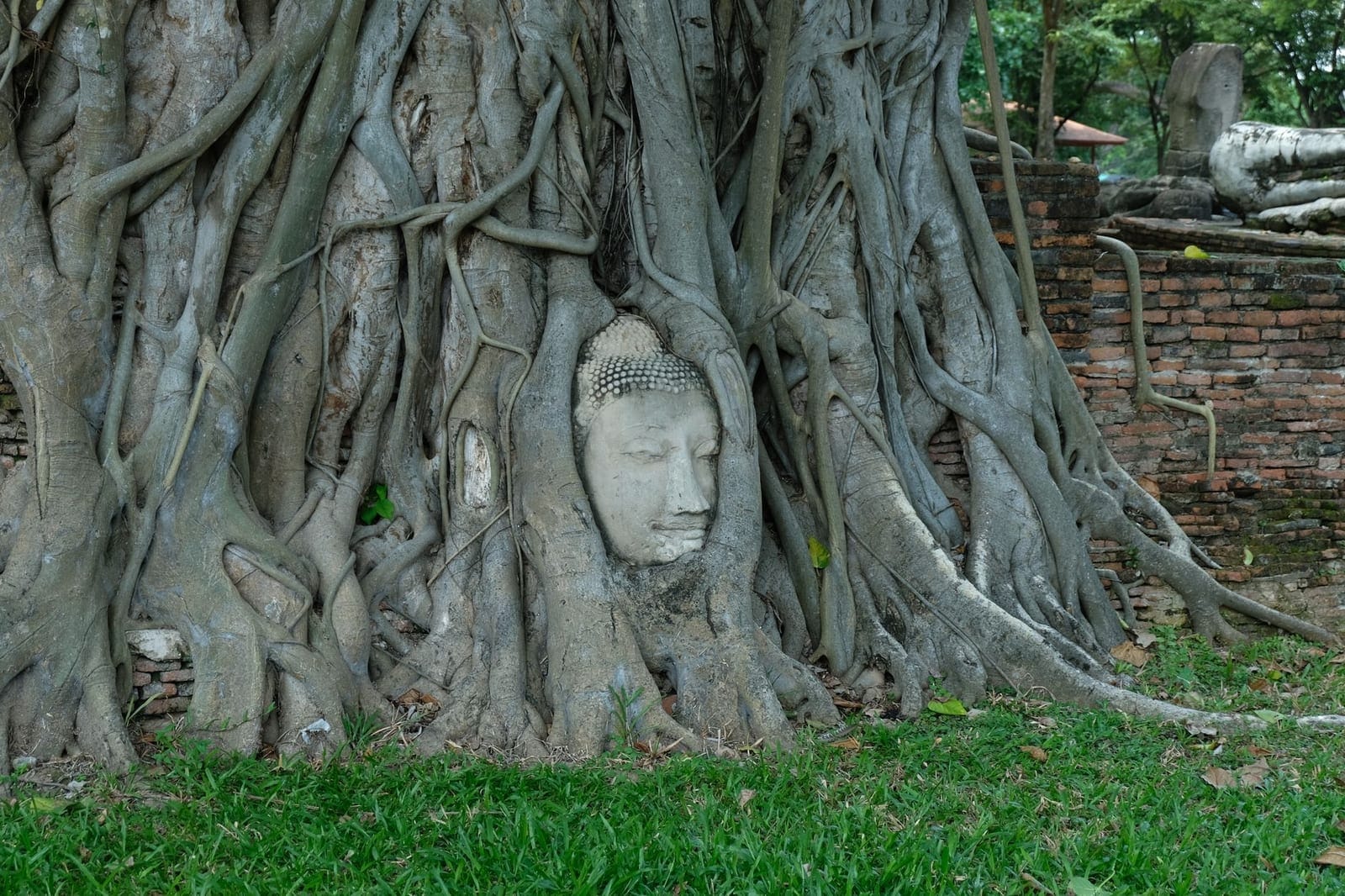
The Buddha head in the tree roots is at Wat Mahathat in Ayutthaya, one of the seven Fine Arts Department temples where foreigners pay 80 baht to enter, according to Wikivoyage and the Ayutthaya Historical Research website. For photos, kneel or crouch so that your head is lower than the Buddha's: Thailand's tourism authority says visitors should not raise themselves higher than a Buddha image. Do not touch the head, expect to wait your turn and follow the guard on duty. On our day trip, Wat Mahathat is the second temple.
The head is at Wat Mahathat, and the ticket is 80 baht
The Buddha head in the tree roots is at Wat Mahathat, the Temple of the Great Relic. Wikipedia places the temple in the centre of Ayutthaya Historical Park, between Chi Kun Road and Naresuan Road, and Wikivoyage puts it across the road from Wat Ratchaburana. It lies inside the core zone of the UNESCO World Heritage listing that Ayutthaya received in 1991, and UNESCO names Wat Mahathat among the monasteries that show the city's wealth.
Foreigners pay 80 baht at Wat Mahathat, according to the Ayutthaya Historical Research website and Wikivoyage's entry, updated in August 2026. The same ticket is one of the seven sold by the Fine Arts Department, so it counts towards the combined ticket; our Ayutthaya entrance fee guide shows when that pays off. We could not open an official fee page in October 2026, so check the price at the booth.
How a Buddha head ended up inside a tree
The Ayutthaya Historical Research website describes the image as a sandstone head of the Ayutthaya period, held in the roots of a bodhi fig. It says that stories differ: some people think a thief left the head there, others that it has lain there since the Burmese burned the city in 1767. The site's own account is plainer. Around 1968 to 1970, during restoration of Wat Mahathat, a worker moved a surviving head from a part of the site being restored and set it under the tree.
The roots did the rest. The site says the fig grows fast, that the roots had not yet wrapped the head in the early 1990s, and that around 2017 and 2018 they had added another 0.5 to 2.5 centimetres. Park staff watch the growth and try to control it. The same page says the area around the tree is sacred to Thai people and that a guard is present at all times.
The photo rule: keep your head lower than the Buddha's
The rule at the tree is the one that applies to every Buddha image in Thailand. The Tourism Authority of Thailand's etiquette note of August 2018 says plainly: do not raise yourself higher than the Buddha image. Wikivoyage says to sit on your knees for pictures with the head, and the details for our tour say the same: visitors are asked to crouch or kneel so that their head is not higher than the Buddha's.
In practice that means kneeling or crouching beside the head, or taking the photo from a low angle without standing over it. A selfie on tiptoe or a pose with an arm raised above the face breaks the rule. If you are unsure, watch what the visitors in front of you do and follow the instructions of the guard, who is on duty at the tree all day according to the Ayutthaya Historical Research website.
Other rules at the tree
The same TAT note lists rules that apply here. Do not touch or point at a Buddha image, and never turn your back on it without backing away a short distance first. Do not push in front of other visitors, especially people who are praying or making a donation. Keep your voice low, switch your phone to silent and take off hats and sunglasses. Wikivoyage's contributors add that the head is considered holy by Thais.
A back-to-the-statue selfie sits awkwardly with those rules, because you turn away from the image. The safest habit is to kneel beside the head, face the camera and stay only as long as the queue allows. We would also not lean on the roots or climb on them: park staff monitor the growth of the tree, and nothing about the head is meant to be handled.
Expect to wait your turn
The tree is one of the most photographed spots in Ayutthaya, and Wikivoyage warns that you should expect a long wait for your turn, because posing with the head is an extremely popular pursuit. The same entry suggests starting early, before the tour groups arrive from Bangkok, or starting later and avoiding the sites that the day tours visit first.
A day trip from Bangkok arrives in the same flow as the other tours, so plan to queue. Take your photo quickly, move aside and let the next person kneel. If a large group is waiting, walk through the ruins first and come back later. The wait, in Wikivoyage's description, is for the pose with the head, not for the temple itself.
What else the Wat Mahathat ticket buys
The ticket covers a whole ruined monastery, and the head is one corner of it. Wikipedia's account, based on the Royal Chronicles, dates the first temple to around 1374, and says it grew into a large monastery from 1384. Its tall central prang collapsed again in 1911 and was not rebuilt, according to Wikipedia; the Ayutthaya Historical Research site says it first came down on 25 May 1904 and fell further in 1911. What remains is the stepped base.
Wikivoyage describes leaning prangs, rows of headless Buddhas and a temple that the Burmese thoroughly ransacked. In 1956 the Fine Arts Department's excavation at the prang found a Buddha relic in a golden urn and gold Buddha images, which are now kept in the Chao Sam Phraya National Museum, according to Wikipedia. Give the temple half an hour, not five minutes, and the head becomes one stop among several.
Where Wat Mahathat sits on our Ayutthaya day
On our Ayutthaya day trip from Bangkok, Wat Mahathat is the second stop, after Wat Yai Chai Mongkhon and before Wat Phra Si Sanphet and Wat Chaiwatthanaram. The tour is from $25 per person and includes transport from a central Bangkok meeting point, an English-speaking guide and drinking water. Temple tickets, about 280 baht for the four temples on the details we hold, and lunch are paid on the day.
Dress for temples with shoulders and knees covered, bring a hat and water, and expect a lot of walking in the sun. The route and the other stops are in the travel guide for the tour; if you are choosing between temples, our guide to the best temples in Ayutthaya puts Wat Mahathat in context.
Practical checklist
- Kneel or crouch beside the Buddha head so that your head is lower than the Buddha's.
- Do not touch the head or the roots, and follow the guard's instructions.
- Keep 80 baht for the Wat Mahathat ticket, or about 300 baht in small notes for a four-temple day.
- Expect a wait for your turn at the tree and take your photo quickly.
- Cover shoulders and knees, take off hats and sunglasses at the tree and keep your voice low.
- Walk the rest of the ruins before you leave: the head is one corner of Wat Mahathat.
Questions and answers
Where is the Buddha head in the tree in Ayutthaya?
At Wat Mahathat, on the city island of Ayutthaya Historical Park, between Chi Kun Road and Naresuan Road. Foreigners pay 80 baht at the gate, according to Wikivoyage and the Ayutthaya Historical Research website.
Can you take photos with the Buddha head?
Yes, and it is one of the most popular photos in Ayutthaya. The rule is to kneel or crouch so your head is not higher than the Buddha's. Do not touch the head, and expect to wait for your turn.
Why do people kneel for the photo?
Thailand's tourism authority says visitors should not raise themselves higher than a Buddha image. Kneeling keeps your head below the Buddha's, which is the respectful position.
How did the head get inside the tree?
According to the Ayutthaya Historical Research website, a worker moved a surviving head and placed it under the bodhi tree during restoration around 1968 to 1970, and the fast-growing roots then grew around it.
Is there anything else to see at Wat Mahathat?
Yes: the stepped base of the central prang, leaning prangs, rows of headless Buddhas and the ruins of a large royal monastery. The 80 baht ticket covers all of it, not only the tree.