

Short answer
For one day, the best temples in Ayutthaya are Wat Phra Si Sanphet, Wat Mahathat, Wat Chaiwatthanaram and Wat Ratchaburana, with Wat Yai Chai Mongkhon as a fifth stop. All four are among the seven Fine Arts Department sites where foreigners pay 80 baht each, according to the Ayutthaya Historical Research website in 2026; Wat Yai Chai Mongkhon charges about 20 baht. This is our judgement of what each place offers, not an official ranking. Our day trip from Bangkok visits Wat Yai Chai Mongkhon, Wat Mahathat, Wat Phra Si Sanphet and Wat Chaiwatthanaram.
Four temples make a good first visit
There is no official ranking, so this list is our judgement, based on what each temple has that the others lack. For a first visit we would choose Wat Phra Si Sanphet, Wat Mahathat, Wat Chaiwatthanaram and Wat Ratchaburana. They are four of the seven sites where the Fine Arts Department sells tickets, and foreigners pay 80 baht at each, according to the Ayutthaya Historical Research website and Wikivoyage in 2026.
Add Wat Yai Chai Mongkhon, which charges about 20 baht, if you have time for a fifth stop. Wat Phra Si Sanphet, Wat Mahathat and Wat Ratchaburana lie inside the core zone of Ayutthaya's UNESCO listing, according to Wikipedia; Wat Chaiwatthanaram and Wat Yai Chai Mongkhon are in the surrounding park but outside that core zone. Our entrance fee guide explains the tickets.
Wat Phra Si Sanphet: the royal temple and its three chedis
Wat Phra Si Sanphet stood inside the old royal palace grounds and was used for royal ceremonies. Wikipedia and the Ayutthaya Historical Research website describe three chedis that hold the ashes of Ayutthaya kings; the first two were added in 1492 and the third in 1529, according to Wikipedia. Wikivoyage notes that the row of restored chedis appears on many images of the city.
A very large Buddha once stood here: Wikipedia gives its height as 16 metres, with a bronze core covered in about 343 kilograms of gold. When the Burmese took Ayutthaya in April 1767, the research site says, they burned the monastery and melted the gold from the larger images, and only the chedis survived. Next door, Wihan Phra Mongkhon Bophit holds a seated Buddha of about 13 metres, in brick and bronze under gold leaf, according to Wikipedia, and it is free to enter.
Wat Mahathat and Wat Ratchaburana: two temples on one corner
Wat Mahathat and Wat Ratchaburana face each other across the road, so they are one stop in practice. Wat Mahathat has the Buddha head in the tree roots, rows of headless Buddhas and the stepped base of a prang that fell in the early 20th century. Our guide to the Buddha head and the photo rules covers how to behave at the tree.
Wat Ratchaburana has the more complete prang, which Wikipedia calls one of the finest in the city. Wikipedia says it was founded in 1424 for the ashes of two royal brothers, and that the floods of autumn 2011 left water about a metre deep in the park for weeks; restoration ran from December 2011 to 2013. A narrow stair leads down into a crypt where faded murals survive, but Wikivoyage noted it closed in January 2020 with no end date, so ask at the gate whether it is open.
Wat Chaiwatthanaram: the riverside prang
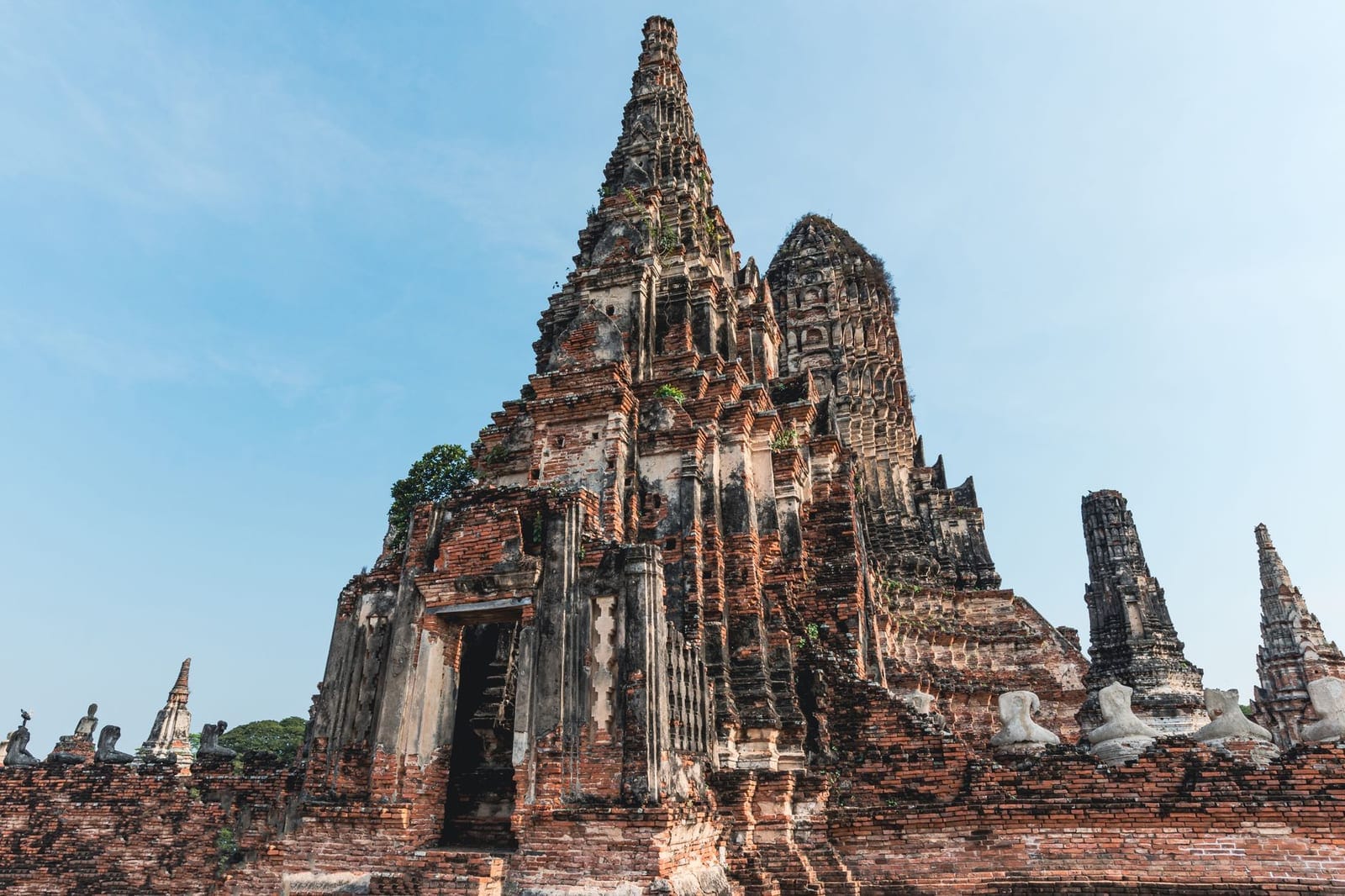
Wat Chaiwatthanaram stands on the west bank of the Chao Phraya, outside the island, and it is the temple on most Ayutthaya posters. Wikipedia says King Prasat Thong built it in 1630 in Khmer style, as a memorial to his mother's residence; the Ayutthaya Historical Research site says foster mother. Its central prang is 35 metres high, ringed by four smaller prangs and eight chapels, with 120 seated Buddhas once lining the wall.
It is off the island and reached by its own road, so it is a separate stop from the temples in the centre. Wikivoyage lists it as open from 08:30 to 18:30, with no tickets sold after 18:30. The research site notes that the temple was deserted for over 200 years after 1767 and opened to the public in 1992. It is the temple to see for the view of the whole complex rather than for details.
Wat Yai Chai Mongkhon and the free sights
Wat Yai Chai Mongkhon, south-east of the island, has the tallest chedi in the city, according to Wikipedia. King Naresuan ordered it built after his victory over the Burmese crown prince in 1592, says the research site. Wikivoyage describes a large reclining Buddha in saffron robes and a courtyard of Buddha images in robes of the same colour; it lists the entry at 20 baht.
Two other sights cost nothing. Wat Lokayasutharam has a very large reclining Buddha, which Wikipedia gives as 37 metres long and Wikivoyage as 42, so treat the length as approximate; Wikivoyage lists entry as free and suggests going early. Wihan Phra Mongkhon Bophit beside Wat Phra Si Sanphet is free as well. These two make cheap additions if you are in Ayutthaya for more than a day.
What to leave for a second day
Several worthwhile places sit too far apart for a day trip. Wikivoyage describes Wat Phra Ram, near Wat Phra Si Sanphet, as a huge prang you can climb partway for a view; Wat Phu Khao Thong, about 3 km north of town, as a large white chedi you can climb, at 20 baht for foreigners; and Wat Phanan Choeng, a working temple with a gilded seated Buddha 19 metres high.
The museums are for a second day too: the Chao Sam Phraya National Museum, where the gold from the crypts is kept, charges foreigners 150 baht according to the research site. If you can stay a night, these are the places to add. For a single day, the four temples above are plenty, and trying to fit all seven means rushing the ones you came for.
Which four our day trip visits
Our Ayutthaya day trip from Bangkok is from $25 per person and lasts about 9 hours, including about 1.5 hours of driving each way. The guide takes the group to Wat Yai Chai Mongkhon, Wat Mahathat, Wat Phra Si Sanphet with Wihan Phra Mongkhon Bophit, and Wat Chaiwatthanaram, with a lunch stop on the way. Wat Ratchaburana and Wat Lokayasutharam are not on the route.
Temple tickets are paid on the day: about 280 baht in total on the details we hold for the tour, and lunch is extra. If you want the crypt at Wat Ratchaburana, the free reclining Buddha or a museum, ask us when you book and we will tell you what fits. The travel guide for the tour follows the route stop by stop.
Practical checklist
- Pick your four: Phra Si Sanphet, Mahathat, Chaiwatthanaram and Ratchaburana make a strong first list.
- Carry about 300 baht in small notes for temple tickets on a four-temple day.
- Ask at the Wat Ratchaburana gate whether the crypt is open before you plan around it.
- Check closing times: Wat Chaiwatthanaram stops selling tickets at 18:30.
- Cover shoulders and knees and bring a hat, water and sunscreen for the walking in the sun.
- Leave the museums and the far temples for a second day.
Questions and answers
Which is the most beautiful temple in Ayutthaya?
That is a matter of taste, not an official ranking. Wat Chaiwatthanaram, with its riverside prang, and Wat Phra Si Sanphet, with its three chedis, are the two that appear most often in pictures of Ayutthaya.
How many temples can you see in one day in Ayutthaya?
On our day trip the group visits four temples in about 9 hours, with about 1.5 hours of driving each way and a lunch stop. Wikivoyage calls cycling the most enjoyable way to cover the ruins if you stay longer.
Which Ayutthaya temples are free?
According to Wikivoyage, Wat Lokayasutharam and Wihan Phra Mongkhon Bophit are free, as is the Phra Chedi Suriyothai. The seven Fine Arts Department temples charge foreigners 80 baht each.
Is Wat Ratchaburana worth visiting?
Yes, for its prang, which Wikipedia calls one of the finest in the city, and for the story of the crypt. The stair down into the crypt was closed in January 2020, so ask at the gate.
Do I need a guide to visit the temples?
No. You can walk the ruins on your own, but most of what you see is brick, and a guide supplies the history. Our day trip includes an English-speaking guide, and temple tickets are paid separately on the day.