

Short answer
At our Chiang Mai cooking class you cook five dishes and choose them yourself: a curry paste and a curry (green, red, panaeng or massaman), a stir-fry (pad Thai, fried rice, cashew chicken or holy basil chicken), a soup (tom yum or tom kha) and deep-fried spring rolls. There is no fixed menu, and dessert is not part of the half day. Every dish can be made vegetarian or vegan, and you decide how spicy it is. The class is from $30 per person.
The menu: five dishes, and you pick most of them
The school has no fixed menu. You cook five dishes: a curry paste and a curry, a stir-fry, a soup and deep-fried spring rolls, and within each group you choose. The curry is green, red, panaeng or massaman; the stir-fry is pad Thai, fried rice, cashew chicken or holy basil chicken; the soup is tom yum or tom kha. You make everything at your own station with an English-speaking instructor, then eat it, or take it away.
Dessert is not part of the half-day class. The school's full-day course adds a salad, a dessert and a herbal drink; ask us if you prefer it. There are two sessions, a morning class and an evening class, so tell us which you want. Our price guide lists what the $30 covers, and the tour schedule has the times.
The curry: green, red, panaeng or massaman
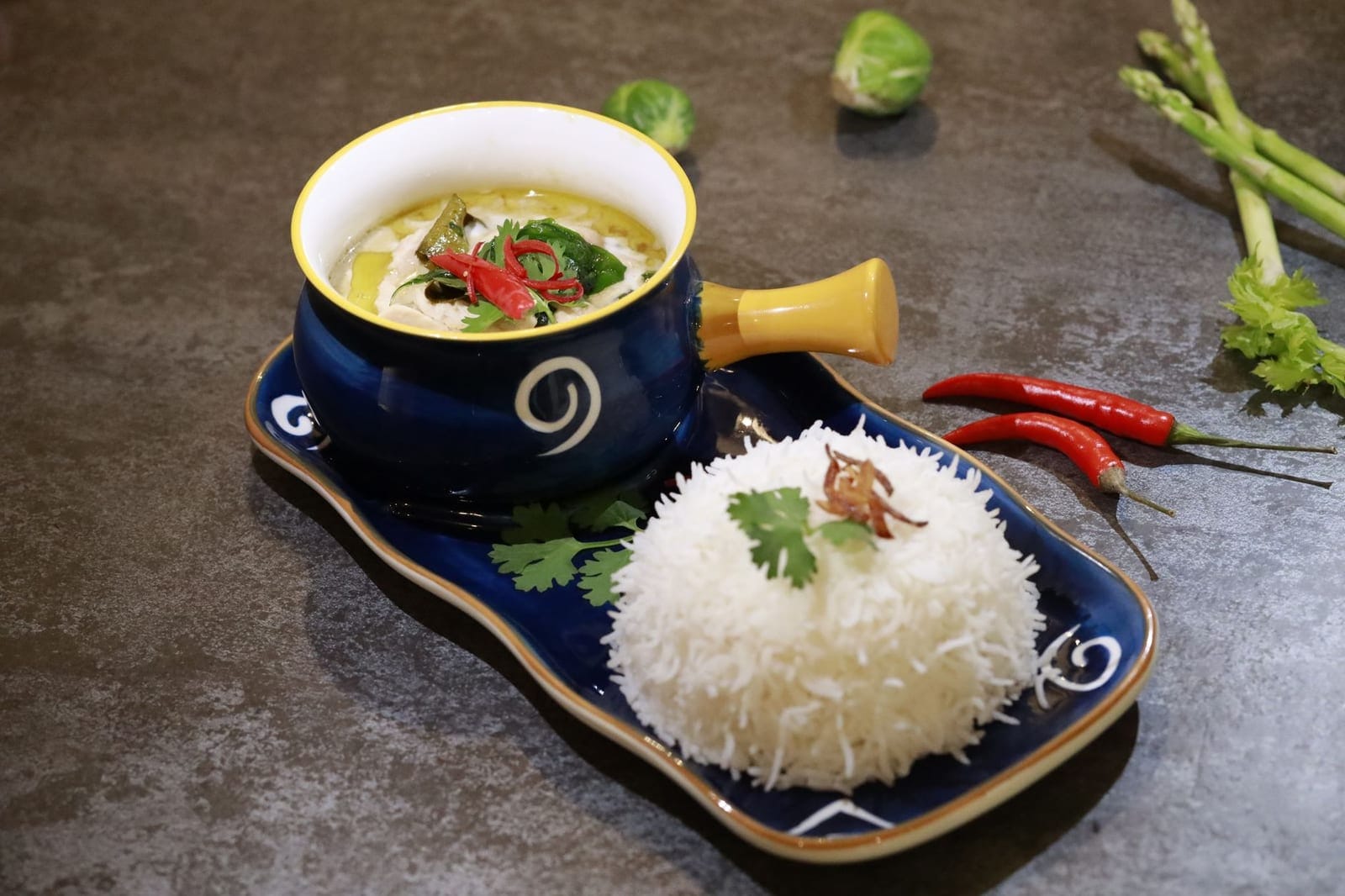
Wikipedia says Thai curries differ from Indian ones in using fresh rhizomes, herbs and aromatic leaves rather than a mix of dried spices, and that the spiciness depends on the amount and kind of chilli in the paste. At our class you make the paste yourself and set the heat. Green curry is named for the colour of its green chillies; Wikipedia says the Thai word for sweet in its name refers to the colour, not the taste, and that it tends to be more pungent than the milder red curries.
Red curry, whose Thai name means spicy curry, has a paste made traditionally with a mortar and pestle from dried red chillies. Panaeng is thick, creamy and mildly sweet, and massaman combines Persian, Indian and Malay spices with potatoes and peanuts; Wikipedia traces its roots to Muslim traders. Wikipedia says the green curry tends to be more pungent than the milder red curries, but you can ask for any of them mild.
The stir-fry: pad Thai, fried rice, cashew chicken or holy basil chicken
Pad thai is the one most guests have heard of. Wikipedia describes it as rice noodles stir-fried with egg, tofu, tamarind, fish sauce and often dried shrimp, garlic and shallots, served with lime and crushed roasted peanuts. Holy basil chicken is pad kaphrao, which Wikipedia calls one of the most popular Thai dishes; it is stir-fried holy basil, garlic and meat seasoned with soy, fish sauce, sugar and bird's eye chilli, served with rice.
If you want a familiar dish, fried rice is one. Wikipedia says Thai fried rice is typical of central Thai cuisine, with egg, onion, garlic and a meat such as chicken or shrimp, seasoned with soy, sugar and fish sauce, and served with cucumber, tomato, lime and a chilli fish sauce on the side. Cashew chicken is the fourth option on our list; the school sets the recipe, and we hold no more detail than the name.
The soup: tom yum or tom kha
Tom yum is the hot and sour one. Wikipedia lists lemongrass, kaffir lime leaves, galangal, lime juice, fish sauce and chilli as its core, and says the two most popular kinds in Thailand are nam khon, the creamy version, and nam sai, the clear one. Tom yum with prawns, tom yum kung, is described by Wikivoyage as very spicy, so tell the instructor if you prefer less heat.
Tom kha is the rounder choice. Wikipedia calls tom kha kai a spicy and sour soup with coconut milk, galangal, lemongrass, kaffir lime leaves, mushrooms and chicken, and says it originated around 1890 and was first recorded in a Thai recipe book, in a version with duck. At the school you choose one of the two. Wikipedia still calls tom kha spicy, so tell the instructor if heat is a worry; you set the level.
Spring rolls, and what the class leaves out
The fifth dish is deep-fried spring rolls, which you roll and fry yourself. Nothing on the half-day list is raw or served cold, and there is no salad or dessert, so if you want a fresh course to balance the fried food, ask us about the full-day course. If you like to bring something home, remember that the class lets you eat what you cooked or take it away.
One Chiang Mai dish is missing: khao soi. Wikipedia says khao soi is served in northern Thailand, is believed to have evolved from Chin Haw Muslim traders, and is a soup of egg noodles in a coconut-milk curry sauce, with crispy noodles on top. Wikipedia also says that northern Thai curries mostly do not use coconut milk, because coconut palms grow poorly in the highlands, and it describes green curry and panaeng as originating in central Thailand. So the curries at our class are not northern dishes; you will find khao soi in restaurants and on the street.
Vegetarian, vegan, allergies and spice
All dishes are available as vegetarian or vegan, and you decide whether each dish is spicy or mild. Tell us about food allergies when you book. Several of the dishes contain ingredients that matter: Wikipedia lists peanuts in massaman, in the panaeng paste and as a topping for pad thai, shrimp paste in red, panaeng and massaman curry pastes, and fish sauce in curries, soups and stir-fries. A vegetarian version has to replace these.
Wikipedia says vegetarians and vegans have created their own massaman by using tofu and substituting any shrimp paste or fish sauce, which shows the idea. How the school makes its vegan pastes and sauces is a question to ask in advance, particularly for a strict vegan or an allergy. Guests aged 9 and over cook at their own station, and children aged 4 to 8 come as visitors and do not cook. See our vegetarian class guide.
How the class fits the day, and how to book
The class is a small-group half day of about 6.5 hours at an organic farm near San Kamphaeng, about 45 minutes from the Old City, with a market stop on the way and a guided walk through the herb garden. Hotel pickup is included within about 3 km of the Old City, at about 8:00 to 8:30 am for the morning class or 3:00 to 3:30 pm for the evening one. You get a recipe e-book for all the dishes, plus a welcome snack, drinking water and seasonal fruit.
Send us the date, your hotel, the number of guests and your menu choices on WhatsApp, and tell us about any allergy. We confirm availability, the pickup time and the total before you pay. The class is from $30 per person. If you cannot decide between curries, choose the one you eat most at home: you will get the most from learning how the paste is made.
Practical checklist
- Decide your five dishes before the day: one curry, one stir-fry, one soup, plus the paste and the spring rolls.
- Tell us about allergies and vegetarian or vegan needs when you book, and ask about peanuts, shrimp paste and fish sauce.
- Say how spicy you want each dish: you set the heat.
- Choose the morning or the evening class: pickup is about 8:00-8:30 am or 3:00-3:30 pm.
- Check your hotel is within about 3 km of the Old City, or ask us first.
- Bring mosquito repellent, sunscreen and comfortable shoes.
Questions and answers
What dishes do you cook in the Chiang Mai class?
Five: a curry paste and a curry (green, red, panaeng or massaman), a stir-fry (pad Thai, fried rice, cashew chicken or holy basil chicken), a soup (tom yum or tom kha) and deep-fried spring rolls.
Is there a fixed menu?
No. The school has no fixed menu, so you choose a curry, a stir-fry and a soup from the options. Tell us your choices when you book, or decide with the instructor on the day.
Is dessert included in the half-day class?
No. The school's full-day course adds a salad, a dessert and a herbal drink. Ask us if you want the full day instead of the half day.
Can you make the dishes vegetarian or vegan?
Yes. All dishes are available as vegetarian or vegan. Tell us about allergies when you book, and ask how the school replaces shrimp paste and fish sauce.
Can you cook khao soi at the class?
It is not on our list of dishes. Wikipedia describes khao soi as a northern Thai dish of egg noodles in a coconut-milk curry sauce; you can find it in restaurants around Chiang Mai.
Can children join?
Guests aged 9 and over cook at their own station. Children aged 4 to 8 come as visitors and do not cook. Ask us about prices and about children under 4.
Read next
- Chiang Mai cooking class price: what $30 covers, what it leaves out and which session to pick
- Can you cook vegetarian or vegan at a Chiang Mai cooking class, and what about spice and allergies?
- Thai cooking class at an organic farm in Chiang Mai: why book it
- Thai cooking class in Chiang Mai: times, packing and seasons