

Short answer
The best time to visit Chiang Mai is November to February: the 1991 to 2020 normals give only 0.7 to 3.0 rainy days a month, average daytime highs of 29 to 33 degrees and night lows from 20 down to 16 degrees. March to May is hot, with highs of 35 to 37 degrees, and February to May is the official burning season. The rains run from May to October, with August the wettest at 223 mm. Our Doi Inthanon day is from $40 per person.
November to February is the best stretch
The numbers point to November to February. In the World Meteorological Organization's 1991 to 2020 normals for Chiang Mai, November has 3.0 rainy days with at least 1 mm, December 1.2, January 1.0 and February 0.7. Rainfall is 40.9, 14.1, 11.3 and 9.6 mm. The average daytime high ranges from 29.2 to 32.9 degrees, and the night low from 19.9 in November to 15.7 in January.
The Thai Meteorological Department's winter outlook, issued on 27 September 2024, expected the upper north to become chillier from the end of the third week of October to the end of January, with cold weather at times in the mountains. Mornings can be foggy or hazy. The same outlook expected warmer days and some haze again in the first half of February, which leads into the next season.
Averages hide extremes. In the same table the wettest November of the 30 years had 332.3 mm of rain and the driest none, while the wettest January had 78.9 mm and the wettest February 66.4 mm. So the cool season is reliable but not guaranteed, and November, at the edge of the rains, is the month most likely to surprise you.
Month by month in the cool season
November is the gentlest start: 40.9 mm of rain, a high of 30.8 degrees and a low of 19.9 degrees. December and January are the coolest, with lows of 16.9 and 15.7 degrees and highs of 29.2 and 30.0, and about 238 and 258 hours of sunshine. February warms up to 32.9 degrees by day, with the lowest rainfall of the year, 9.6 mm.
Two events fall in this season. Loy Krathong takes place on the night of the full moon of the twelfth Thai lunar month, and Wikipedia's table gives 24 November 2026 for this year. In Chiang Mai it coincides with Yi Peng. Our Chiang Mai in November guide covers the month in detail, and the Yi Peng guide covers the lantern festival.
March to May is hot, and February to May is the burning season
The heat arrives with the smoke. The normals give an average high of 35.4 degrees in March, 36.7 in April and 34.7 in May, with night lows of 20.1, 23.4 and 24.2 degrees. March has just 20.4 mm of rain and the lowest humidity of the year, 53.6 per cent. Rain returns in force in May with 167.5 mm on 12 days.
These are also the months of the burning season. The National Environment Board declared Chiang Mai a pollution control zone for February to May, and in 2026 the Pollution Control Department counted 1,967 hotspots in Thailand on 3 March alone, according to The Nation. Read the Chiang Mai burning season guide before booking these months. Songkran, the national holiday of 13 to 15 April, falls in the hottest weeks.
May to October is the rainy season
The rain builds from May and peaks late. The normals give 118.2 mm in June, 148.6 in July, 223.3 mm in August, 207.2 in September and 123.8 in October, with 9 to 17 rainy days a month. Highs ease to 31.6 to 33.2 degrees, humidity rises to about 82 per cent in August and the sunshine falls to 110.8 hours, against 267.9 hours in March.
It is a green season, with showers, and not a washout. Rain falls on 14 to 17 days a month from July to September. That suits visitors who accept showers and want cooler days than the hot months. If your trip depends on a clear view from the mountain, aim for the cool season instead.
What the seasons mean on Doi Inthanon
The mountain has its own climate. A station at 1,280 metres in Doi Inthanon National Park, listed in Wikipedia from data of the Highland Research and Development Institute for 1990 to 2013, shows an average January high of 23.9 degrees and low of 11.2, and an April high of 29.6 degrees. It also shows 383.1 mm of rain in September, against 15.8 mm in December. The summit is at 2,565 metres.
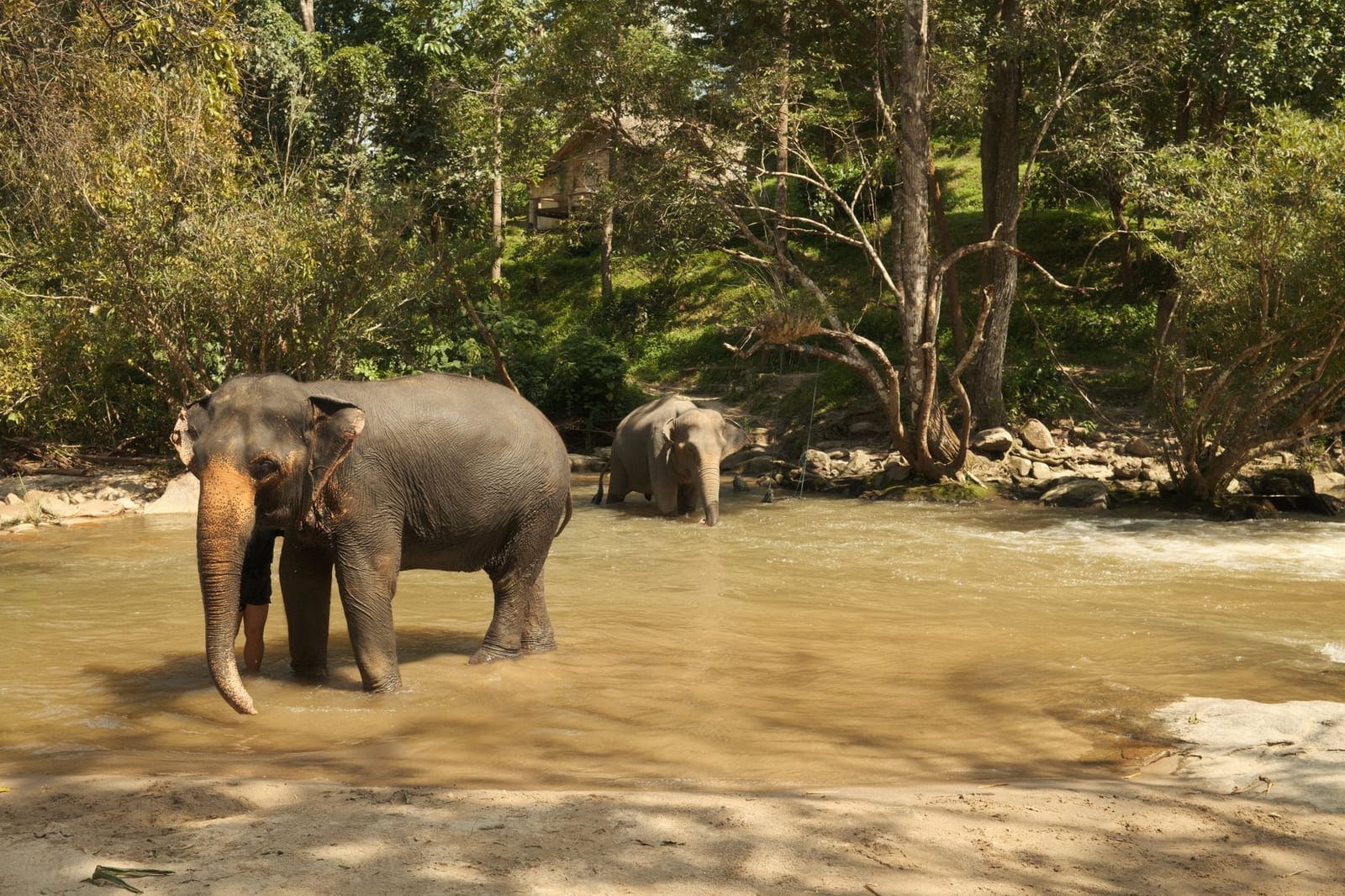
Our Elephant Sanctuary and Doi Inthanon day is from $40 per person and lasts 10 to 12 hours. It has no elephant riding; you feed, walk with and bathe the elephants, have lunch, drive up to the King and Queen pagodas and hike to a waterfall. The park fee, 300 baht per adult and 150 per child, is paid on the day unless your quote says otherwise. The order of the stops can change with the weather.
Which month for which kind of trip
For the most comfortable weather, choose November or December. For the coolest nights, choose December or January. For the driest days and a little more warmth, choose February, but watch the air quality. If you want green hills and can live with showers, the rainy months from June to September work, with a rain jacket.
If your dates are fixed in March or April, build a flexible plan with indoor options. The Thai cooking class, from $30 per person, is a half day, with a morning and an evening session. If you are also choosing between cities, see Bangkok or Chiang Mai and Chiang Mai or Chiang Rai.
Planning around the seasons
Whatever the month, a few habits help. Check the forecast and, from February to May, the Air4Thai reading for your district on the evening before a long outdoor day. Book the long day, such as Doi Inthanon, early in your stay so you can move it. Bring a light jacket for the mountain in the cool months, and a rain jacket in the wet ones.
Tell us the month you are visiting and your hotel in Chiang Mai on WhatsApp. We confirm availability, the pickup time and the total before you pay. Our guide to the elephant sanctuary price explains what the $40 covers and what you pay on the day.
Practical checklist
- Pick November to February for the driest, coolest weather, and December or January for the coolest nights.
- Avoid March and April if heat and smoke worry you, and check Air4Thai from February to May.
- Pack a rain jacket for June to October and a light jacket for the mountain from November to February.
- Hold 24 November 2026 for Loy Krathong, and check the official programme nearer the date.
- Keep cash for the Doi Inthanon park fee: 300 baht per adult and 150 per child.
- Book the long outdoor day early in your stay so you can move it.
Questions and answers
What is the best month to visit Chiang Mai?
November and December. They have 3.0 and 1.2 rainy days, highs of 30.8 and 29.2 degrees and lows of 19.9 and 16.9 degrees in the 1991 to 2020 normals, and the burning season has not begun.
What is the hottest month in Chiang Mai?
April, with an average daytime high of 36.7 degrees and a night low of 23.4 degrees. March follows with 35.4 degrees. Both are in the burning season.
When is the rainy season in Chiang Mai?
May to October. August is the wettest, with 223.3 mm on 17.1 days. June to September each bring 118 to 223 mm.
When is the burning season?
February to May, when Chiang Mai is a declared pollution control zone. In 2026 the province banned open burning from 1 January to 31 May. See our burning season guide for the numbers.
Is it cold in Chiang Mai in December?
Not in the city: the average low is 16.9 degrees and the high 29.2. On Doi Inthanon at 1,280 metres the average December low is 11.5 degrees, so bring a jacket.
Is Chiang Mai worth visiting in the rainy season?
It can be, if you accept showers. June to October bring 9 to 17 rainy days a month, but the hills are green. For clear mountain views, the cool season is more reliable.