

Short answer
For most visitors, base yourself in Chiang Mai and visit Chiang Rai on a long day trip; stay in Chiang Rai only if you want the town, the evening markets or the Golden Triangle. Chiang Rai is about 200 km north-east of Chiang Mai and the drive takes about 3 hours each way, so our day trip is 12 to 13 hours with 6 to 7 of them on the road. It is from $40 per person and covers the White Temple, the Blue Temple, the Black House and a hot-spring stop. The White Temple charges foreign visitors 200 baht from 1 January 2026.
Chiang Mai is the base; Chiang Rai is the destination
For most visitors, base yourself in Chiang Mai and visit Chiang Rai on a long day trip; stay in Chiang Rai only if the far north is your focus. Wikipedia says Chiang Rai is about 200 kilometres north-east of Chiang Mai and 62 kilometres south of Mae Sai on the Burmese border. Chiang Mai is the larger place, with about 127,000 people in its city municipality, according to Wikipedia, against about 70,000 in Chiang Rai in 2012.
The two are linked by history. Wikipedia says King Mangrai founded Chiang Rai in 1262 as the capital of his dynasty, and founded Chiang Mai in 1296 as the new capital of Lan Na, succeeding Chiang Rai. Wikivoyage describes Chiang Rai as the commercial centre of the Golden Triangle region, with a distinctly northern character and spicier food. Our Blue Temple guide and Black House guide cover two of its sights.
How far it really is: about 3 hours each way
Plan on about three hours each way. On our Chiang Rai day the drive is about 3 hours each way, which puts 6 to 7 hours in the van out of 12 to 13. For public buses, Wikivoyage's Chiang Rai page lists Greenbus services from Chiang Mai's Arcade Terminal 3 taking 3 hours 20 minutes on the standard and VIP buses and 3 hours 45 minutes on the cheaper bus, at 196 to 305 baht as of May 2025. Wikipedia says official bus schedules give about 3 hours 30 minutes.
That drive is why the question is base or day trip. Wikipedia says the rainy season, from about June to late October, can severely inhibit travel, so allow extra time then. If you dislike long days in a van, or travel with small children, a night in Chiang Rai removes the second three hours at the end of the day. Our Chiang Mai to Chiang Rai bus guide compares the public options.
What Chiang Rai gives you: three temples and a border region
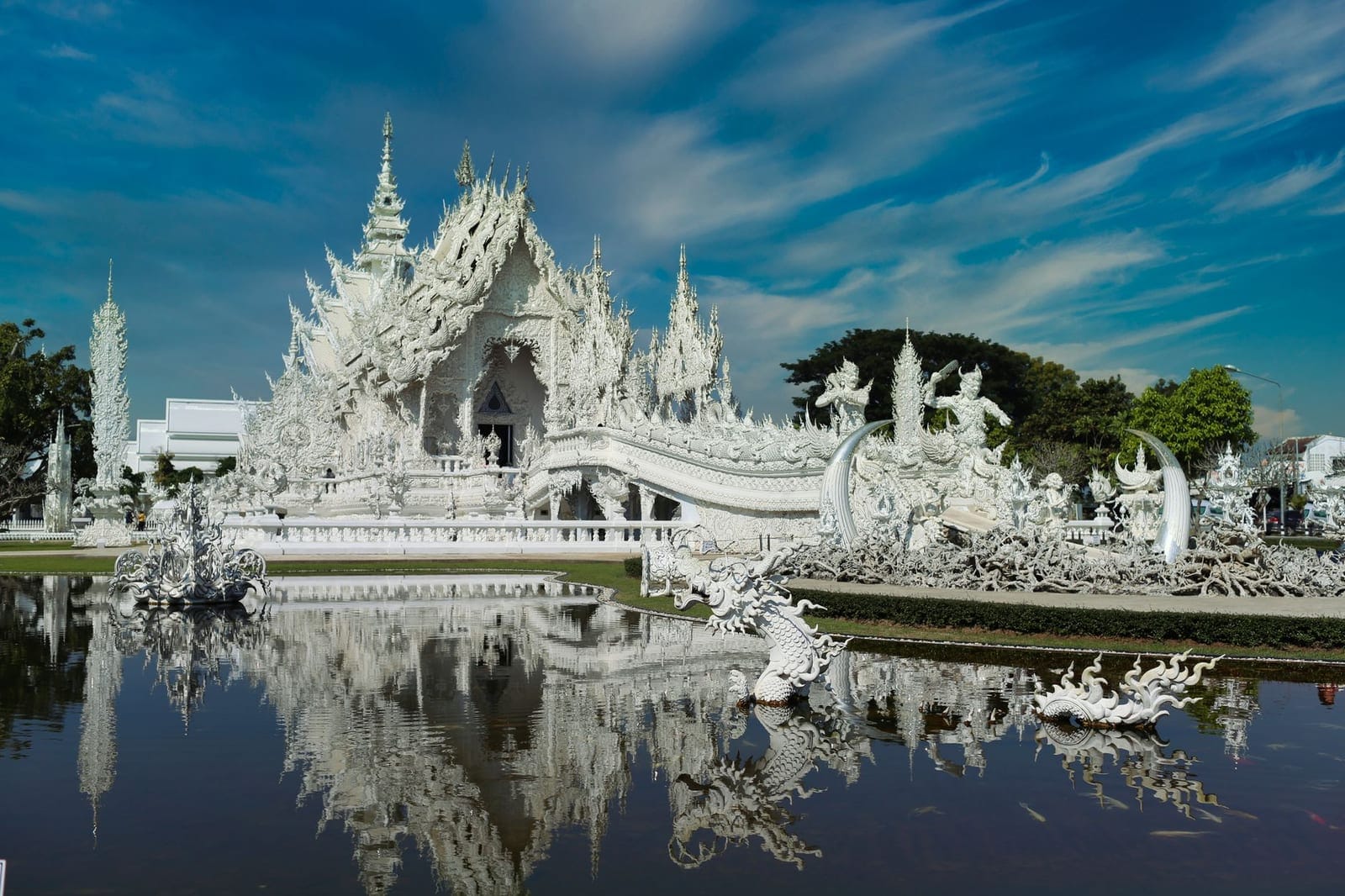
The reason most people go is Wat Rong Khun, the White Temple. Wikivoyage puts it about 13 km from the city on the Phahonyothin road. The Thaiger reported on 11 November 2025 that from 1 January 2026 the entry fee for foreign visitors doubles from 100 baht to 200 baht, with Thai nationals, children under 120 cm and visitors aged 70 and over free, and that the ticket includes the Cave of Art gallery. Our White Temple entrance fee guide has the hours and the dress code.
The town adds the Blue Temple, Wat Rong Suea Ten, which Wikivoyage places in town, and the Black House, Baan Dam, about 10 km north, with nearly 40 small black houses in its grounds. Further north are Mae Sai and the Golden Triangle, where the borders of Thailand, Laos and Myanmar meet. Our Golden Triangle guide is aimed at people who stay overnight.
What staying overnight changes
A night in Chiang Rai changes the evenings and the pace. Wikivoyage lists a Night Bazaar and food court open 19:00 to 22:00, a Saturday Walking Street from 18:00 to 22:00 and a smaller Sunday Walking Street, so a weekend stay has more to do after dark. It calls Chiang Rai an excellent base for exploring the region, and says most of the compact city, even the Blue Temple, can be explored on foot.
The trade-off is a second base. You move your luggage and you lose a night in Chiang Mai. Wikivoyage notes that Chiang Rai's airport had only domestic flights, to Bangkok, Hat Yai and Phuket, as of October 2022, so check flights if you plan to leave from there. If you have only three or four days in the north, a long day trip is the more efficient choice, and Wikivoyage also offers a suggested three-day Chiang Mai to Chiang Rai itinerary for those with more time.
Weather and smoke compared
The two cities have similar weather with small differences. On the Thai Meteorological Department's 1981 to 2010 table, Chiang Rai is a little cooler at night, with a January mean minimum of 12.8 degrees against 14.9 at Chiang Mai, and a little wetter, at 1,690.5 mm a year against 1,130.6 mm. August is the wettest month at Chiang Rai, with 358.4 mm, against 216.9 mm at Chiang Mai. April is the hottest, with a mean maximum of 34.8 degrees at Chiang Rai and 36.5 at Chiang Mai.
Smoke affects both. Wikivoyage gives the burning season as February to April and says the whole of northern Thailand often falls under haze, and that moving to a neighbouring province will generally not help, because the pall stretches from northern Laos to eastern Burma. For a Chiang Rai day in those weeks, views from the temples and hills may be poor, so choose November to January if you can. Our Chiang Mai burning season guide has more.
Our Chiang Rai day: the length and the costs
Our Chiang Rai day from Chiang Mai is from $40 per person and takes about 12 to 13 hours. A van collects you from your hotel between about 7:00 and 7:30 am, and you are back at about 7:00 to 8:00 pm. The day covers the White Temple, the Blue Temple, the Black House and a hot-spring stop, and the order can change with traffic and crowds. The travel guide walks through the stops.
The price covers the van, an English-speaking guide, drinking water and accident insurance. Entrance fees are paid on the day unless your quote says otherwise: 200 baht for foreign visitors at the White Temple, and a fee at the Black House gate. We confirm on WhatsApp what your price covers, including lunch, before you pay. The Golden Triangle is not included; ask us if you want the longer version of the day. Our price guide has the full breakdown.
Who should do it as a day trip, and who should stay
Do it as a day trip from Chiang Mai if you have three or four days in the north, are comfortable with about 3 hours each way and want the three big sights in one go. Stay in Chiang Rai if you want the Night Bazaar or a walking street, a slower look at the Blue Temple and the town, or the Golden Triangle and Mae Sai. On our day the temples take roughly 30 to 60 minutes each, so a night in Chiang Rai buys time and rest rather than extra sights.
Our day is not for everyone. It suits children who can sit in a van for about 3 hours each way, and the road is winding in places, so travel-sickness tablets help if you need them. The Black House shows furniture made from animal skins, horns and bones, which is not to everyone's taste. Dress for temples with shoulders and knees covered, and note that photos are not allowed inside the main hall of the White Temple.
Practical checklist
- Decide how many days you have in the north: three or four suits a day trip, more suits a night in Chiang Rai.
- Allow about 3 hours each way by road and a full 12 to 13 hour day if you go by van.
- Keep cash for the entrance fees on the day, including 200 baht for foreign visitors at the White Temple.
- Dress for temples with shoulders and knees covered, and take your photos of the White Temple bridge before you cross it.
- Take travel-sickness tablets if the winding road bothers you, and avoid February to April if smoke is a worry.
Questions and answers
How far is Chiang Rai from Chiang Mai?
About 200 km north-east, according to Wikipedia. By road it takes about 3 hours each way: Wikivoyage lists Greenbus journeys of 3 hours 20 to 3 hours 45 minutes as of May 2025, and our van takes about 3 hours.
How much is the bus from Chiang Mai to Chiang Rai?
Wikivoyage's Chiang Rai page lists Greenbus fares of 196 baht on the cheaper bus and 305 baht on the standard and VIP buses, as of May 2025. Check the current timetable and fare on the day.
Can you visit Chiang Rai as a day trip from Chiang Mai?
Yes. Our day is from $40 per person, 12 to 13 hours with 6 to 7 hours on the road, and covers the White Temple, Blue Temple, Black House and a hot-spring stop. The Golden Triangle is not included.
How much does the White Temple cost?
The Thaiger reported that foreign visitors pay 200 baht from 1 January 2026, up from 100 baht, while Thai nationals, children under 120 cm and visitors aged 70 and over enter free. On our day it is paid on the spot.
Is Chiang Rai wetter than Chiang Mai?
Yes. The Thai Meteorological Department's 1981 to 2010 table shows 1,690.5 mm a year at Chiang Rai against 1,130.6 mm at Chiang Mai. August is the wettest month at both, with 358.4 and 216.9 mm.
Is Chiang Rai worth a night?
It can be. Wikivoyage lists a Night Bazaar, a Saturday and a Sunday Walking Street, and calls the town an excellent base for the region. If you have only three or four days in the north, a day trip is more efficient.
Read next
- Chiang Rai day trip from Chiang Mai price: what $40 covers, which entrance fees you pay on the day and how long the day is
- White Temple Chiang Rai entrance fee: what foreigners pay, opening hours, dress code and photo rules
- Chiang Mai to Chiang Rai by bus: times, fares and where to board
- Chiang Rai temples day trip: times, packing and seasons