
Short answer
Tourists can fly a drone in most of Thailand in 2026, but not casually. The Tourism Authority of Thailand says the drone must be registered with both the NBTC and CAAT, insured for at least 1 million baht, and approved for each flight through CAAT's UAS Portal at least three days ahead. Controlled districts in seven border provinces stay restricted, and national parks ban drones without permission. For a short holiday, leaving the drone at home is often simpler.
Drones are allowed in most of Thailand, with conditions
The Tourism Authority of Thailand (TAT) advised visitors on 29 June 2026 that drone operations are now permitted in most areas of the country, provided the operators are properly registered and follow Thai aviation rules. TAT's guide says that drones may be brought into Thailand, but cannot be operated legally until they are registered. The UK Foreign Office goes further on the NBTC side: it says you must register a drone within 30 days of entering Thailand or buying one there, even if you never fly it, and that the fine for a drone not registered with the NBTC is 100,000 baht or five years in prison, or both.
The word "most" matters. TAT says use is generally possible in most destinations after proper registration, insurance and flight approval, and that restrictions remain in selected border districts. Violations can lead to fines, imprisonment or confiscation of the equipment. If you want a drone only for a few holiday photos, count the paperwork before you pack one.
Registration: two agencies, not one
According to TAT, every drone must be registered with the National Broadcasting and Telecommunications Commission (NBTC), regardless of weight or use. The Civil Aviation Authority of Thailand (CAAT) registers the drone and the operator as well, and this is required for drones fitted with a camera or recording device, for drones of 2 to 25 kilograms, and for heavier ones. TAT stresses that registration with only one agency is not enough.
CAAT's process runs through its UAS Portal. TAT says you need a Thai SIM card to start it, because the portal verifies identity with a one-time password. To get the drone pilot certificate you pass an online exam, which can be retaken after 24 hours if you fail, and the certificate stays valid for two years. A registration number is then issued and must be displayed on the drone.
Insurance and approval for every flight
TAT says drones must carry third-party liability insurance of at least 1 million baht, arranged locally or abroad. On top of registration, flight approval is needed through the UAS Portal before each operation. The area, date, time and purpose of the flight must be sent to CAAT at least three days in advance.
TAT adds that operators must also email the Anti-Drone Centre of the Metropolitan Police Bureau before each approved flight, and must follow every condition written in the CAAT approval. Special operations, such as night flights, flights above 90 metres or entry into restricted zones, need prior written approval. This is why a spontaneous flight on arrival day is not realistic: plan the approvals, and the Thai SIM, before the trip.
The rules in the air
TAT lists the basic safety rules. Flights are allowed only in daylight, in clear weather and within visual line of sight; navigating by a first-person-view screen or the onboard camera alone is not allowed. Drones may not fly within nine kilometres of an airport or temporary airfield without prior approval, and they must keep minimum safe distances of 30 metres (under 2 kilograms) or 50 metres (2 to 25 kilograms).
Flights over urban areas, gatherings, government buildings, hospitals and military zones are prohibited unless authorised. In practice, Bangkok's old town and its temples are not places to fly. On our Grand Palace tour we tell guests that drones are not allowed over the palace, which has its own rules on filming. Hazardous items, including laser devices, may not be carried by a drone.
Border districts: CAAT Notice No. 16
CAAT Notice No. 16 has been in effect since 26 June 2026 and applies until further notice. TAT says it relaxed earlier special restrictions linked to the Thai-Cambodian border situation, but flights stay prohibited in controlled districts of seven provinces: Ubon Ratchathani, Si Sa Ket, Surin, Buri Ram, Sa Kaeo, Chanthaburi and Trat. Tourism or recreational flights are not generally permitted there unless CAAT and the area owner specifically authorise them.
TAT lists the exact districts, for example Mueang Chanthaburi, Soi Dao and Pong Nam Ron in Chanthaburi, and Mueang Trat, Khlong Yai and Bo Rai in Trat. Violations of the notice are punishable by up to one year in prison, a fine of up to 40,000 baht, or both. Because the notice can change, read TAT's latest page and CAAT's guidance before every flight.
National parks and islands: ask first
In a statement of 2 June 2026 about Khao Laem National Park, the Department of National Parks, Wildlife and Plant Conservation gave examples of park rules: no vehicles in restricted areas, no loud noise and no flying a drone without permission. The Department calls such rules a shield for fragile resources, not a limit on tourism. TAT's guide also tells visitors to check national park requirements before they fly.
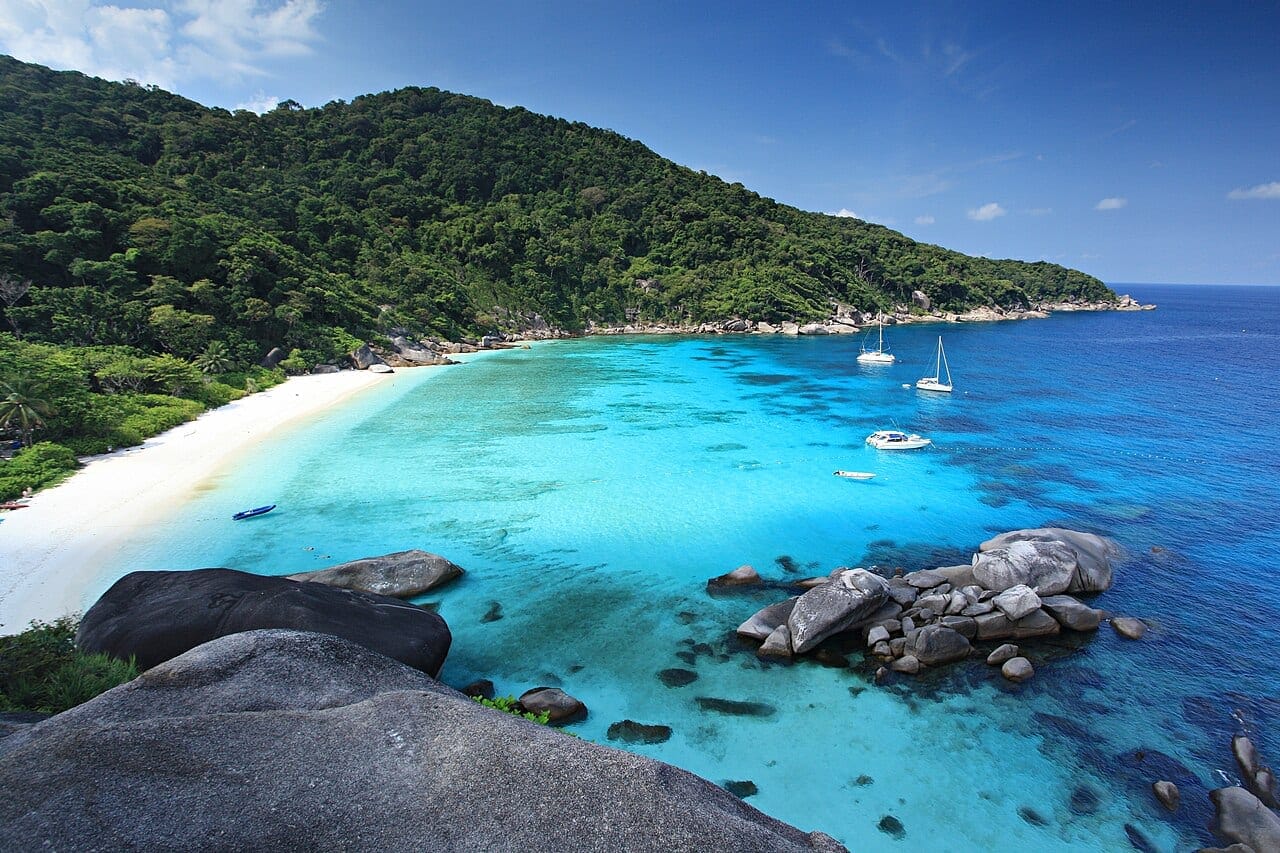
The Similan Islands are a national park. The season opened on 15 October 2026, when the park reported 1,409 visitors on the first day, almost all of them on day trips. Our Similan Islands speedboat day trip is from $105 per person, and the price includes the park fee, but nothing in it includes permission to fly a drone. A shared boat with up to 35 guests is also no place to launch one.
Is it worth bringing a drone to Thailand?
For a one- or two-week holiday, the honest answer is often no. You need a Thai SIM, an NBTC registration, a CAAT registration, a pilot certificate, insurance and approval three days before each flight, and you cannot use it in a park or a city centre without further permission. Many visitors settle for photos from the boat and the beach.
If you do bring one, treat the paperwork as a project and start before you travel. Read our Similan Islands season guide for the dates the park is open, and our national park fees guide for what you pay there. For packing on the Similan day, bring a towel, swimwear, reef-safe sunscreen and a dry bag.
Practical checklist
- Register the drone with the NBTC and with CAAT, and get a pilot certificate before you fly.
- Buy third-party insurance of at least 1 million baht.
- Send the area, date, time and purpose of each flight to CAAT at least three days ahead.
- Keep the drone away from airports, crowds, temples, government buildings and the border districts.
- Do not fly in a national park without written permission from the park.
Questions and answers
Can tourists fly drones in Thailand?
Yes, in most areas, says TAT, if the drone and the operator are registered with the NBTC and CAAT, the drone is insured and each flight is approved through CAAT's UAS Portal at least three days ahead.
How much insurance does a drone need in Thailand?
TAT says third-party liability cover of at least 1 million baht, which can be arranged locally or abroad. It is required alongside registration and flight approval.
Can you fly a drone at the Similan Islands?
Treat it as no unless the park gives permission. The Similans are a national park, the Department of National Parks gave "no drone without permission" as an example of park rules in June 2026, and TAT tells visitors to check park requirements.
Where are drones banned in Thailand in 2026?
TAT says controlled districts in seven provinces under CAAT Notice No. 16 stay restricted, along with urban areas, crowds, government buildings, hospitals and military zones, unless authorised.
What is the penalty for breaking the drone rules?
For breaking CAAT Notice No. 16, TAT reports up to one year in prison, a fine of up to 40,000 baht, or both. The UK Foreign Office says a drone not registered with the NBTC can draw 100,000 baht, five years in prison, or both.