

Short answer
The Big Buddha on Koh Samui, at Wat Phra Yai, is a 12-metre golden statue built in 1972 on a small island joined to Samui by a causeway. Dress as for any Thai temple: the Tourism Authority of Thailand says men should wear a sleeved shirt and trousers or shorts that cover the knees, and women a top with sleeves and a skirt below the knee. We could not find official opening hours; one travel guide says the temple is open daily, including evening, and that entry is free. Check on the day.
What the Big Buddha is and where it stands
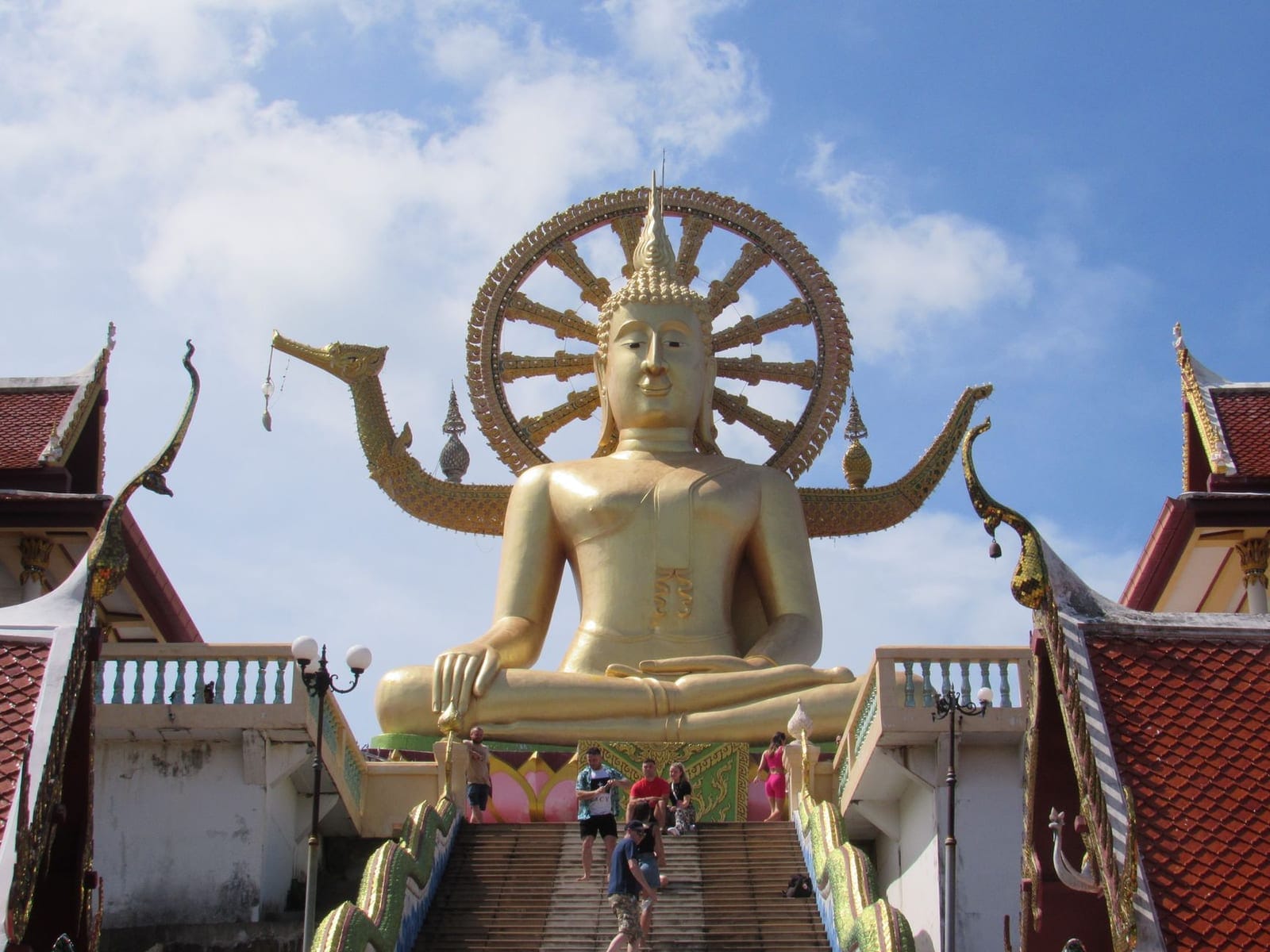
Wat Phra Yai, known in English as the Big Buddha Temple, stands on Ko Phan, also spelled Koh Fan, a small island off the north-east of Koh Samui. Wikipedia says it is joined to Samui by a short causeway 3 km north of the airport, and that the gold-painted Buddha is 12 metres high. Built in 1972, it is one of Samui's main tourist attractions. The statue sits in the Mara posture, with the right hand over the right knee.
Wikipedia notes that nāga statues line the staircase and that a bazaar inside the temple grounds sells tourist items and amulets. The wheel behind the statue's head and the dragon decoration were added later, according to The Koh Samui Guide. Wikivoyage's Koh Samui page gives a height of 15 metres, but Wikipedia and two other guides say 12, so we use 12.
Opening hours: what we could confirm
We could not find official opening hours, and the pages we opened do not give times. Ume Travel's guide says the temple is open daily, including evening, and The Koh Samui Guide gives no hours. Treat any set of times you see elsewhere as unconfirmed. This is a working temple, and hours can change for religious days or events.
The practical answer is to go in daylight and check at the gate. The Koh Samui Guide, in a 2020 post, says the statue is beautiful at sunset, but that you should otherwise go early because the stairs get very hot at midday, and suggests avoiding Thai religious holidays out of respect. If a fixed time matters to you, for example before a boat or a flight, ask your hotel to check by phone on the day.
Dress code: sleeves, knees and shoes
Dress as for any Thai temple. The Tourism Authority of Thailand's 2018 etiquette guide says swimming shorts and tank tops should not be worn to a temple. For men it means a shirt with sleeves and long pants or shorts that cover the knees. For women it means a skirt longer than knee length and a top with sleeves, not spaghetti straps. It says shoes are the norm, or sandals with a strap at the back.
Ume Travel's guide gives a similar rule at Wat Phra Yai: dress respectfully, with no bare shoulders, short pants or short skirts. The Koh Samui Guide says there is an enormous sign about the dress code, and that monks routinely turn away visitors who are dressed improperly. Carry a light shirt or sarong in your bag if you are coming from the beach, and keep your swimwear for afterwards.
The steps: heat, shoes and rain
Expect to take your shoes off. TAT says anyone entering a temple is expected to do so barefoot, with racks or spaces for shoes outside, and The Koh Samui Guide says signs show where to take them off. The same guide warns that the tiled stairs get very hot in the midday sun, suggests ankle socks with a grip, and says they would be slippery in the rain. It also describes the staircase as a steep flight, which may be a stretch for young children.
A few more TAT points apply here: remove hats and sunglasses, switch your phone to silent, keep your voice down and do not eat or chew gum as you walk. Do not touch the Buddha image or point your feet at it, and do not raise yourself higher than it. Women should not touch a monk or his robes. Photographs are generally fine, but do not get in the way of people praying.
How long to allow and what is nearby
Allow half an hour to an hour. The Koh Samui Guide says it is not a full day's outing and that a visit can last half an hour or much longer, and adds that one visitor stayed nearly an hour. Wikipedia says there are many restaurants and shops around the temple in the area known as Big Buddha Beach, or Bang Rak, and Wikivoyage calls it a beach with good swimming and lovely views.
Wat Plai Laem, which Wikipedia calls nearby, is a modern temple with a Chinese-style main statue of Avalokiteshvara, a white Budai statue and a temple lake. Wikipedia places the Big Buddha 3 km east of Bophut, so a walk through our guide to Fisherman's Village in Bophut fits the same trip. For the longer list, see things to do in Koh Samui.
Getting there from Chaweng, the airport and the pier
Wikipedia says the temple is on Thai highway 4171, a side route off the island's ring road, 7.5 km north-west of Chaweng. The Koh Samui Guide says the causeway has been paved, that you can walk across, and that there is a small parking area in the temple grounds. The airport is close; see our airport to Chaweng guide for taxi and minibus fares.
Bangrak Pier, where Wikipedia says ferries leave for Koh Phangan, is nearby. Wikivoyage says songthaews run fixed routes and fares until 18:00, from 20 to 80 baht depending on distance, and that taxi prices must be agreed in advance. If you have a boat to catch, add time for the stairs, the shoes and the queue, and see our Phangan ferry guide.
Fitting the temple around a boat day
The temple works well with a short boat day. Our Pig Island tour is from $50 per person for the speedboat option, which takes about 5 to 6 hours in total including hotel transfers, and $65 for the island day, which starts at about 9:00 with the Heaven Gate viewpoint, lunch and elephants. We confirm the pickup time on WhatsApp the day before, so ask for your date's time before you plan the temple.
On our tour, free pickup covers Mae Nam, Bophut, Choeng Mon, Bang Rak, Chaweng, Chaweng Noi and Lamai, so the Big Buddha area is on the pickup list. The tour is not wheelchair accessible and is not recommended for travellers with back problems or prone to seasickness. If the sea is unsafe, the operator moves the trip to another date or refunds it. Dress for the temple first, then pack swimwear for the boat.
Practical checklist
- Wear a top with sleeves and shorts, trousers or a skirt that cover the knees; keep a sarong or light shirt in your bag.
- Go early or near sunset: the tiled stairs get very hot at midday, and slippery in rain.
- Check opening hours at the gate or by phone through your hotel; we could not confirm official times.
- Remove shoes where signs say, take off hats and sunglasses and put your phone on silent.
- Allow half an hour to an hour, and more if you add Wat Plai Laem or the Bang Rak restaurants.
Questions and answers
What are the Big Buddha opening hours?
We could not find official hours. Ume Travel's guide says the temple is open daily, including evening, and gives no times. Check at the gate or ask your hotel to phone on the day.
Is there an entrance fee for the Big Buddha?
Ume Travel's guide says admission is free and that small donations for maintenance are appreciated. We could not confirm this from an official source, so check on the day.
What should I wear to the Big Buddha?
TAT's etiquette guide says men should wear a sleeved shirt and trousers or shorts that cover the knees, and women a top with sleeves and a skirt longer than knee length. Shoes come off at the steps.
How tall is the Big Buddha on Koh Samui?
Wikipedia says the gold-painted statue is 12 metres high, and The Koh Samui Guide and Ume Travel say the same. Wikivoyage gives 15 metres. The statue was built in 1972.
How long does a visit take?
The Koh Samui Guide says half an hour to an hour is typical, and that the visit is not a full day's outing. Add time for the steep stairs and for any nearby temple.
Is the Big Buddha suitable for young children?
The Koh Samui Guide describes a steep flight of stairs that may be a stretch with younger children, and says you need to stop them racing up and down at a religious site.