

Short answer
James Bond Island is not closed in the rainy season: the national park's 2026 closure list names Koh Lawa Yai, Ao Khian and Koh Boi Yai from 1 August to 30 September, and Khao Phing Kan is not on it. What changes is the weather. Thai Meteorological Department normals for Phuket give about 22 rainy days in both September and October, against about 3 in February, and the sea can turn rough. Our tour is from $85 per person; if the sea is unsafe, the operator moves the trip to another date or refunds it.
The island stays open in the rainy season
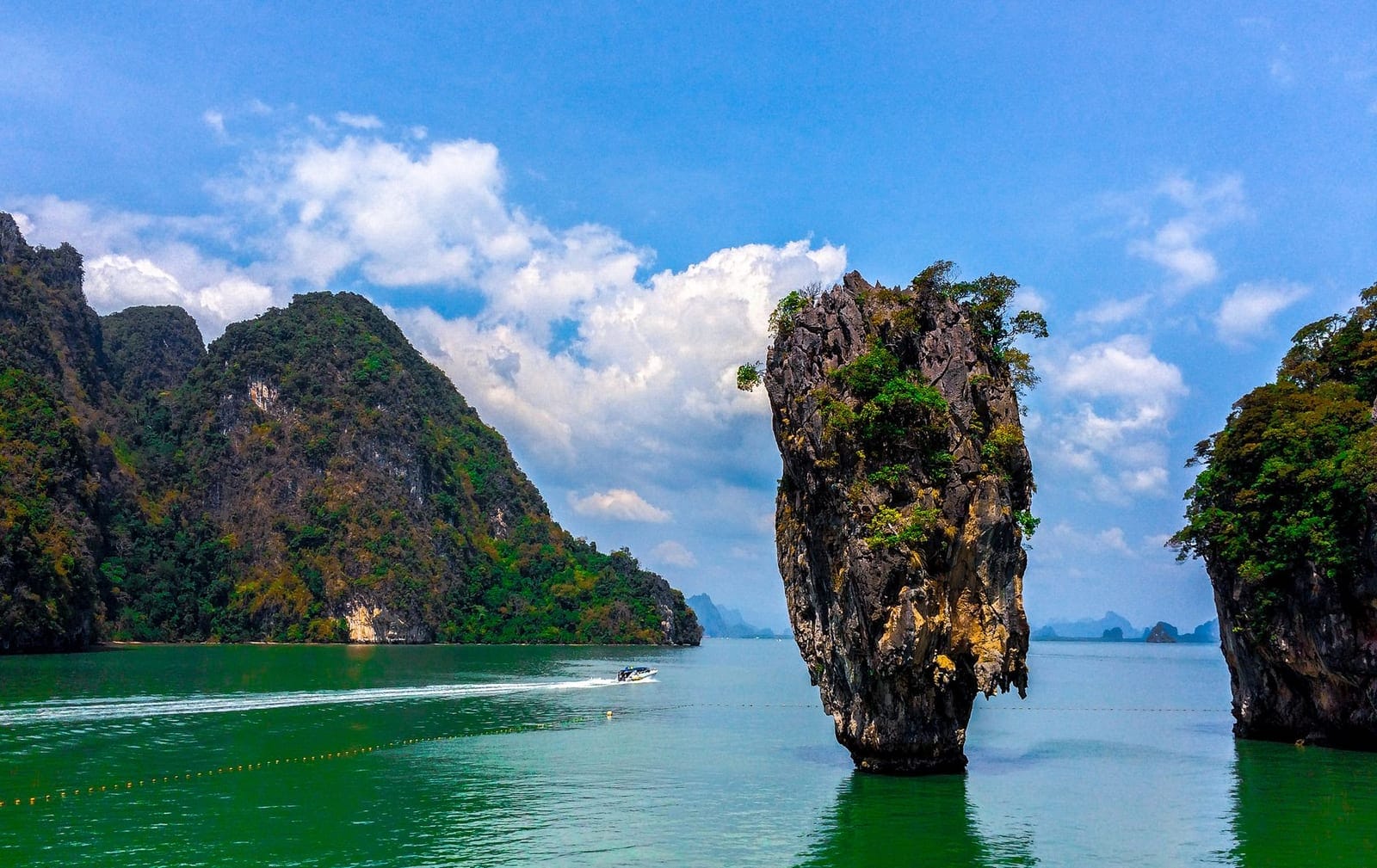
James Bond Island, officially Khao Phing Kan, lies inside Ao Phang Nga National Park, and the park does not close it for the monsoon. The Department of National Parks' closure list for 2026, published in the Royal Gazette on 9 January 2026, names Koh Lawa Yai, Ao Khian and Koh Boi Yai, together with the park's lodging and camping area on Koh Lawa Yai, from 1 August to 30 September. Khao Phing Kan, Panak and Hong islands are not on it.
One independent guide, Thai National Parks, still says Ao Phang Nga is closed from 16 May to 14 October. That matches the Similan and Surin parks, which really do close then, but it does not match the park's own 2026 list. If a seller tells you the bay is shut in the monsoon, ask for the announcement. The real risk is weather, not a closure.
How wet is it? The Phuket rainfall numbers
The Thai Meteorological Department's 1981 to 2010 normals for the Phuket station show how sharply the weather changes. September averages 22.1 rainy days and 361 mm of rain, October 22.5 days and 320 mm, and August 19.0 days and 287 mm. May has 18.8 days and 260 mm, while February has just 3.1 days and 24 mm. Wikipedia, citing older data for Khao Phing Kan itself, gives 189 rainy days a year, most of them between May and October.
Read those figures carefully. A rainy day in the tables means rain was recorded, not that it rained all day, and the normals cannot tell you whether your morning on the water will be wet. What they do say is that in September and October rain on most days is normal, while December to February is the dry stretch. Our September guide and August guide cover those months in more detail.
The sea decides the day more than the rain does
The risk on a monsoon day is the sea. In its forecast issued on 25 August 2026, the Thai Meteorological Department expected waves of 2 to 3 metres in the upper Andaman Sea, higher than 3 metres in thunderstorms, and advised small boats there to stay ashore. Asia News Network reported the forecast. Those figures describe the open sea, not the bay.
Phang Nga Bay lies between Phuket island and the mainland, according to Wikipedia, and every stop on our day is inside it. We found no published wave figures for inside the bay, so we do not claim it is calm. What we can say is how the decision is made: on our tour, if the sea is unsafe, the operator moves the trip to another date or refunds it. For comparison, Phi Phi lies about 46 kilometres from Phuket across open water, as our Phi Phi or James Bond Island guide explains.
Tides change the canoe route in any season
Wikipedia says the tides around Khao Phing Kan have an amplitude of 2 to 3 metres, which floods the beaches and caves and makes some caves reachable only at low tide. On our tour, low tide can change the order of the stops or shorten the canoe route into the lagoon at Hong Island. A paddler steers the canoe, so you need no experience, and the guide plans the day around the tide and the crowds.
This has little to do with the season: a low tide in January affects the canoe the same way as one in September. What the rainy season adds is the chance that the morning forecast and the tide table disagree with your hopes. Keep one spare day in your plan, and ask us for the tide on your date when you book. The canoe guide explains how the sea caves and hongs work.
What you see in wet-season light
Expect softer colours and some litter. The Department of National Parks reported on 19 September 2026 that Ao Phang Nga National Park and volunteers collected monsoon rubbish around the park's station on Koh Lawa Yai, and the park chief said the monsoon's currents and waves bring sea rubbish onto islands and beaches every year. The park planned regular beach clean-ups through the monsoon.
The water around Khao Phing Kan is shallow and pale green, and Wikipedia says the seabed is silt carried in by rivers from the north, so this is not a clear-water snorkelling day in any month. Since 1998 boats have not been allowed to approach Ko Tapu closely, so the famous needle is photographed from a distance whatever the weather. A dry bag for your phone matters more in the monsoon, especially in the canoe.
Who should go in the rainy season, and who should wait
The wet months suit flexible visitors who can move a day, accept grey skies and do not mind a shower. Wikipedia notes that tourists visit Koh Panyee in significant numbers mainly in the dry season, which suggests the village is quieter in the wet one. Lunch at Koh Panyee is part of our day, and there is more about the village in our guide to Koh Panyee.
Wait if this is your only free day, if you are prone to seasickness or if you are travelling with an infant, a pregnant partner or a guest over 70, who cannot join the speedboat in any season. The dry months, roughly December to February in the Phuket normals, give the best odds of a calm sea and a clear sky, and our rainy season guide explains what the wet months are like across Thailand.
How to book the Phang Nga Bay day in the monsoon
Our James Bond Island and Phang Nga Bay day is from $85 per person. Hotel pickup in Phuket is between about 7:00 and 8:00 am, the speedboat leaves Laem Nga pier on Koh Siray at about 9:00, and you are back at about 5:00 pm. The price includes the national park fee, lunch at Koh Panyee, sea canoeing at Hong Island, snorkelling gear, a life jacket and accident insurance.
Send us your date, your hotel and the number of guests on WhatsApp, and we confirm availability, the pickup time and the total before you pay. In the wet months, check the Thai Meteorological Department forecast the evening before and ask us if the plan has changed. Our price guide lists what is and is not included, and the tour schedule gives the times.
Practical checklist
- Check the Thai Meteorological Department's sea forecast for the Andaman Sea the evening before.
- Keep one spare day in your plan if you visit between May and October.
- Ask us for the tide and the likely canoe route on your date.
- Bring a dry bag for your phone, a poncho and a towel.
- Do not rely on a seller who says Ao Phang Nga is closed in the monsoon; ask for the announcement.
- Confirm that nobody in your group is pregnant, over 70 or an infant under 1 year.
Questions and answers
Is James Bond Island open during the rainy season?
Yes. The national park's 2026 closure list names Koh Lawa Yai, Ao Khian and Koh Boi Yai from 1 August to 30 September; Khao Phing Kan is not on it. Trips can still be moved when the sea is unsafe.
How many rainy days does Phuket get in September?
The Thai Meteorological Department's 1981 to 2010 normals for the Phuket station give 22.1 rainy days and 361 mm of rain in September, and 22.5 days and 320 mm in October.
What happens to the tour if the sea is rough?
On our tour, if the sea is unsafe, the operator moves the trip to another date or refunds it. We confirm the date, pickup time and total on WhatsApp before you pay.
Can you still paddle the sea canoe in the monsoon?
Tide affects the canoe more than the season: low tide can change the order of stops or shorten the route into the lagoon at Hong Island. A paddler steers, so no experience is needed.
Is the national park fee included on our tour?
Yes. The Phang Nga Bay national park fee is included in our James Bond Island tour, so there is no park fee to pay on the day.
Is the Phang Nga Bay trip better than Phi Phi in the rainy season?
We have no wave figures for inside the bay. All our stops are in the bay, while Phi Phi needs an open-water crossing of about an hour. Our comparison guide sets out the differences.