

Short answer
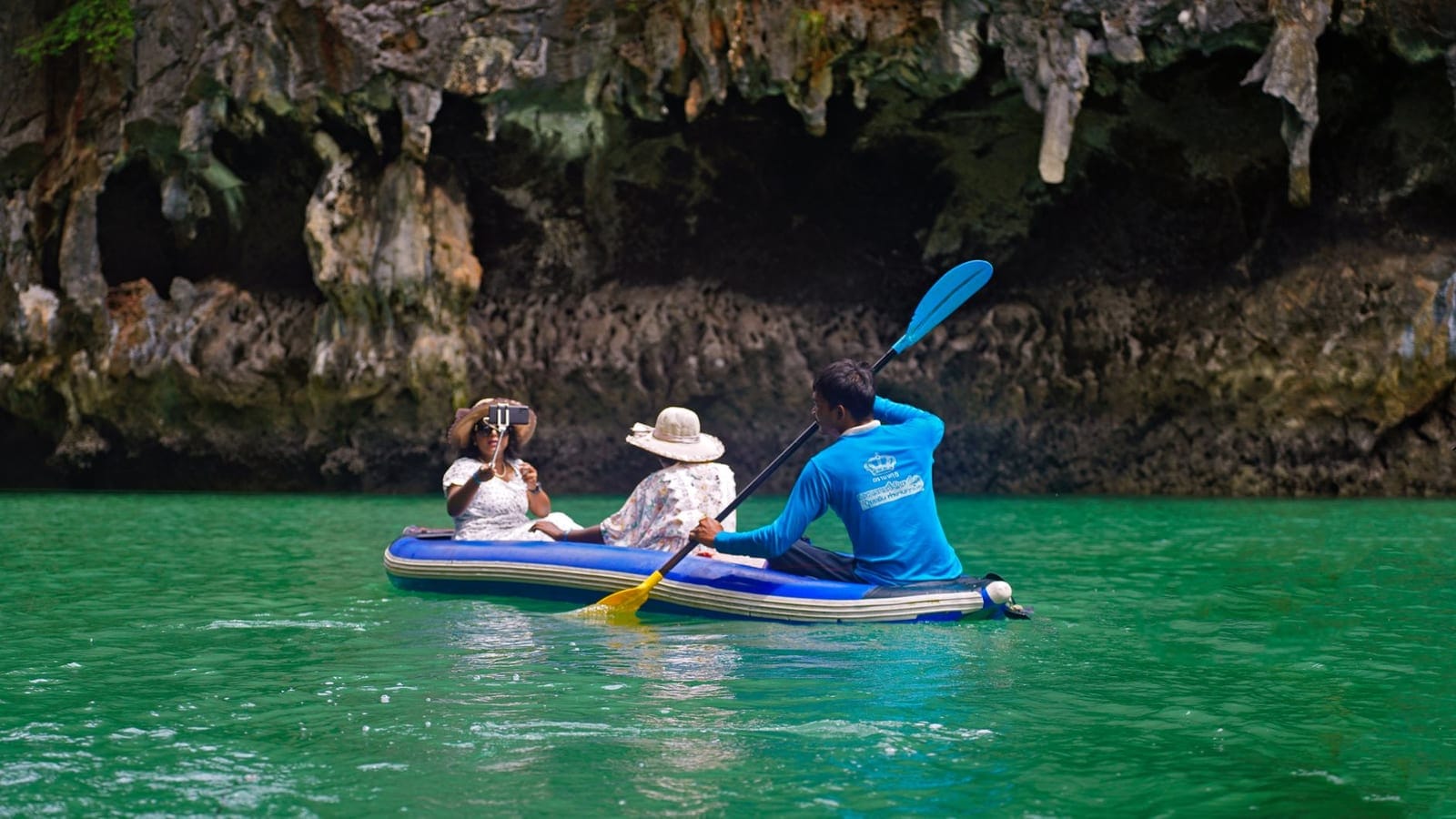
A Phang Nga Bay canoe tour takes you by sea canoe through low caves into a hong, a lagoon enclosed by limestone cliffs that can be entered only through tidal caves. On our tour, from $85 per person, a professional paddler does the paddling at Hong Island, so you need no experience, and a life jacket is included. Children from 1 year old can go. The tide decides the route: low tide can change the order of the stops or shorten the canoe route into the lagoon. Bring swimwear, a towel and a dry bag.
What is a hong?
A hong is the reason people paddle into the limestone islands of Phang Nga Bay. Liz Price's 2011 paper on the bay explains that hong is a Thai word meaning room. Hongs are large sinkholes open to the sky, surrounded by steep limestone cliffs and holding tidal lagoons. Price says they can be reached only through caves, unless you climb the sheer walls, and that some are more than 300 metres across.
The setting is Ao Phang Nga National Park, which Wikipedia describes as a mostly maritime park of limestone tower islands with steep, sheer sides and many caves. It covers about 400 square kilometres, was established in 1981 and protects the largest expanse of native mangrove forest remaining in Thailand. Inside a hong the effect is of a hidden garden: Price describes mangroves at water level and cycads clinging to the cliffs.
How do you get in? The tide decides
Price explains that access through the caves depends on the tide. At high tide the entrance, and possibly the whole cave, can be underwater, and as the tide falls a way through appears. Many caves have low entrances close to the water level, so access may be limited to short periods, perhaps an hour or so, around low tide. Wikipedia gives the tides at nearby Khao Phing Kan an amplitude of 2 to 3 metres and notes that some caves there can be used only at low tide.
That is why no operator can promise the order of a canoe day. On our tour, low tide can change the order of the stops or shorten the canoe route into the lagoon, and the guide times the James Bond Island stop around the tide. Treat the timetable as a plan, not a promise, and read the tour schedule for how the day is usually arranged.
What happens in the canoe, and who paddles
On our tour you do not paddle. At Hong Island a professional paddler takes the canoe through the caves and the lagoon while you sit, so you need no canoeing experience. The canoe is part of the price, as are the life jacket and the national park fee, and the day is a shared speedboat tour for up to 35 guests. The price is from $85 per person, and you will find the details in our price guide.
Price's account of Ko Hong in 2011 shows what the passage can be like. After a low entrance the cave roof rises, revealing stalagmites and stalactites on the dry banks. Then the roof suddenly lowers and the walls close in, leaving a gap not much larger than a kayak, where canoeists have to lie flat. The tunnel leads out into a hong whose walls rise more than 100 metres. Conditions change with the tide, so read this as a description, not a promise.
Can children and non-swimmers go?
Children can go from 1 year old on our tour, because the canoe is paddled for them and the boat stops at calm beaches. Infants under 1 year, pregnant women and guests over 70 cannot join the speedboat. A life jacket is included in the price. A low entrance and a tunnel where canoeists may have to lie flat are worth knowing about if a child, or an adult, dislikes small dark spaces: the paddler does the work, but you still pass through the cave.
Swimming ability is not a condition on our tour page. The canoe is paddled for you and a life jacket and snorkelling gear are included in the price. The swim and snorkel at Khai Island is the one stop where it matters, so tell us on WhatsApp if anyone in your group cannot swim, and we will check with the operator before you pay.
What to wear and bring
Wear swimwear under your clothes and bring a towel, because towels are not included. Add sunscreen, a hat and a dry bag for your phone in the canoe. Koh Panyee, where lunch is served, is a village of about 1,600 people descended from two seafaring Muslim families, with a mosque as its meeting place, according to Wikipedia. A light shirt or sarong over swimwear is a polite thing to pack for that stop.
Choose your sunscreen with care. NationofChange reported in August 2021 that Thailand had banned sunscreens containing oxybenzone, octinoxate, 4-methylbenzylidene camphor and butylparaben in its marine national parks, with fines of up to 100,000 baht. The independent guide Thai National Parks describes Ao Phang Nga as a marine national park declared in 1981. A sunscreen without those four ingredients keeps you within the rule.
What you may see inside, and what not to do
Inside the hongs Price lists mangroves, cycads on the walls and fig trees that feed birds and monkeys. Long-tailed macaques feed on fruit, insects and crabs at water level, vegetarian dusky langurs live on the plants, and some caves hold bats and swiftlets. These are wild animals, so nobody can promise a sighting. Price adds that sea-level caves differ: some have low entrances and deep water, others have high ceilings with stalagmites and stalactites.
Price also records one negative effect of visitors: boats feeding sea eagles with scraps of chicken, which upsets the birds' natural diet. The simple rule is not to feed any wildlife from the boat or the canoe and to take your rubbish back with you. Wikipedia adds that Fodor's put the park on its No List for 2018 because of mass tourism, a reminder that the bay is busy and fragile.
Crowds, the other Hong Island, and who should skip it
Expect company. Price wrote in 2011 that flotillas of canoes go to the hongs each day, and Nation Thailand reported in March 2023 that around 10,000 people and up to 300 boats cruise the bay daily. On our tour a professional paddler takes you through the caves. It does not suit everyone: skip this day if low, dark caves worry you or if you want a canoe you can steer yourself.
One name causes confusion: Phang Nga's Koh Hong is not Hong Island in Krabi, a different group of islands between Krabi and Ko Yao that Wikivoyage describes as popular for kayaking because of its lagoon. Our canoe is in Phang Nga Bay, reached from Phuket. The Krabi islands are covered in our guide to the Hong Island tour from Ao Nang.
Practical checklist
- Wear swimwear under your clothes and bring a towel; towels are not included.
- Pack a dry bag for your phone, sunscreen and a hat.
- Choose a sunscreen without oxybenzone, octinoxate, 4-MBC or butylparaben.
- Tell us on WhatsApp if anyone cannot swim or dislikes small dark spaces.
- Do not feed wildlife from the boat or the canoe.
- Treat the order of the stops as a plan: low tide can change it.
Questions and answers
Do I need canoeing experience?
No. On our tour a professional paddler takes the canoe through the caves and the lagoon at Hong Island, and you sit. Canoe, life jacket and national park fee are all included in the price.
Why does the tide matter for a sea canoe tour?
Hongs are entered through low sea caves. Price explains that at high tide the entrance may be underwater and that access may last only an hour or so around low tide.
Can children join the canoe?
Yes, from 1 year old on our tour, because the canoe is paddled for them. Infants under 1 year, pregnant women and guests over 70 cannot join the speedboat.
Should I take my phone in the canoe?
Bring it in a dry bag. Our tour page recommends a dry bag for your phone in the canoe, along with swimwear, a towel and sunscreen. Towels are not included.
Is Hong Island in Phang Nga the same as Hong Island in Krabi?
No. Phang Nga's Koh Hong lies in Phang Nga Bay; the Hong islands in Krabi are a separate group between Krabi and Ko Yao.