

Short answer
Thailand's rainy season runs from about mid-May to mid-October, according to the Thai Meteorological Department, with August and September the wettest months for most of the country. The coasts follow different calendars. Phuket and the Andaman side peak in September (399 mm at Phuket Airport, on 1991 to 2020 normals), while Koh Samui and the Gulf side are wettest in November (about 445 mm). A rain day in the statistics means at least 1 millimetre, not a washed-out day, so most trips still work with a flexible plan.
Thailand's rainy season runs from mid-May to mid-October
The Thai Meteorological Department (TMD) divides the year into three seasons: rainy or south-west monsoon from mid-May to mid-October, winter or north-east monsoon from mid-October to mid-February, and summer from mid-February to mid-May. The wettest period for most of the country is August and September. The Department of Meteorology's page on the Thai seasons adds that the start of the rains can arrive one or two weeks early or late, so the dates are a guide, not a switch.
Inside the rainy season, TMD describes a pause. A dry spell of one to two weeks or more is common in upper Thailand from June to early July, when the rain belt moves north towards southern China. TMD also says thunderstorms are most frequent in upper Thailand from April to October and in the south from March to November. Afternoon and evening storms come from heating, which is why mornings are the safer part of a rainy-season day.
Andaman coast: Phuket, Krabi and Phang Nga
On the Andaman side the rains last from May to October and peak in September, as TMD says. The 1991 to 2020 normals for Phuket Airport show the gap clearly: 399 mm in September on 19 days with at least 1 mm of rain, 378 mm in August and 371 mm in October, against only 32 mm on 3 days in February. The yearly total at Phuket Airport is about 2,664 mm, so a rainy-season month brings more rain than a dry-season month by a factor of ten.
The sea matters more than the rain. The UK Foreign Office warns of strong riptides during the monsoon, and says jellyfish can come close to shore from May to October. On 15 October 2026 the Department of National Parks declared the Andaman marine park season open, naming the Similan Islands, the Surin Islands, Phi Phi, Lanta and Ao Phang Nga as ready for visitors. Our Phuket in September guide and Krabi rainy-season guide cover the detail month by month.
Gulf coast: Koh Samui, Koh Tao and Koh Phangan
The Gulf side of the south has the opposite calendar. TMD says the south-east coast has its peak in November, with rain lasting into January. The Koh Samui normals fit this: 445 mm in November on 16.5 days, 295 mm in October and 263 mm in December, but only 102 to 134 mm a month from June to September, and 64 mm in February. A traveller who avoids Phuket in September because of rain may find Samui much drier in the same weeks.
The Gulf has a closure of its own. Ang Thong National Marine Park is closed to visitors from 1 November to 15 December 2026, and our Ang Thong tour runs before and after those dates. TMD's seasonal outlook of 15 October 2026 also warned of heavy rain along the Gulf coast from Chumphon southwards in November and December, with waves of two to four metres possible, as The Thaiger reported. Plan sea days there with spare time.
Bangkok, Pattaya and the north
Bangkok has a single wet peak. Its 1991 to 2020 normals show 336 mm in September on 18 days, 289 mm in October, then a drop to 45 mm in November and 12 mm in December. Flooding is the practical issue: the Cabinet gave special holidays on 28 and 29 September 2026 in Bangkok, Nonthaburi, Pathum Thani and Samut Prakan because of flooding. TAT said on 29 September that the Grand Palace, Wat Pho and Wat Arun stayed accessible and that both Bangkok airports were open, though the UK Foreign Office's advice, current at 28 October, still lists severe flooding.
Chiang Mai is wettest in August, with 223 mm on 17 days, and then dries quickly: 14 mm in December and 11 mm in January. The hot season comes before the rains, with a mean April high of 36.7 degrees Celsius, and TMD says maximum temperatures in upper Thailand reach near 40 from March to May. The Foreign Office adds that currents in rivers and near waterfalls can be extremely strong in the rainy season, so treat swimming spots with care.
What is happening in October 2026
This year the season has run long. On 28 October 2026 TMD said the cold season could not yet be declared and that provinces along the upper southern coast, including Surat Thani, Phang Nga, Phuket and Krabi, were still facing rain, with heavy falls possible in places. It expected rain in parts of the south to decrease after 29 October, with scattered showers continuing. TMD's seasonal outlook says the cool season should run to around mid-February 2027.
For a traveller arriving in November, that means two things. The Andaman side is entering its better months, as the December figure of 86 mm at Phuket Airport shows, while the Gulf side is entering its wettest. If your plans cross the coasts, check the day's TMD warning before you commit to a boat, and keep a free day in the programme in case the sea closes a trip.
Is the rainy season a bad time to travel?
Not necessarily, but it rewards flexibility. Temple visits work in rain, and our Bangkok temples tour runs in the rain, with a light poncho advised in the rainy season. Our elephant sanctuary morning in Paklok runs in all weather, with umbrellas, rain coats and boots provided. Boat days are the part that can move. On the normals, Phuket Airport's rainfall is lowest from December to March, at 32 to 117 mm a month, so that is the better window for the Andaman side.
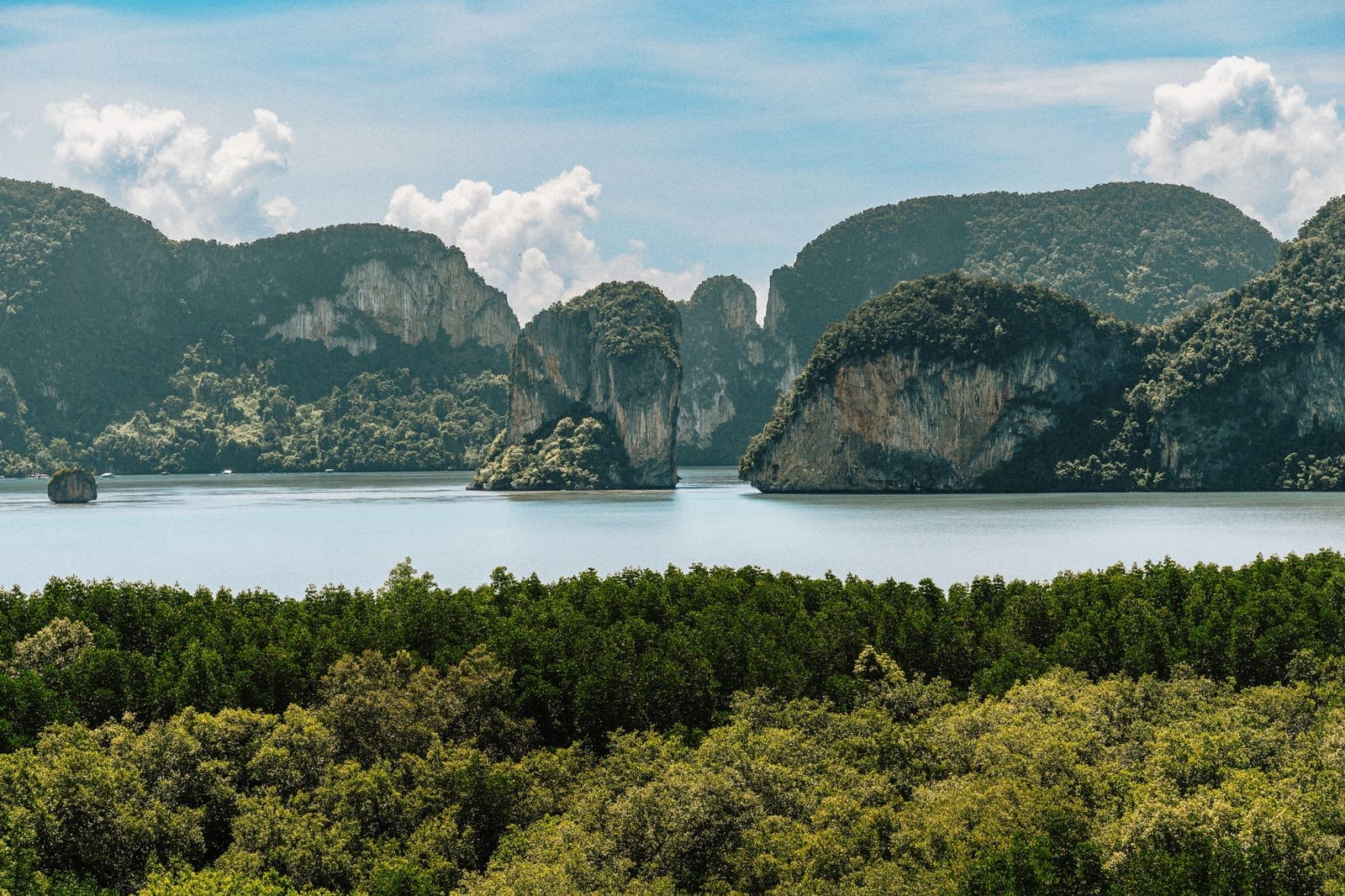
Our James Bond Island and Phang Nga Bay canoe tour, from $85 per person, includes the national park fee, and a low tide can change the order of the stops. If the sea is unsafe, the operator moves the trip to another date or refunds it. We explain what happens to this route in the rains in our guide to James Bond Island in the rainy season.
Practical checklist
- Match the coast to the month: Andaman side from December to March, Gulf side from January to September.
- Plan boat days for the morning, and keep one spare day in the programme in case the sea closes a trip.
- Check the Thai Meteorological Department's daily warning and the sea forecast the night before a boat day.
- Pack a light poncho or rain jacket, a dry bag for your phone and shoes with grip for wet paths.
- Take travel insurance that covers cancelled trips and read the Foreign Office advice for flooded areas.
Questions and answers
When does the rainy season start in Thailand?
The Thai Meteorological Department puts it at mid-May for most of the country, ending in mid-October. The start can come one or two weeks early or late. In the Gulf side of the south the rain peaks later, in November.
Which month is the wettest in Thailand?
It depends on the coast. September is the wettest month at Phuket Airport (399 mm) and in Bangkok (336 mm), August in Chiang Mai (223 mm) and November on Koh Samui (445 mm), on 1991 to 2020 normals.
Does it rain all day in the rainy season?
Usually not. A rain day in the statistics means at least 1 mm. TMD says afternoon and evening storms come from heating, so mornings are often the drier part of the day.
Do boat tours run in the rainy season?
On many days, yes, when the sea allows. On our tours, if the sea is unsafe the operator moves the trip to another date or refunds it. The Similan Islands are closed until 15 October.
Is the Gulf of Thailand better than Phuket in September?
On the normals, yes: Koh Samui gets about 118 mm in September against 399 mm at Phuket Airport. The Gulf side turns wet from October, peaking at about 445 mm in November.