

Short answer
Three days is enough for the essentials of Chiang Mai, though the Thaiger's 2026 guide says the city alone justifies four to five. Spend day one on the old city temples and an evening market, day two on a 10 to 12 hour mountain and elephant day (ours is from $40 per person), and day three on Doi Suthep in the morning and a cooking class (from $30) in the evening. Pai, a trip of about three hours each way, does not fit into three days.
Three days: what fits and what does not
The Thaiger's 2026 Thailand guide says Chiang Mai alone justifies four to five days, and that adding Pai or the full Mae Hong Son Loop makes it a week to ten days. With only three days, choose a few things well. This plan has one temple day, one mountain day and one day that mixes a hilltop temple with a cooking class. It leaves out Pai and the Chiang Rai day.
Each day below is short on detail on purpose, because every stop has its own guide. This page gives the order and the reasons. Check the day of the week before you fix it: the Sunday walking street only runs on Sunday evenings, and the Saturday market on Wua Lai Road runs on Saturdays, so move the days around those if your dates allow.
Day one: old city temples and an evening market
Walk the three temples inside the old city in order: Wat Chiang Man, Wat Chedi Luang and Wat Phra Singh. By the coordinates Wikivoyage lists they are roughly 0.8 km and 0.5 km apart in a straight line. Wikivoyage lists 50 baht for foreigners at Chedi Luang, and its Thailand guide advises covering shoulders and knees. Our old city temples guide has the history.
In the evening choose a market. On a Sunday, Wikivoyage lists the walking street on Ratchadamnoen Road from 17:00 to 23:00, running past Wat Chedi Luang and ending at Wat Phra Singh, with smoking and drinking banned. On other nights the Night Bazaar on Chang Khlan Road is the main market; the Nation says it is fully alive from 7 pm. See the Sunday market and Night Bazaar guides.
What to look for: Wikipedia says Wat Chiang Man's Elephant Chedi has the front halves of 15 life-sized elephants, and Wikivoyage points to the painted Wihan Lai Kham at the back of Wat Phra Singh, with its Lanna-style murals. We could not confirm opening hours for the three temples, so check each gate, and keep the afternoon free in case a temple closes early or you want a longer lunch in the old city.
Day two: elephants and Doi Inthanon
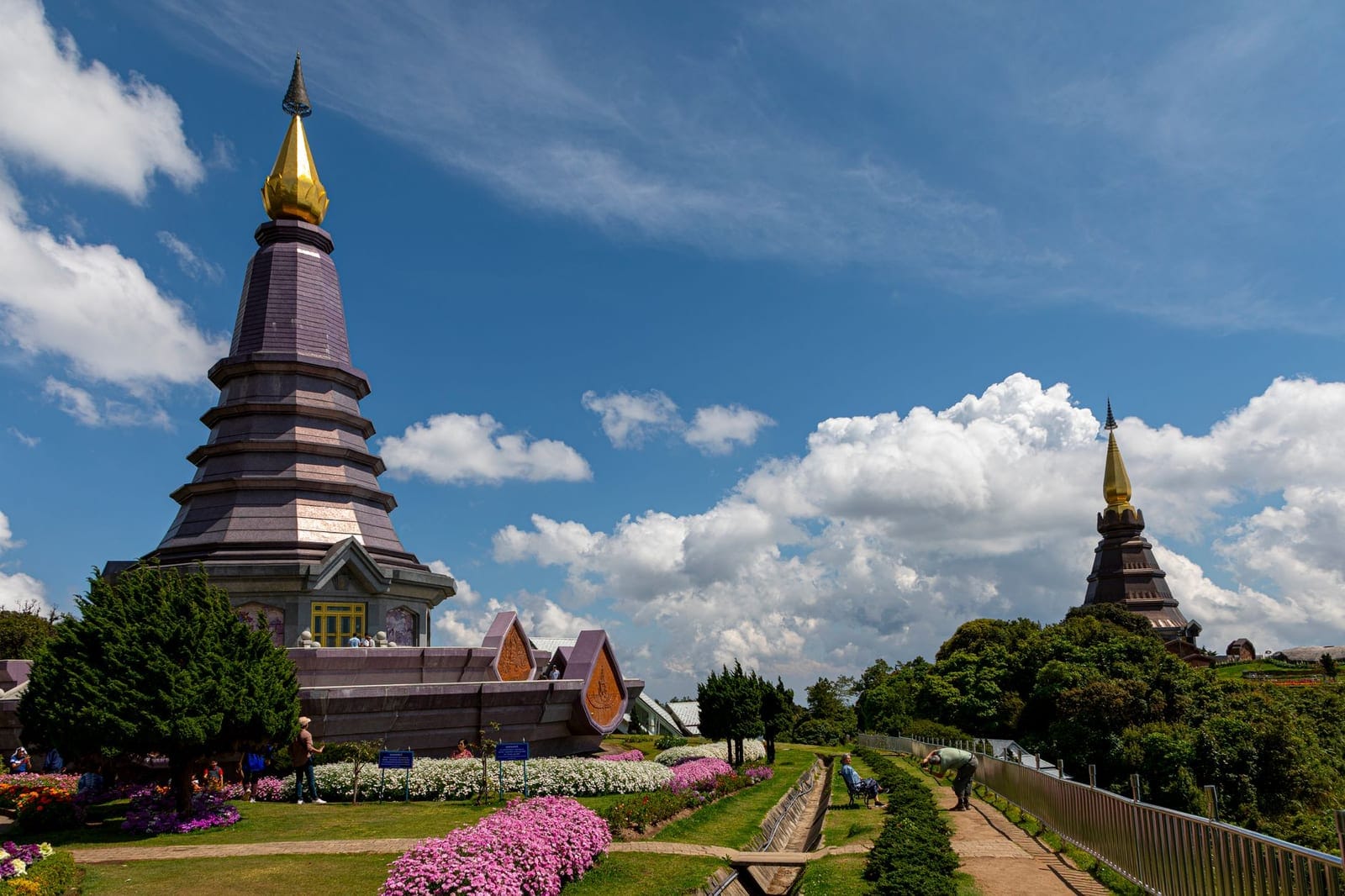
Our elephant sanctuary and Doi Inthanon tour is from $40 per person, lasts 10 to 12 hours and starts with hotel pickup in the morning, confirmed the day before. It combines a sanctuary with no riding, lunch, the drive up Thailand's highest mountain at 2,565 metres and a guided waterfall hike. The route and times are in our travel guide.
The Doi Inthanon park fee, 300 baht per adult and 150 per child, is paid on the day unless your quote says otherwise. Bring a light jacket: TAT's January 2026 feature reports 24°C in the city and 5°C at the summit on one winter morning. It is a long day, so avoid placing it straight after a late night.
On our tour there is no elephant riding: you feed the elephants, walk with them and bathe them in the river with the mahouts. Bring clothes you can get wet and muddy for the bath, a change of clothes and good walking shoes for the hike. The order of the stops can change with the weather, and we confirm the pickup time for your hotel the day before.
Day three: Doi Suthep in the morning, a cooking class in the evening
Doi Suthep is a half-day trip. TAT calls it an easy half-hour drive from downtown, and Wikipedia counts 309 steps from the car park, with a cable car as the alternative. A shared songthaew waits for passengers, so allow extra time. Wikivoyage says fares should be 80 baht or less as of 2025. The Doi Suthep guide has fees, hours and the dress code.
Then book our Thai cooking class, from $30 per person. The evening class picks you up at about 3:00 to 3:30 pm from hotels within about 3 km of the old city and returns at about 9:30 pm, after five dishes at your own station. Take the evening class on this day so the morning is free for the temple. Tell us your hotel and your session when you book.
If you would rather take the morning cooking class, which picks you up at about 8:00 to 8:30 am and returns at about 2:30 pm, swap the days: go up Doi Suthep on day one and walk the old city temples on the afternoon of day three, after checking their closing times. Tell us which session you want when you book, and ask us first if your hotel is further out than about 3 km from the old city.
Swaps: Sticky Waterfall, Pai, Yi Peng and the weekend markets
If you prefer water to temples, Sticky Waterfall is about 60 km north, a drive of about 90 minutes each way according to TAT, so it takes the place of the morning on day three. Our Sticky Waterfall guide covers the entry and the climb. Pai is about three hours each way by minivan, so it does not fit; see our Pai guide.
If your dates include the full-moon night of 24 November 2026, Yi Peng and Loy Krathong fall then. Wikipedia's schedule gives that date, and permitted lantern releases run only between 7pm and 1am, according to the Thaiger. Read our Yi Peng guide first, book rooms early, and keep the morning after a late festival night free.
Getting around, and when to go
Inside the old city, Wikivoyage says a red songthaew is fixed at 30 baht per person and Grab costs about 60 to 80 baht for a few kilometres. Wikivoyage says the airport is 3 km south-west of the city centre, and Airports of Thailand lists the city bus at 30 baht and airport shuttle routes at 40 or 60 baht. See the red truck guide and the airport guide.
On timing, TAT's January 2026 feature says Chiang Mai cools from November to February, and the Thaiger's guide warns that agricultural burning pushes air quality down between late February and April, which matters for outdoor sightseeing. Plan the mountain day for the cooler months where you can, and see our burning season guide and best time to visit.
Practical checklist
- Check which weekday each evening market runs before you fix day one.
- Book the mountain day and the cooking class on WhatsApp early, and tell us your hotel.
- Bring a light jacket for Doi Inthanon and a scarf for the temples.
- Carry small notes for temple tickets (Chedi Luang 50 baht) and for the park fee on the mountain day.
- Keep the morning after a late night free, whether that is a market or a festival.
Questions and answers
Is three days enough for Chiang Mai?
For the essentials, yes. The Thaiger's 2026 guide says Chiang Mai alone justifies four to five days, so with three days you choose a temple day, a mountain day and one more activity.
What is the best order for three days in Chiang Mai?
Temples and a market on day one, a long mountain day on day two, and Doi Suthep plus a cooking class on day three. Move days around the Sunday and Saturday markets if you can.
Can you fit Pai into a Chiang Mai 3 day itinerary?
Not comfortably. TAT and the Thaiger say Pai is about three hours each way by minivan, so a day trip uses six hours on the road. Pai works better as an overnight stop.
Do your tours cover Doi Suthep or the markets?
Our cooking class stops at a local ingredients market on the way to the farm, but neither tour visits Doi Suthep or the evening walking markets. Those are separate outings, and this plan shows where they fit.
How much do the two tours cost?
Our elephant sanctuary and Doi Inthanon day is from $40 per person and our cooking class is from $30 per person. The Doi Inthanon park fee is paid on the day, 300 baht per adult and 150 per child.