

Short answer
Choose Phuket from November to March and Koh Samui from April to September, because the two islands get their rain in opposite seasons. The Thai Meteorological Department's 1981 to 2010 table shows Samui averaging 506.6 mm of rain in November, against 177.4 mm at Phuket, and Phuket averaging 361.2 mm in September, against 121.7 mm at Samui. Phuket is more than twice the size, at 543 against 228.7 square kilometres. Our Ang Thong day from Koh Samui is from $50 per person, and the park is closed from 1 November to 15 December 2026.
The two islands get their rain in opposite seasons
The Thai Meteorological Department's 1981 to 2010 table makes the swap obvious. At the Phuket station September averages 361.2 mm of rain and October 320.1 mm, while Ko Samui's station records 121.7 mm and 309.8 mm. Then the positions reverse: November averages 506.6 mm at Samui, with 19.2 rainy days, against 177.4 mm at Phuket. Annual totals are close, 1,960.1 mm for Samui and 2,219.5 mm for Phuket, so the difference is when the rain falls, not how much.
Wikivoyage says the same in words: from April to September, when most of the country has its monsoon, Samui stays fairly dry, but from October to December it is wet on Samui and drier elsewhere. Wikipedia adds that Samui's heaviest rain typically falls from mid-October to early December, and that Phuket's wet season is spread over six to eight months. In the table only October and November pass 300 mm at Samui, so the wet spell is short but heavy.
Month by month: which island to pick
From November to March, Phuket is the drier island on the table. January averages 30.3 mm at Phuket against 86.2 mm at Samui, February 23.9 against 54.4, and December 72.4 against 210.3. March is level, at 73.5 and 80.8 mm. So Christmas and New Year are a Phuket season, even though Wikivoyage names January and February as the best time for Samui, when it is dry and slightly cooler.
From April to September the order flips. April averages 83.1 mm at Samui against 142.9 mm at Phuket, July 116.3 against 258.2, and August 110.9 against 286.8. October is wet on both. If your dates are July or August, Samui is the safer bet for sea days; if they are late November or December, it is Phuket. Our guides to Koh Samui in November, Koh Samui in December and Phuket in August go month by month.
Size and feel: a big island against a mid-sized one
Phuket is the larger and busier island. Wikipedia gives it 543 square kilometres and calls it the country's largest island, and Wikivoyage says it is 48 km long, with most beaches on the west coast and a need for some form of transport to get around. Koh Samui covers 228.7 square kilometres, according to Wikipedia, which makes it Thailand's second largest island. Wikivoyage says Samui can be driven around in a couple of hours.
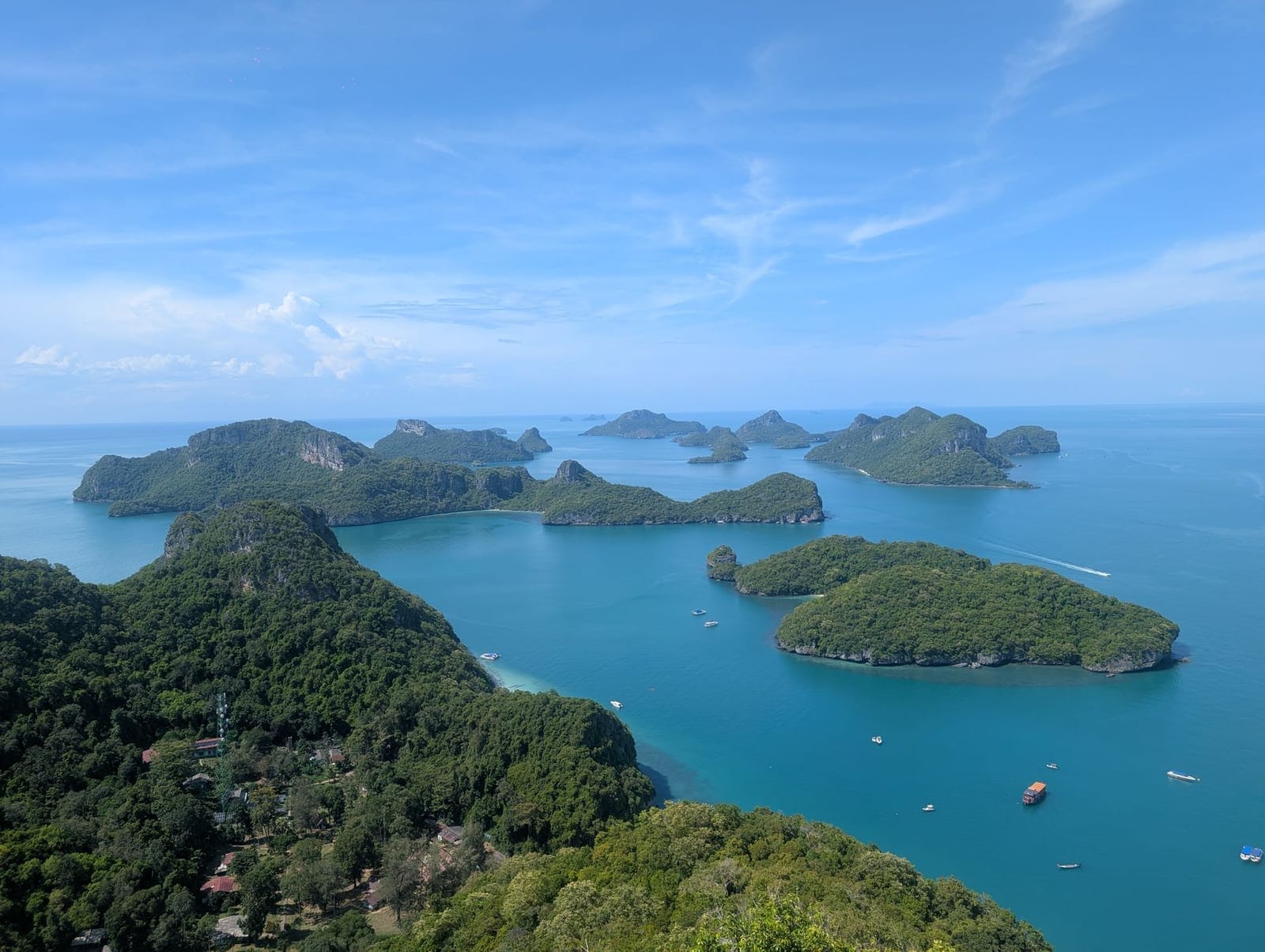
Each island has a nightlife centre and quieter sides. On Phuket, Wikivoyage names Patong as the largest and most popular beach resort, known for its nightlife, with Kamala quieter. On Samui it describes Chaweng as the place for nightlife, Lamai as also offering late entertainment, and the northern beaches of Mae Nam, Bophut and Choeng Mon as the quieter choice. Samui is also the base for Ang Thong Marine Park, which is about an hour each way by speedboat on our tour.
How you get there
Phuket is easier to reach. Wikipedia gives 17.5 million passengers at Phuket International Airport in 2025, and Wikivoyage lists frequent flights from Bangkok and year-round direct flights from elsewhere in Asia, the Middle East, India and Australia. Samui's airport is different. Wikipedia says it is a private airport built and owned by Bangkok Airways, and Wikivoyage describes near-hourly departures to and from Bangkok, with tickets that are comparatively expensive.
Samui also has a slower way in. Wikivoyage describes combined bus and ferry services from Surat Thani's train station and airport, taking about three hours from the airport on one operator's service, and Lomprayah catamarans from Chumphon that call at Ko Tao and Ko Pha Ngan on the way. Wikipedia notes that flights from Samui to Phuket and other Thai destinations are available, if you want both islands. Our Samui airport to Chaweng guide covers arrival.
Islands and tours from each, and their closures
Samui's big boat day is Ang Thong Marine Park, and it has a closed season. The Royal Gazette's 2026 closure list shuts Mu Ko Ang Thong from 1 November to 15 December 2026, with tourism and overnight stays closed. Our Ang Thong day from Koh Samui is from $50 per person for 8 to 9 hours and runs before and after those dates. Samui's other days are Pig Island, from $50 for 5 to 6 hours, and Koh Tao and Koh Nang Yuan, from $55 for about 8.5 hours.
Phuket's days have closed seasons too. The same list closes Ko Similan and Ko Miang from 16 May to 14 October, so our Similan day, from $105 for 12 to 13 hours, runs from 15 October to 14 May. Maya Bay, on the Phi Phi day from $75, is closed every year from 1 August to 30 September and is then seen from the boat. The James Bond Island day is from $85. Our Phuket boat tour comparison and Ang Thong or Pig Island guide compare the options.
Cost: day trips, park fees and what is extra
Comparing our own day trips, Samui's boat days are cheaper: from $50 to $55 for Ang Thong, Pig Island and Koh Tao, against from $75 to $105 for the Phuket speedboat days. They also run 5 to 9 hours, against 8.5 to 13 from Phuket. The lower price does not include everything: at Ang Thong the national park fee is paid on the day and is not in the tour price.
On the fee, the Department of National Parks' June 2022 table puts Mu Ko Ang Thong in the group where foreign adults pay 200 baht and children 100. We could not confirm a 2026 notice, and fees get revised, so check the amount when you book. On our Phuket days the James Bond Island and Similan park fees are in the price, while on the Phi Phi day the operator collects 400 baht per adult and 200 per child in cash, which is what the operator collects, not an official rate. We found no reliable hotel or food price comparison, so we do not give one.
Which to pick
Pick Phuket for a trip between November and March, for more beaches and nightlife, direct flights from many countries and long boat days to Phi Phi, Phang Nga Bay or the Similans. Pick Koh Samui for April to September, for a smaller island with quieter northern beaches, and for Ang Thong, Pig Island and Koh Tao as day trips. If your trip falls in late October or November, check the weather and the Ang Thong closure before you choose Samui.
Do not force either island into the wrong season. In November Samui's table shows 506.6 mm of rain, the highest monthly figure for either island, and Ang Thong is closed from 1 November. In September Phuket's table shows 361.2 mm, its wettest month, and the Similan Islands are closed. If your dates are fixed in a wet month, choose the island that is drier in that month, and keep one day free on any boat trip, because if the sea is unsafe our operators move the trip to another date or refund it.
Practical checklist
- Match the island to your month: Phuket from November to March, Koh Samui from April to September.
- If you visit Samui in November or early December, remember that Ang Thong is closed from 1 November to 15 December 2026.
- If you want the Similan Islands from Phuket, travel between 15 October and mid-May.
- Keep cash for the Ang Thong national park fee on the day, and confirm the amount when you book.
- On any boat day, keep one spare day in your plan in case the sea is unsafe.
Questions and answers
Is Phuket or Koh Samui better in July?
Samui. The Thai Meteorological Department's 1981 to 2010 table shows July averaging 116.3 mm of rain at Samui against 258.2 mm at Phuket. Wikivoyage also says Samui stays fairly dry from April to September.
Is Koh Samui rainy in December?
It can be. The table shows 210.3 mm in December at Samui against 72.4 mm at Phuket, and Wikipedia says Samui's heaviest rain typically falls from mid-October to early December. November is the wettest month, at 506.6 mm.
Can you visit Ang Thong in November 2026?
No. The Royal Gazette's 2026 closure list closes Mu Ko Ang Thong from 1 November to 15 December 2026. Our Ang Thong day from Koh Samui runs before and after those dates, and starts again on 16 December.
How big is Koh Samui compared with Phuket?
Wikipedia gives Samui 228.7 square kilometres and Phuket 543 square kilometres, so Phuket is more than twice as large. Phuket is Thailand's largest island and Samui its second largest.
Can you fly between Koh Samui and Phuket?
Wikipedia says flights from Samui to Phuket and other Thai destinations are available. Schedules change, so check with the airline. Samui's airport is privately owned by Bangkok Airways.
Which island has more nightlife?
Phuket, where Wikivoyage names Patong as the largest and most popular beach resort for nightlife. On Samui, Wikivoyage names Chaweng for nightlife and says Lamai also has some late entertainment.