

Short answer
Snorkelling in the Similan Islands means clear water, plenty of reef fish such as clownfish and lionfish, and a fair chance of a sea turtle, but never a promise of one. Manta rays and whale sharks are possible, yet an independent park guide calls them rare, typically around March and April. The national park is open from 15 October to 15 May, and the 2026–27 season began on 15 October 2026. On our Similan day, from $105 per person, the park fee, fins, mask, snorkel and life jacket are included.
What you can expect to see while snorkelling
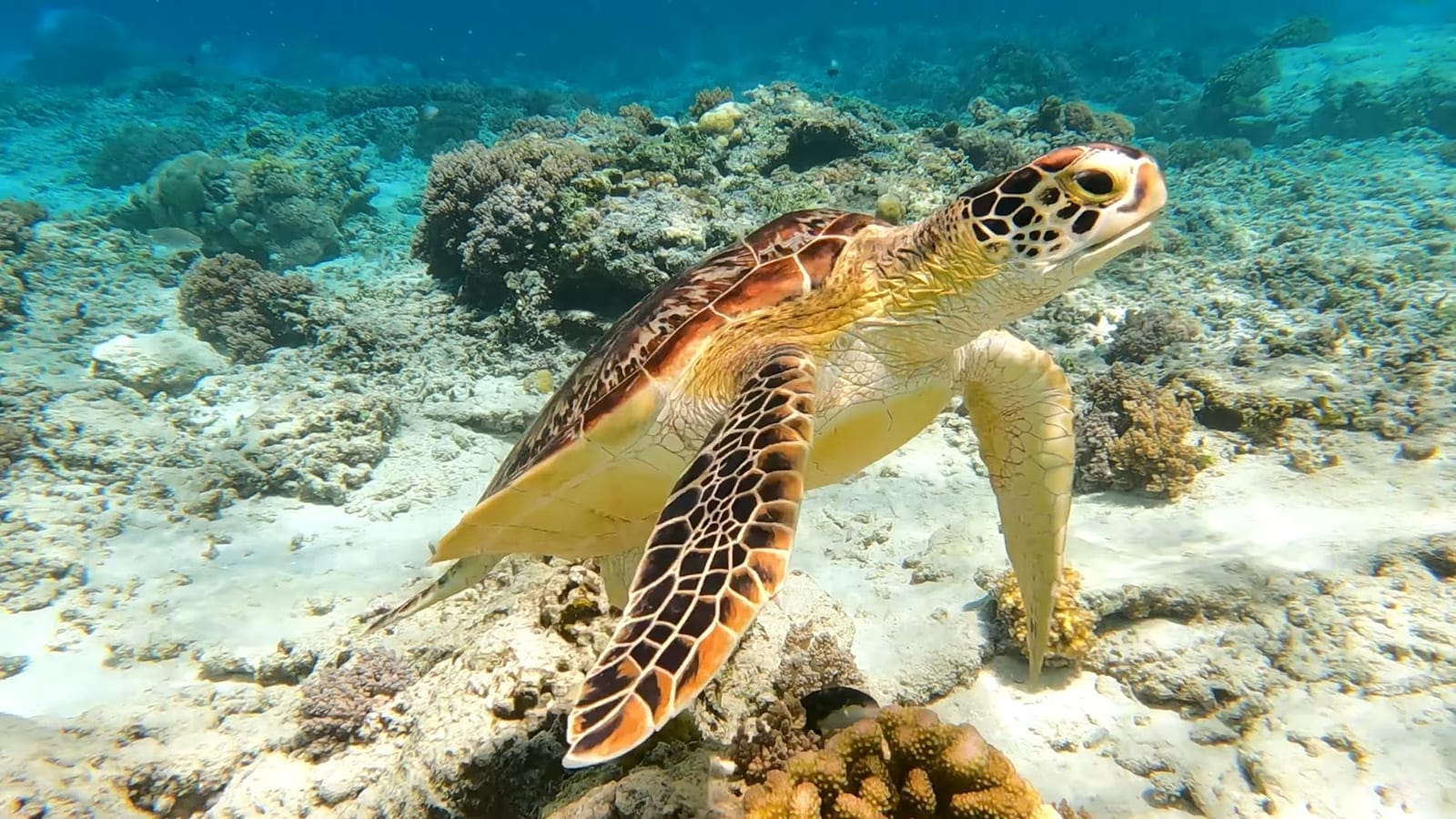
Expect reef fish first. Wikivoyage's guide describes an enormous diversity of fish in the Similans, with colourful species such as lionfish and clownfish, and says underwater visibility is the best you will find in Thailand. On our Similan day, sea turtles and clownfish are often seen at Koh Payu, but they are wild animals and nobody can guarantee them. Treat the turtle as a bonus, not as the reason to book.
The granite is the other half of the picture. Wikipedia says the sea around Ko Similan is full of rock formations and coral reefs, and Wikivoyage lists gently sloping reefs on the east side and huge boulders with swim-throughs on the west side as the two kinds of dive site. A day trip like ours snorkels in shallow water close to the islands, so you meet the reef edge, the sand patches and the fish that live there.
Manta rays and whale sharks: possible, rare, never promised
The independent guide Thai National Parks lists manta rays, whale sharks, whitetip and blacktip reef sharks, leopard sharks, spotted eagle rays and four kinds of sea turtle among the animals of the Similans. It adds that whale sharks and manta rays are rare sightings that show up only occasionally, typically around March and April. That list covers the whole park, including sites that only divers visit, so do not read it as a menu for a snorkelling day.
Wikivoyage says the same in fewer words: if you are lucky you may spot a manta or even a whale shark. We found no official count or season for either animal in the Department of National Parks' news, so we give none. If a seller promises mantas on a particular date, ask what the promise rests on, because nobody controls where a wild animal swims.
Turtles: what the park's own records show for 2026
The park's news shows that turtles are a real part of the Similans. On 9 March 2026 the Department of National Parks reported that green turtles had nested on Ko Tachai. One nest, laid on 10 January with 121 eggs, produced 98 hatchlings on 8 March, and with an earlier nest the park had released more than 159 hatchlings that season. On 25 March it reported a third nest, laid on 23 January, that produced 65 hatchlings from 130 eggs.
Two other reports place turtles near the waters visitors use. The department's November 2025 report on a snorkelling incident says a turtle was found around Ko Ha and Ko Hok (islands 5 and 6), and in March 2026 rangers rescued an olive ridley turtle tangled in fishing net remains near Ko Bon. Nesting happens on beaches that visitors cannot land on, so a snorkeller sees turtles in the water, not on the sand.
How the reefs look today, after the bleaching years
Coral is the part with a complicated history. Thai National Parks says that in 1998 and 2010 about 90 per cent of the coral life in the Surin and Similan islands died after temperature changes, and that in August 2019 the park authorities announced the corals were nearly fully recovered. Wikivoyage's note is older: it says the 2010 bleaching left corals that had not yet recovered, though the fish still make snorkelling worthwhile.
We found no 2026 survey of the snorkelling sites, so we cannot give you a figure for live coral today. The park's 2026 closure list does show places kept shut with no end date, among them Fantasy Reef and Ko Tachai with the reefs around it. Expect plenty of fish and a mix of healthy and damaged coral, and read recent reports if the condition of the reef is the main point of your trip.
When to go: the park season and the calmest months
The national park is open from 15 October to 15 May. The 2026 closure list in the Royal Gazette shows Ko Similan and Ko Miang closed from 16 May to 14 October, and the Department of National Parks opened the 2026–27 season on 15 October 2026 with 1,409 visitors on the first day. Outside those dates boats cannot land, so there is no off-season Similan snorkelling to compare. Our season guide has the quota and the rules.
Inside the season, Wikivoyage calls December to April the high season, when the monsoon stays far away, and names March as the best month, with calm winds and clear water. Thai National Parks also gives December to April for clear water. October and November sit at the edge of the monsoon, so the sea can be livelier. On our tour, if the sea is unsafe the park or the operator cancels and the trip is moved or refunded.
Rules that protect what you came to see
Keep your distance from every animal. In November 2025 the Department of National Parks said a visitor snorkelling off Ko Ha and Ko Hok had been filmed offering a wristband to a sea turtle, described it as life-threatening for a rare animal, set out to find the person for prosecution and ordered a stricter distance between visitors and sea animals. The report gives no distance in metres, so the working rule is simple: look, do not touch, do not feed, do not chase.
Thailand's marine national parks also ban sunscreens containing oxybenzone, octinoxate, 4-methylbenzylidene camphor or butylparaben, with fines of up to 100,000 baht, according to a 2021 report. On the 2026 opening day the park again promoted coral-friendly sunscreen and less single-use plastic. Pack a mineral sunscreen and a refillable bottle, and see our sunscreen guide for what to look for on the label.
How our Similan day fits snorkelling
On our Similan day, from $105 per person, you snorkel from the boat at Koh Bangu (Island 9), swim at Donald Duck Bay on Koh Similan, snorkel at Koh Payu (Island 7) and then walk or swim at Koh Miang (Island 4). The price includes mask, snorkel, fins and life jacket, the Similan national park fee, light breakfast and lunch. The order and times are in the travel guide and the tour schedule.
You do not need to be a strong swimmer: life jackets and fins are provided, and you can stay on the beach at Donald Duck Bay and Koh Miang. It is still a long day, about 12 to 13 hours door to door from Phuket, on a fast boat in open sea, so take seasickness tablets if you need them. The speedboat is not suitable for pregnant women, infants under 1 year or guests over 70. If you are choosing between islands, read Similan or Phi Phi.
Practical checklist
- Check that your dates fall between 15 October and 15 May, when the national park is open.
- Send us a passport copy for every guest by email no later than the day before the tour.
- Pack a mineral sunscreen without oxybenzone, octinoxate, 4-MBC or butylparaben.
- Do not touch, feed or chase turtles or any other animal in the water.
- Take seasickness tablets if you need them: it is a long day on a fast boat.
- Treat mantas and whale sharks as luck, not as part of the plan.
Questions and answers
Is the snorkelling in the Similan Islands good?
Wikivoyage describes a great variety of fish and the best underwater visibility in Thailand, though its older note says coral bleaching in 2010 left reefs that had not recovered. Thai National Parks reports near-full recovery announced in 2019. Expect lots of fish and mixed coral.
Will you see turtles on a Similan snorkelling trip?
Often at Koh Payu on our tour, but never guaranteed. The national park recorded green turtle nests on Ko Tachai in January 2026 and a turtle near Ko Ha and Ko Hok in November 2025. They are wild animals.
Can you see manta rays or whale sharks while snorkelling in the Similans?
Rarely. An independent park guide calls both rare sightings, typically around March and April, and Wikivoyage says you may spot one if you are lucky. We found no official season for either, so we cannot promise them.
Is Similan snorkelling suitable for non-swimmers?
On our tour life jackets and fins are provided, and you can stay on the beach at Donald Duck Bay and Koh Miang. Tell us before you book; the long day on a fast boat is the bigger question.
Can you touch or feed the turtles?
No. In November 2025 the Department of National Parks searched for a visitor who offered a turtle a wristband and ordered stricter distance between visitors and sea animals. Look, do not touch, do not feed.
Which sunscreen is allowed in the Similan Islands?
Marine national parks ban sunscreens with oxybenzone, octinoxate, 4-methylbenzylidene camphor and butylparaben, with fines up to 100,000 baht, according to a 2021 report. A zinc-oxide mineral sunscreen is the simple choice.