

Short answer
The Pattaya Floating Market, also called the Four Regions Floating Market, charges foreign visitors 200 baht, according to Wikipedia, while Thai nationals enter free with an ID card, Pattaya Mail reported in August 2024. Wikipedia gives the hours as 8:00 am to 8:00 pm, so check before you go. It is a purpose-built market opened in 2008 on the outskirts of Pattaya, not an old trading market.
How much does the Pattaya Floating Market cost?
Foreign tourists pay 200 baht to enter, according to Wikipedia's article on the market. Pattaya Mail reported in August 2024 that Thai nationals enjoy free entry with an ID card. We could not find a dated price list on a page we could trust for 2026, so treat 200 baht as a reported figure and confirm it at the ticket window.
The entrance ticket is not the whole cost. The market is built around shopping and eating, with boat vendors, food stalls and souvenirs, and Wikipedia describes vendors selling balsams, T-shirts and cooked foods. Bring cash for snacks and gifts. We found no source that sets typical prices, so we cannot give you a budget beyond the ticket.
When is the Pattaya Floating Market open?
Wikipedia says the market is open from 8:00 am to 8:00 pm every day and mentions no closing day. Hours at attractions like this change without much notice, so plan to arrive well before evening and check the day's hours at the ticket desk.
Pattaya Mail wrote in August 2024 that tourist numbers drop in the off-peak season, with the high season running from November to April, and that the market stays busy at weekends and during local events. If you want space to walk and take photographs, arrive soon after opening on a weekday. Check the day's hours at the gate, because changes are not always posted online.
What is it, and is it a real floating market?
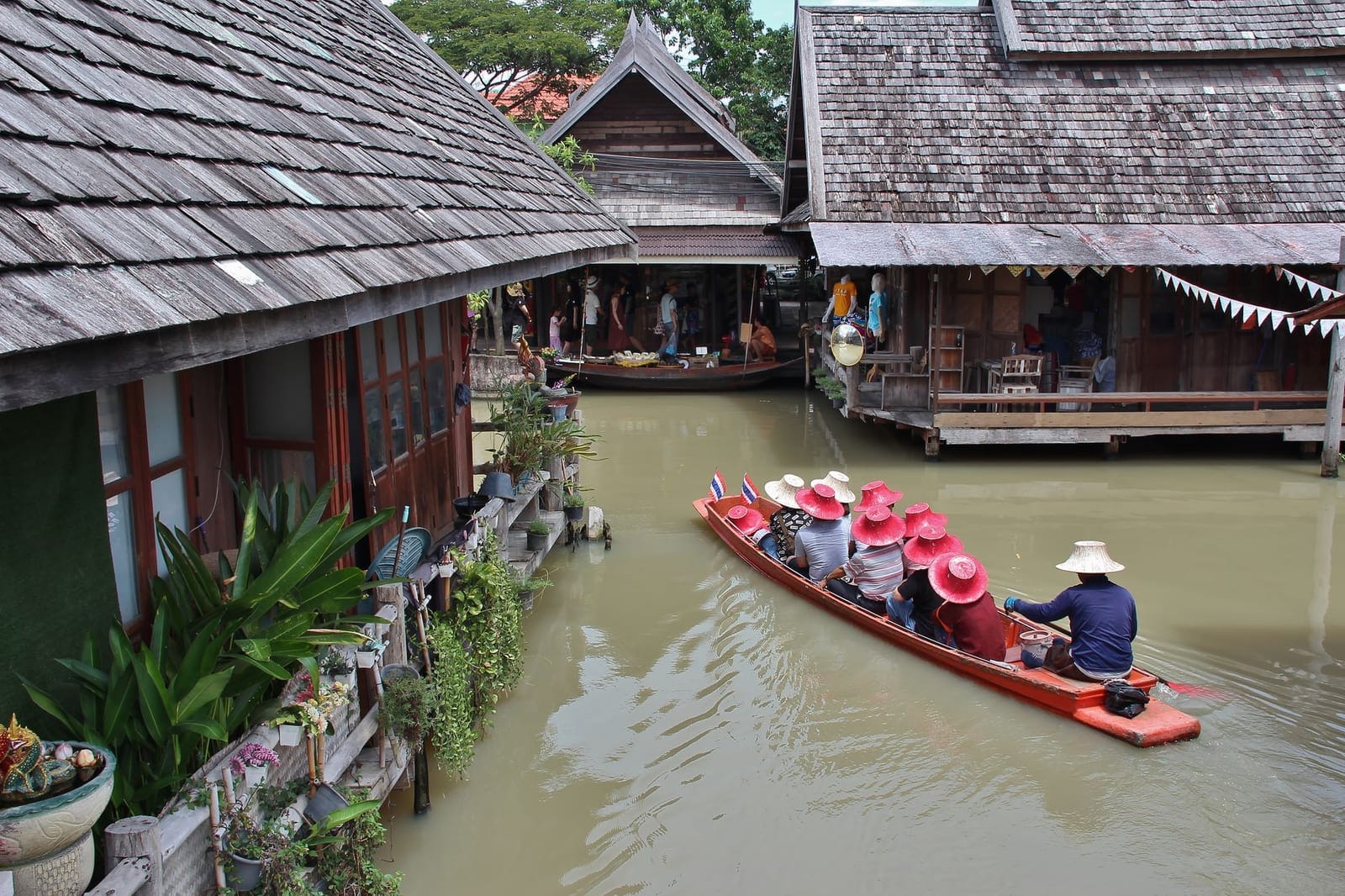
It is a themed, purpose-built market, not a historic one. Wikipedia says the market opened on 1 November 2008, built by private investors on swampland beside Sukhumvit Road, covering 109,270 square metres and costing 350 million baht. It describes it as the only floating market in Pattaya and as a floating market on a man-made pond, with teak buildings and thatched roofs in traditional Thai style.
Wikipedia also notes that it is owned by a private company and only themed as old Thailand, and that old boats from Ayutthaya were bought for it. Merchants, mostly from Bangkok, were brought in to sell at booths, and locals were hired as vendors on boats. That does not make it bad, but it sets expectations: you are visiting a visitor attraction, closer to a theme market than to the canal-side markets where people once traded goods. The buildings are mostly wood and bamboo spread over about 60 acres, The Thaiger noted in September 2023, when a fire that started at a wooden toilet block after closing time caused damage put at 50 million baht or more, with no serious injuries.
What can you buy, eat and see?
The market is divided into four sections, for the North, the Northeast, the Centre and the South of Thailand, each in its region's architecture. Wikipedia says the North sells crafted wood, silverware and silk and paper umbrellas, the Centre rattan furniture and woven bags, the Northeast silk, scented candles and backrest pillows, and the South wooden boat models, batik and coconut products. It counts about 500 shops and notes that vendor boats sit beside the walkways, while the market's site says over 400.
On food, a study in 2013 and 2014 found that many vendors used traditional recipes for dishes such as pad Thai, alongside snacks aimed at Chinese tourists. Wikipedia lists a herbal garden, a massage demonstration and a monkey show among the attractions, and the market's website promises a traditional Thai dance show every day. If wild-animal shows are not for you, skip the monkey show; the walkways and the food are the main event.
Who goes there, and when is it busy?
The market is built for groups. Wikipedia says it drew about 200,000 visitors a month in 2014, with around 80 percent from Asian countries, mainly China, and that most visitors came through tour agencies; in 2017 the typical tourist was Asian, female, aged 36 to 50 and in a tour group. It says visits are particularly high at Chinese New Year and Loy Krathong, and that signposts use Chinese alongside English.
Pattaya Mail's 2024 report gives a similar picture of visitors from China, India and Vietnam and Thai tourists from other provinces, and notes that the market earned a Trip.com award that year. Those figures are old and the mix may have changed, so use them as a guide to crowds, not a count. Weekends, Thai holidays and the high season from November to April will feel busier, and a weekday morning will be calmer.
How do you get to the Pattaya Floating Market?
It stands on the outskirts of Pattaya along Sukhumvit Road, in Chonburi province, according to Wikipedia, so it is not within walking distance of Pattaya Beach. Wikivoyage's guide lists Pattaya Floating Market as the start and end point of the circular Beach Bus route, which also calls at Jomtien Beach Road, Dolphin Roundabout, the northern bus terminal, City Hall, Beach Road and Walking Street. We found no fare, so ask the driver before you board.
Wikivoyage also notes that songthaews cost usually 10 baht within Pattaya when run as a bus, but warns against asking a driver for a destination, because an empty songthaew may treat the request as a private charter. For a market on the edge of town, agree a price with a taxi or app driver for the round trip, including the wait, before you set off. Do not rely on finding a ride back at closing time.
Is it worth your time, and what else could you do?
It is worth a few hours if you like markets, snacks and souvenirs and want a rainy-day or evening option. It is not the place for a quiet cultural visit. If you want a floating market of the older kind, the canal markets near Bangkok are the ones people mean; see our Damnoen Saduak floating market tour from Bangkok, and our comparison of Bangkok's floating markets. For Pattaya itself, our things to do guide places the market next to the other sights.
It also fits around a boat day. Our Koh Larn Coral Island tour is from $25 per person: you meet at the marina on Pattaya Beach Road at about 9:00 am and the tour takes about 6 hours, so you are back at about 3 pm. That leaves time before the closing hours the sources list, but allow time to cross town. Lunch and water sports are paid on the spot. See the tour schedule for the times.
Practical checklist
- Bring 200 baht per adult in cash for the ticket, and confirm the price at the window.
- Plan to arrive before 6:30 pm, when tickets stop being sold on the market's own timetable.
- Go on a weekday morning if you want space, because weekends and holidays are busier.
- Agree a taxi or app fare for the round trip, because the market is on the edge of town.
- Skip the monkey show if wild-animal performances bother you.
Questions and answers
How much is the entrance fee for Pattaya Floating Market?
Wikipedia says foreign tourists pay 200 baht. Pattaya Mail reported in August 2024 that Thai nationals enter free with an ID card. We found no dated 2026 price list, so confirm at the ticket window.
What are the opening hours?
Wikipedia says 8:00 am to 8:00 pm daily. Check the hours at the gate on the day, because they can change.
Is Pattaya Floating Market a real floating market?
It is a purpose-built, privately owned market that opened on 1 November 2008 and is themed as old Thailand, according to Wikipedia. It is an attraction, not a historic trading market.
How many shops does it have?
Wikipedia counts about 500 shops and boat vendors.
Is the Pattaya Floating Market in Pattaya town?
No. It is on the outskirts, along Sukhumvit Road. Wikivoyage says the circular Beach Bus route starts and ends there, but you can also take a taxi.
Can you go to the market on the same day as Koh Larn?
Yes, in principle. Our tour finishes at about 3 pm, and the sources list closing hours of 7:00 or 8:00 pm. Allow time to cross town.