

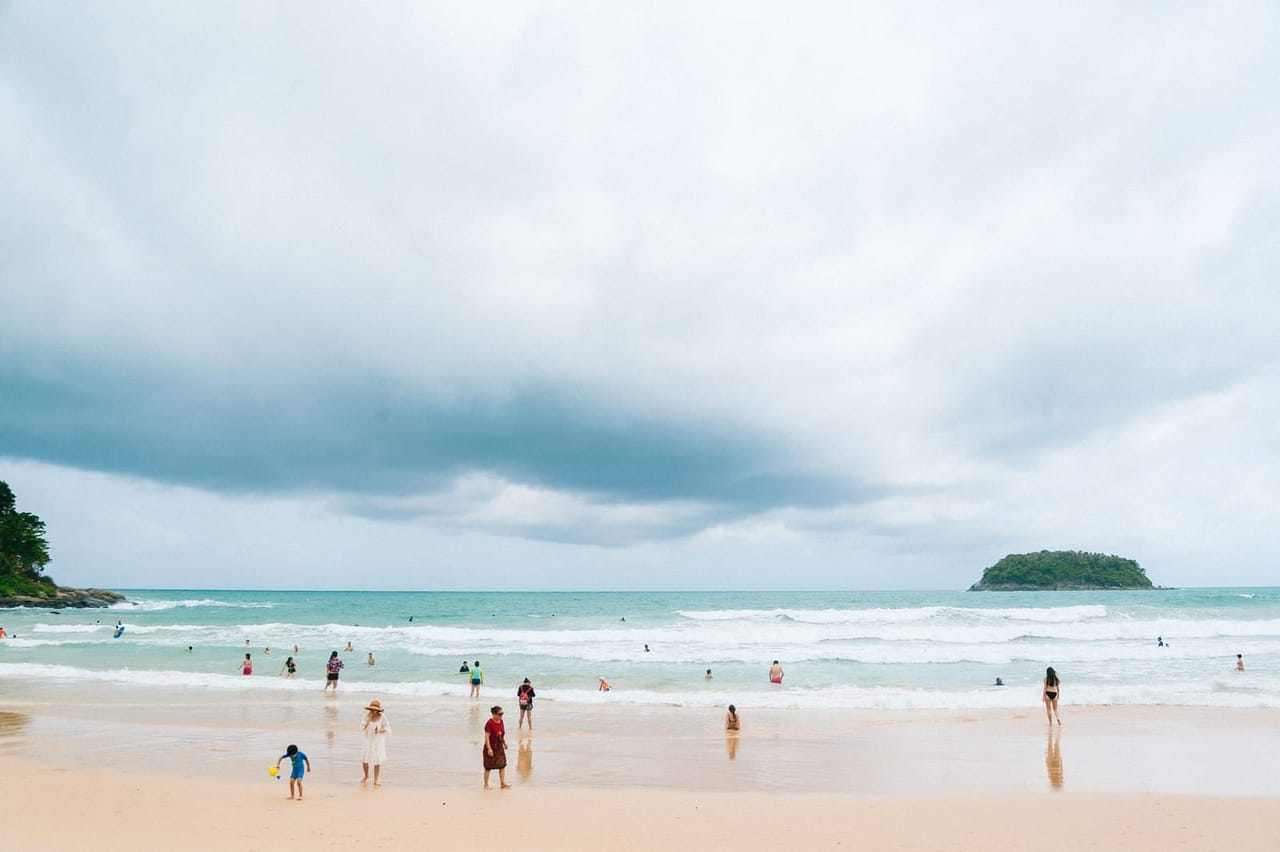
Short answer
The best beach in Phuket depends on the month more than on the beach. From November to April the west-coast beaches, Kata, Karon, Kamala and Nai Harn, are generally calm and clear. From May to October waves and rip currents make red flag days common, and the sheltered east coast or a hotel pool is safer for swimming. Kata suits families, Karon long walks, Kata Noi and Nai Harn quieter days, and Mai Khao solitude. Always obey the lifeguards' red flags.
Choose by the month first, then by the beach
Phuket 101's beach guide, updated on 29 September 2026, says that in the sunny high season, from November to April, the bay at Kata is generally calm, and that in the low season, from May to October, bigger waves roll in. The same pattern applies along the west coast. So for swimming, the first question is when you travel, and the second is which beach.
The rainfall figures agree. The World Meteorological Organization's 1991–2020 normals for Phuket, as tabulated by Wikipedia, give February 24.0 mm of rain and 2.2 rainy days, against September 350.4 mm and October 336.0 mm, with 18.9 and 19.4 rainy days. Wikivoyage's Phuket page describes mornings and afternoons as often sunny in the summer monsoon, but with rain in the evenings and lower water clarity.
Why the wind side matters: west coast and east coast
Most of Phuket's famous beaches face west, straight out to the Andaman Sea. Phuket 101 says that from May the sea starts getting rougher on the west coast while the east-coast beaches stay calmer, and that from May to October the west coast gets strong waves and dangerous riptides. It names Patong, Kata, Karon, Surin and Kamala as getting rough in the monsoon, and gives the sea temperature as 29 to 30 degrees Celsius.
For swimming in those months the same guide names the sheltered east-coast spots of Ao Po and Cape Panwa, and also suggests a beachfront hotel with a pool, so you can enjoy the beach on calm days and swim in the pool when the sea is rough. It describes Rawai, on the southern tip, as a working beach for fishing boats, not a typical swimming beach.
Best beaches from November to April
In the calm season, Phuket 101 picks Kata for families and first-timers (about 1.5 km long, with the island of Ko Pu offshore), Karon for long walks (almost 3.5 km, with golden-white sand), and Kamala (about 2 km) for calm family stays. Kata Noi, a smaller bay of roughly 700 to 800 metres, is the quiet, upmarket one. Bang Tao is about 8 km long, and the guide says the water is generally calm and shallow from November to April.
Nai Harn, a cove of about 700 metres in the south-west, is the guide's choice for natural beauty, with a freshwater lake behind the sand and sailboats at anchor between November and April. For a quiet escape the guide names Nai Yang and Naithon, and for solitude Mai Khao, Phuket's longest beach at 11 km, where it says swimming is only recommended in the calm season and the water gets deep quickly.
Best beaches for families, quiet days and snorkelling
Phuket 101's picks by purpose: for children, Kata, Karon and Kamala; for nightlife and convenience, Patong; for quiet sunsets away from the crowds, Nai Harn, Nai Yang and Naithon; and for avoiding crowds entirely, Mai Khao, Naithon and Freedom. It adds that Layan, at the north end of Bang Tao, has shallow, calm water that suits families with small children, and that Patong is not where you go for a quiet beach day.
For snorkelling from the sand, the guide recommends Ya Nui, Freedom and Ao Sane, and Wikivoyage says Ya Nui has good snorkelling on a shallow reef but gentle waves only from December to March, with crashing surf in the monsoon months. On Karon and Kata the same guide mentions snorkelling near the rocky ends in the calm season. For boat snorkelling, see our snorkelling guide.
May to October: what to do when the sea is rough
Rough water does not close the island. Phuket 101 says Kata becomes a small surfing spot in the low season, especially at the south end, and that Nai Harn is popular with kite surfers on breezy days. It also says tours to Phi Phi and Phang Nga Bay still run, and that Phang Nga Bay is calm in the monsoon because the cliffs protect it. If swimming matters, pick a hotel with a pool or an east-coast beach.
Use the days sensibly. The same guide describes a typical rainy-season day as sunny in the morning, with heavy showers building at 3 or 4 pm, and says September and October are the wettest months, when the sea is at its roughest. It also warns of unlucky stretches of continuous rain, so keep an indoor plan; our rainy day guide has one.
Red flags: what they mean and why they matter
A red flag means do not go in. Phuket 101 says lifeguards patrol and put up flags, that on Karon there are often red flag days when it is unsafe to swim, and that the undertow can pull experienced swimmers out to sea within seconds. A news item reposted by 12GO ASIA, undated, quotes the Phuket Lifeguard Club as saying that red flags go up where rip currents are likely, and that anyone ignoring them endangers the lifeguards who must rescue them.
Our guide to rip currents and red flags explains the rest. Our rule of thumb is to swim only where lifeguards are on duty and never to enter the water under a red flag, even in shallow water, where the Phuket Lifeguard Club item above says six people were swept away. If you travel with children, read our Phuket with kids guide before you choose a beach.
Beach by boat: Phi Phi, Bamboo Island and the sea in each month
Wikipedia gives the Phi Phi Islands as 46 kilometres south-east of Phuket. On our Phi Phi and Maya Bay speedboat tour the swimming stops are Pileh Lagoon and Bamboo Island, which has beach time, swimming and snorkelling over the reef. Swimming at Maya Bay is not allowed, and the bay is closed every year from 1 August to 30 September. The tour is from $75 per person.
The tour is a boat day, not a beach holiday, and the sea can be bumpy: our operator suggests seasickness tablets for those who need them, and if the sea is unsafe the trip is moved to another date or refunded. On our tour the national park fee is 400 baht per adult and 200 per child, paid in cash, as what the operator collects. For the season by month, see our Phi Phi in August and September guide.
Practical checklist
- Decide your month first: November to April is the calm season on the west coast, May to October the rough one.
- Pick Kata, Karon or Kamala for children, Kata Noi or Nai Harn for quieter sand, and Mai Khao for solitude.
- Check the flag before you enter the water, and stay out under a red flag.
- From May to October, choose a hotel with a pool or look at the east-coast beaches for swimming.
- Bring sunscreen, a hat and water for open beaches.
- Book a Phi Phi boat day for a swim that does not depend on your hotel beach.
Questions and answers
Which is the best beach in Phuket for swimming?
In the calm season, from November to April, Kata, Karon, Kamala and Nai Harn are generally good, according to Phuket 101. From May to October pick a sheltered east-coast beach or a hotel pool.
Can you swim in Phuket in the rainy season?
On the east coast and in sheltered bays, often yes. On the west coast Phuket 101 says strong waves and dangerous riptides are common from May to October, so obey the lifeguards' red flags.
Which Phuket beach is best for children?
Phuket 101 recommends Kata, Karon and Kamala for children, and Layan for families with small children because the water there stays shallow and calm.
Which Phuket beach is the quietest?
Phuket 101 names Mai Khao, Naithon and Freedom for avoiding crowds, and Nai Harn, Nai Yang and Naithon for quiet sunsets. Mai Khao's water gets deep quickly.
Are Phuket beaches better than Phi Phi?
They are different. Phuket beaches suit a stay with sun loungers and restaurants; the Phi Phi day gives a lagoon and a reef swim at Bamboo Island but takes about 8.5 hours from pickup.