

Short answer
July is mid-monsoon in Phuket: the Thai Meteorological Department's 1981–2010 normals give 258.2 mm of rain over 19.6 rainy days and a mean daily maximum of 32.0 °C. Phuket 101 rates the west-coast sea as rough with red flags common. Boat days still run, the Similan Islands are closed, and July is the last month to land at Maya Bay, which the park closes from 1 August to 30 September. Hotels are cheap and the island is quieter, apart from Buddhist holiday weekends.
July: rain on most days and a few bad weeks
July sits in the middle of the Phuket monsoon. The Thai Meteorological Department's 1981–2010 normals for the Phuket station give 258.2 mm over 19.6 rainy days, with a mean daily maximum of 32.0 °C and a mean minimum of 25.1 °C. The airport station in the north records 261.5 mm over 20.3 days. The newer 1991–2020 table on Wikipedia's Phuket City page gives 240.2 mm and 16.3 days with 1 mm or more, with a mean maximum of 32.3 °C.
Averages hide the pattern. Phuket 101 says the weeks alternate between clear sky, cloud and some rain, usually in the evening or at night, but that every year has one or two 'bad luck weeks' with three to five days of steady rain, and nobody can predict when. The Royal Irrigation Department's figures on Wikipedia's Phuket Province page give humidity of 79 percent and about 4.9 hours of sunshine a day. Plan for rain, and keep your mornings for outdoor things.
The sea in July: rough on the west coast, calmer elsewhere
The west coast takes the swell. Phuket 101 rates the July sea as rough on the west coast with red flags common, says stronger waves increase the risk of undertows, and puts the water temperature at 29 °C. Its advice for swimmers is blunt: a red flag means no swimming. If you want to get into the sea anyway, it points to Tri Trang Beach near Patong, which it says is usually calmer, and to east-coast beaches such as Ao Po and Cape Panwa, while asking you to use common sense.
The same swell is a draw for others. Phuket 101 calls July a good month for surfing at Kata and Kalim, and for kitesurfing at Nai Yang, and Wikivoyage also lists Nai Yang as a summer kitesurfing spot. For everyone else, a hotel pool is the plan B. Our guide to rip currents and red flags in Phuket explains the flag colours, and Phuket's rainy-day ideas fill the grey afternoons.
July is the last month to land at Maya Bay
Maya Bay stays open all through July, but the park closes it for two months from 1 August. The Department of National Parks described its 2026 closure as 1 August to 30 September 2026 in a report on its September survey of the bay. Phuket 101 says the park normally confirms the exact dates in July and that they can shift by a day or two. If walking onto the beach is the reason for your trip, July is your last chance until October; our Maya Bay rules guide explains the closure.
Our Phi Phi and Maya Bay speedboat tour is from $75 per person for about 8.5 hours, with the speedboat leaving Royal Phuket Marina at about 9:30. Visits are in rounds of up to 375 people an hour between 07:00 and 18:00, according to the park's December 2021 announcement, and swimming at the bay is not allowed. Phuket 101 says the July crossing can be choppy and suggests a motion-sickness pill; the park fee of 400 baht per adult and 200 per child is collected in cash by the operator.
Phang Nga Bay in July: the steadier day
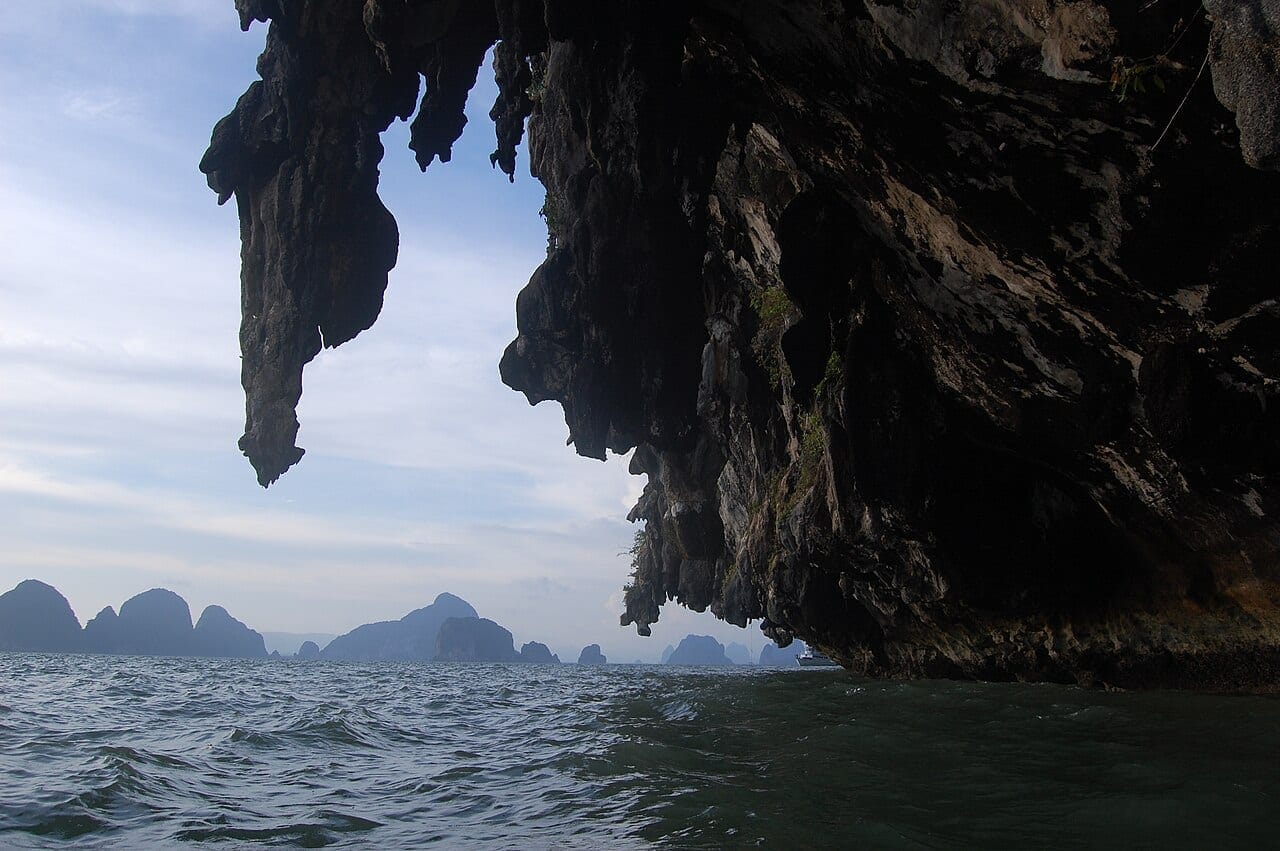
Phang Nga Bay is the sheltered choice. Phuket 101 says tours to the nearby islands operate normally in July unless a serious storm is announced, that a day in Phang Nga Bay is always a great outing, and that the scenery is even more impressive with big clouds above the limestone cliffs. Our James Bond Island and Phang Nga Bay canoe tour is from $85 per person; the details we hold for it list no closed season.
The day runs about 8.5 hours from Laem Nga pier on Koh Siray, with hotel pickup between about 7:00 and 8:00 am, and includes the national park fee, lunch at Koh Panyee, sea canoeing at Hong Island with a professional paddler, and snorkelling gear. If the sea is unsafe, the operator moves the trip to another date or refunds it, so hold a spare day. Our Phi Phi or James Bond Island comparison helps you pick one of the two.
Buddhist holidays, the King's birthday and a regatta
Two Buddhist holidays fall at the end of July. Phuket 101 gives Asalha Bucha as 29 July and Khao Phansa, the start of Buddhist Lent, as 30 July in 2026, both national holidays with candlelit temple processions in the evening. Both follow the lunar calendar, so the dates move each year. Wikipedia's list of Thai public holidays also gives 28 July as the King's birthday, a fixed date.
Holiday weekends bring Thai visitors. A Pattaya Mail report of a Phuket Tourism Authority briefing in July 2025 said Phuket expected nearly 200,000 visitors over the Buddhist holidays from 10 to 13 July 2025, with hotel occupancy forecast at around 60 percent. Wikivoyage lists the Phuket Raceweek sailing regatta as normally held in July. Check the dates for your own year before you plan around any of them.
Prices and crowds in July
July is low season on the island, and prices show it. Phuket 101 says hotels are much cheaper and will give you their best rooms if you ask, bargaining is easier and more rewarding than in high season, and driving around is easy with much less traffic. It also says Patong's OTOP and Chillva markets give better prices than the Bangla walking street. It names the month as one to book the luxury resort you could not afford in December.
On the water, July is quieter than January but not empty. The seats on our speedboats are limited to up to 35 guests, so send your date and hotel on WhatsApp early; we confirm availability, the pickup time and the total before you pay. Phuket 101 says the price of tours never really changes in low season, so do not expect a July discount on the water.
What to pack, and who July suits
Pack a light raincoat or compact umbrella, waterproof sandals, a waterproof bag for the phone and camera, and sunscreen, because Phuket 101 says the UV index stays extreme even on cloudy days. For boat days bring swimwear, a towel (towels are not included), a hat and a dry bag. Wear shoes you can walk in on the boardwalk at Maya Bay, and take seasickness tablets if you need them.
July suits budget travellers, surfers, and visitors who want Maya Bay once more before the closure or a sheltered day in Phang Nga Bay. It does not suit anyone who needs a calm west-coast beach, a Similan day, or a fixed schedule without a spare day. Pregnant women, infants under 1 year and guests over 70 cannot join our speedboats. For the next month, read Phuket in August; for the previous one, Phuket in June.
Practical checklist
- If you want to land at Maya Bay, book your Phi Phi day before 1 August.
- Hold a spare day for any boat trip, because the operator moves or refunds trips when the sea is unsafe.
- Treat red flags as a ban on swimming; use a pool or an east-coast beach instead.
- Pack a rain layer, a dry bag, seasickness tablets and a mineral sunscreen.
- Check the lunar dates of Asalha Bucha and Khao Phansa for your year.
Questions and answers
Is July a good time to visit Phuket?
It is a low-season month: the Thai normals give 258.2 mm of rain over 19.6 rainy days and Phuket 101 rates the west-coast sea as rough. In return, hotels are much cheaper, traffic is lighter, and tours still run.
Is Maya Bay open in July?
Yes, all of July. The national park closes it from 1 August to 30 September each year, so July is the last month to land there until October. Phuket 101 says the exact dates are confirmed in July.
Does the James Bond Island tour run in July?
Yes. The details we hold list no closed season, and Phuket 101 says island tours operate normally unless a serious storm is announced. If the sea is unsafe, the operator moves the trip or refunds it.
Are the Similan Islands open in July?
No. Phuket 101 says the Similan and Surin Islands close from mid-May to mid-October, and our Similan tour runs only from 15 October to 14 May.
Is it safe to swim in Phuket in July?
Only where the flags allow it. Phuket 101 says red flags are common on the west coast and rough water raises the risk of undertows. Tri Trang Beach and the east-coast beaches are usually calmer.